







Question: I need the answer for question 2 (1). 5 points] (a). Give an example of a polygon P that is star-shaped (g(P)-1) but not monotone.
![I need the answer for question 2 (1). 5 points] (a). Give](https://dsd5zvtm8ll6.cloudfront.net/si.experts.images/questions/2024/09/66f461e2d36a4_87466f461e24628c.jpg)
 I need the answer for question 2
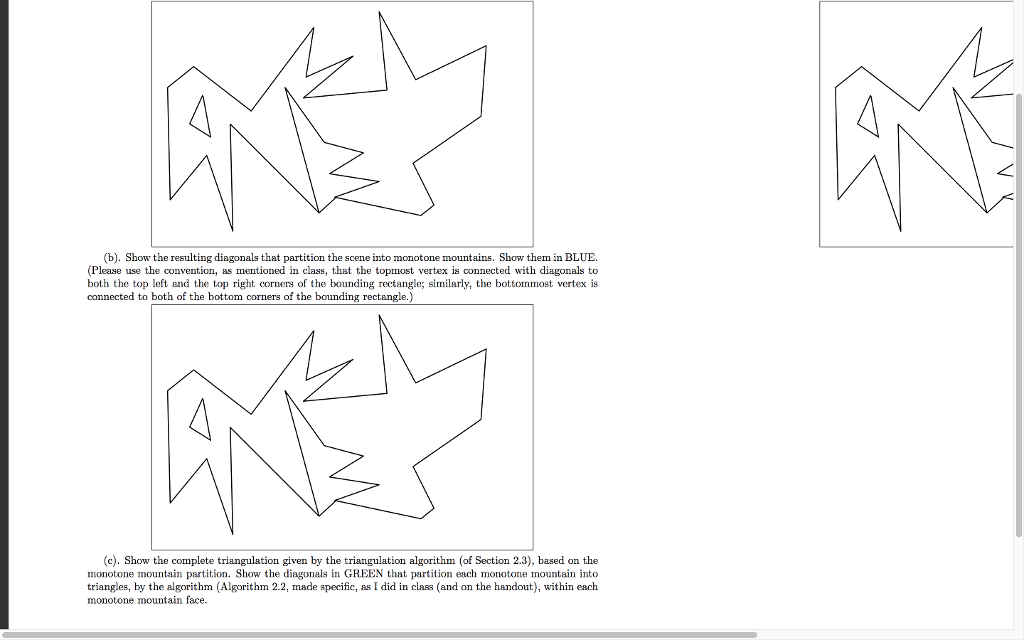
(1). 5 points] (a). Give an example of a polygon P that is star-shaped (g(P)-1) but not monotone. Be sure to (i). show a point g e P that sces every point of P (proving it is star-shaped); and (ii). justify why your polygon P is not monotone Try to give an n-gon with a small value of n, if you can (i.e., a "small, simple example). (I am not sure yet what the smallest possible example is... can you justify that yours is smallest possible? (optional, not required)) b). Given an example of a polygon P that is monotone but not star-shaped (so g(P) > 1). Be sure to (i). show a direction d with respect to which it is monotone; and, ii. justify that it is not star-shaped, e.g., by producing two independent witness points (showing that g(P)(P)2 2). Try to give an n-gon with a small value of n, if you can (i.e., a "small", simple example). (I am not sure yet what the smallest possible example is... can you justify that yours is smallest possible? (optional, not required (c). True or false, and justify: Every simple 7-gon (heptagon) is monotone (with respect to some direction d). Justify: either give an example of a 7-gon that is not monotone (and justify why it is not monotone), or argue briefly why no example is possible 6 (d). True or false, and justify: Every simple 4-gon (quadrilateral) is monotone (with respect to some direction d). Justify: either give an example of a 4-gon that is not monotone (and justify why it is not monotone), or argue briefly why no example is possible. (Optional question for pondering: What about 5-gons? 6-gons?) (2). 5 points] For the planar straight line graph (PSLG) within a big bounding rectangle shown below, do the following: 8 (a). Show the decomposition of the entire scene within the bounding rectangle into horizontal trapezoids given by the sweep algorithm (1). 5 points] (a). Give an example of a polygon P that is star-shaped (g(P)-1) but not monotone. Be sure to (i). show a point g e P that sces every point of P (proving it is star-shaped); and (ii). justify why your polygon P is not monotone Try to give an n-gon with a small value of n, if you can (i.e., a "small, simple example). (I am not sure yet what the smallest possible example is... can you justify that yours is smallest possible? (optional, not required)) b). Given an example of a polygon P that is monotone but not star-shaped (so g(P) > 1). Be sure to (i). show a direction d with respect to which it is monotone; and, ii. justify that it is not star-shaped, e.g., by producing two independent witness points (showing that g(P)(P)2 2). Try to give an n-gon with a small value of n, if you can (i.e., a "small", simple example). (I am not sure yet what the smallest possible example is... can you justify that yours is smallest possible? (optional, not required (c). True or false, and justify: Every simple 7-gon (heptagon) is monotone (with respect to some direction d). Justify: either give an example of a 7-gon that is not monotone (and justify why it is not monotone), or argue briefly why no example is possible 6 (d). True or false, and justify: Every simple 4-gon (quadrilateral) is monotone (with respect to some direction d). Justify: either give an example of a 4-gon that is not monotone (and justify why it is not monotone), or argue briefly why no example is possible. (Optional question for pondering: What about 5-gons? 6-gons?) (2). 5 points] For the planar straight line graph (PSLG) within a big bounding rectangle shown below, do the following: 8 (a). Show the decomposition of the entire scene within the bounding rectangle into horizontal trapezoids given by the sweep algorithm
Step by Step Solution
There are 3 Steps involved in it

Get step-by-step solutions from verified subject matter experts
 Study Help