





Question: i need the answer quickly Homework Problem (1): Suppose that the demand for a product is 10000 per year, and the items are withdrawn uniformly.

i need the answer quicklyi need the answer quickly Homework Problem (1):
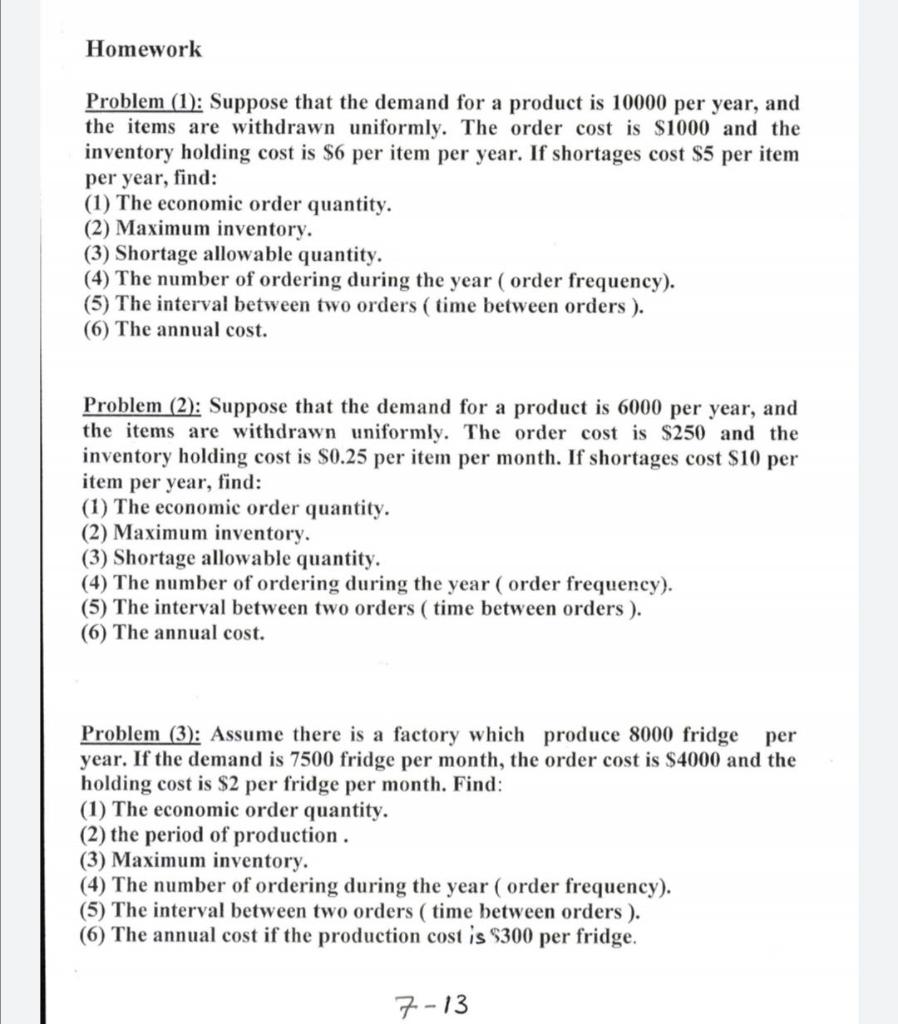
Homework Problem (1): Suppose that the demand for a product is 10000 per year, and the items are withdrawn uniformly. The order cost is $1000 and the inventory holding cost is $6 per item per year. If shortages cost $5 per item per year, find: (1) The economic order quantity. (2) Maximum inventory. (3) Shortage allowable quantity. (4) The number of ordering during the year ( order frequency). (5) The interval between two orders ( time between orders ). (6) The annual cost. Problem (2): Suppose that the demand for a product is 6000 per year, and the items are withdrawn uniformly. The order cost is $250 and the inventory holding cost is $0.25 per item per month. If shortages cost $10 per item per year, find: (1) The economic order quantity. (2) Maximum inventory. (3) Shortage allowable quantity. (4) The number of ordering during the year ( order frequency). (5) The interval between two orders ( time between orders ). (6) The annual cost. Problem (3): Assume there is a factory which produce 8000 fridge per year. If the demand is 7500 fridge per month, the order cost is $4000 and the holding cost is $2 per fridge per month. Find: (1) The economic order quantity. (2) the period of production. (3) Maximum inventory. (4) The number of ordering during the year ( order frequency). (5) The interval between two orders ( time between orders ). (6) The annual cost if the production cost is $300 per fridge. 7-13 Homework Problem (1): Suppose that the demand for a product is 10000 per year, and the items are withdrawn uniformly. The order cost is $1000 and the inventory holding cost is $6 per item per year. If shortages cost $5 per item per year, find: (1) The economic order quantity. (2) Maximum inventory. (3) Shortage allowable quantity. (4) The number of ordering during the year ( order frequency). (5) The interval between two orders ( time between orders ). (6) The annual cost. Problem (2): Suppose that the demand for a product is 6000 per year, and the items are withdrawn uniformly. The order cost is $250 and the inventory holding cost is $0.25 per item per month. If shortages cost $10 per item per year, find: (1) The economic order quantity. (2) Maximum inventory. (3) Shortage allowable quantity. (4) The number of ordering during the year ( order frequency). (5) The interval between two orders ( time between orders ). (6) The annual cost. Problem (3): Assume there is a factory which produce 8000 fridge per year. If the demand is 7500 fridge per month, the order cost is $4000 and the holding cost is $2 per fridge per month. Find: (1) The economic order quantity. (2) the period of production. (3) Maximum inventory. (4) The number of ordering during the year ( order frequency). (5) The interval between two orders ( time between orders ). (6) The annual cost if the production cost is $300 per fridge. 7-13

Step by Step Solution

There are 3 Steps involved in it

1 Expert Approved Answer
Step: 1 Unlock blur-text-image

Question Has Been Solved by an Expert!

Get step-by-step solutions from verified subject matter experts

Step: 2 Unlock
Step: 3 Unlock

Students Have Also Explored These Related General Management Questions!