



Question: I need the answer to these 3 questions please. 1.a) Suppose u(21, 12) = xi, x, . Given M, Pi and P2 derive the demands
I need the answer to these 3 questions please.
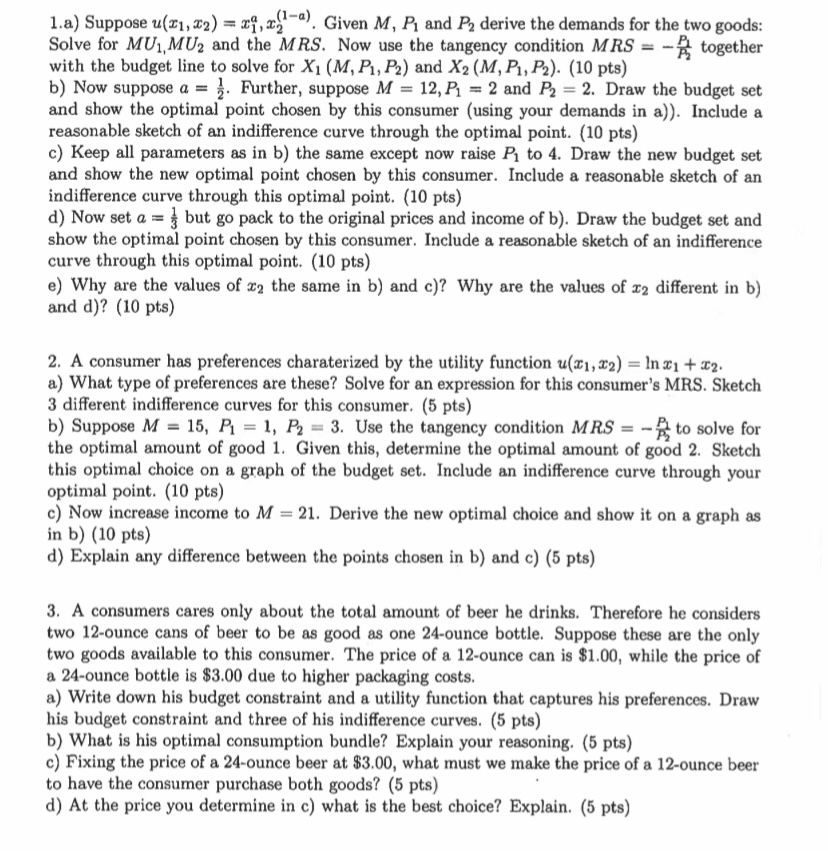
1.a) Suppose u(21, 12) = xi, x, ". Given M, Pi and P2 derive the demands for the two goods: Solve for MU1, MU2 and the MRS. Now use the tangency condition MRS = - together with the budget line to solve for X1 (M, P1, P2) and X2 (M, P1, P2). (10 pts) b) Now suppose a = 2. Further, suppose M = 12, P1 = 2 and P2 = 2. Draw the budget set and show the optimal point chosen by this consumer (using your demands in a)). Include a reasonable sketch of an indifference curve through the optimal point. (10 pts) c) Keep all parameters as in b) the same except now raise P1 to 4. Draw the new budget set and show the new optimal point chosen by this consumer. Include a reasonable sketch of an indifference curve through this optimal point. (10 pts) d) Now set a = ; but go pack to the original prices and income of b). Draw the budget set and show the optimal point chosen by this consumer. Include a reasonable sketch of an indifference curve through this optimal point. (10 pts) e) Why are the values of 22 the same in b) and c)? Why are the values of z2 different in b) and d)? (10 pts) 2. A consumer has preferences charaterized by the utility function u($1, 12) = Inc1 + $2. a) What type of preferences are these? Solve for an expression for this consumer's MRS. Sketch 3 different indifference curves for this consumer. (5 pts) b) Suppose M = 15, P1 = 1, P2 = 3. Use the tangency condition MRS = - - to solve for the optimal amount of good 1. Given this, determine the optimal amount of good 2. Sketch this optimal choice on a graph of the budget set. Include an indifference curve through your optimal point. (10 pts) c) Now increase income to M = 21. Derive the new optimal choice and show it on a graph as in b) (10 pts) d) Explain any difference between the points chosen in b) and c) (5 pts) 3. A consumers cares only about the total amount of beer he drinks. Therefore he considers two 12-ounce cans of beer to be as good as one 24-ounce bottle. Suppose these are the only two goods available to this consumer. The price of a 12-ounce can is $1.00, while the price of a 24-ounce bottle is $3.00 due to higher packaging costs. a) Write down his budget constraint and a utility function that captures his preferences. Draw his budget constraint and three of his indifference curves. (5 pts) b) What is his optimal consumption bundle? Explain your reasoning. (5 pts) c) Fixing the price of a 24-ounce beer at $3.00, what must we make the price of a 12-ounce beer to have the consumer purchase both goods? (5 pts) d) At the price you determine in c) what is the best choice? Explain. (5 pts)
Step by Step Solution
There are 3 Steps involved in it

Get step-by-step solutions from verified subject matter experts