







Question: I need the complete solution please. there are other solutions available for this question but those are not Worthy so please Solve it completely. A
I need the complete solution please. there are other solutions available for this question but those are not Worthy so please Solve it completely.
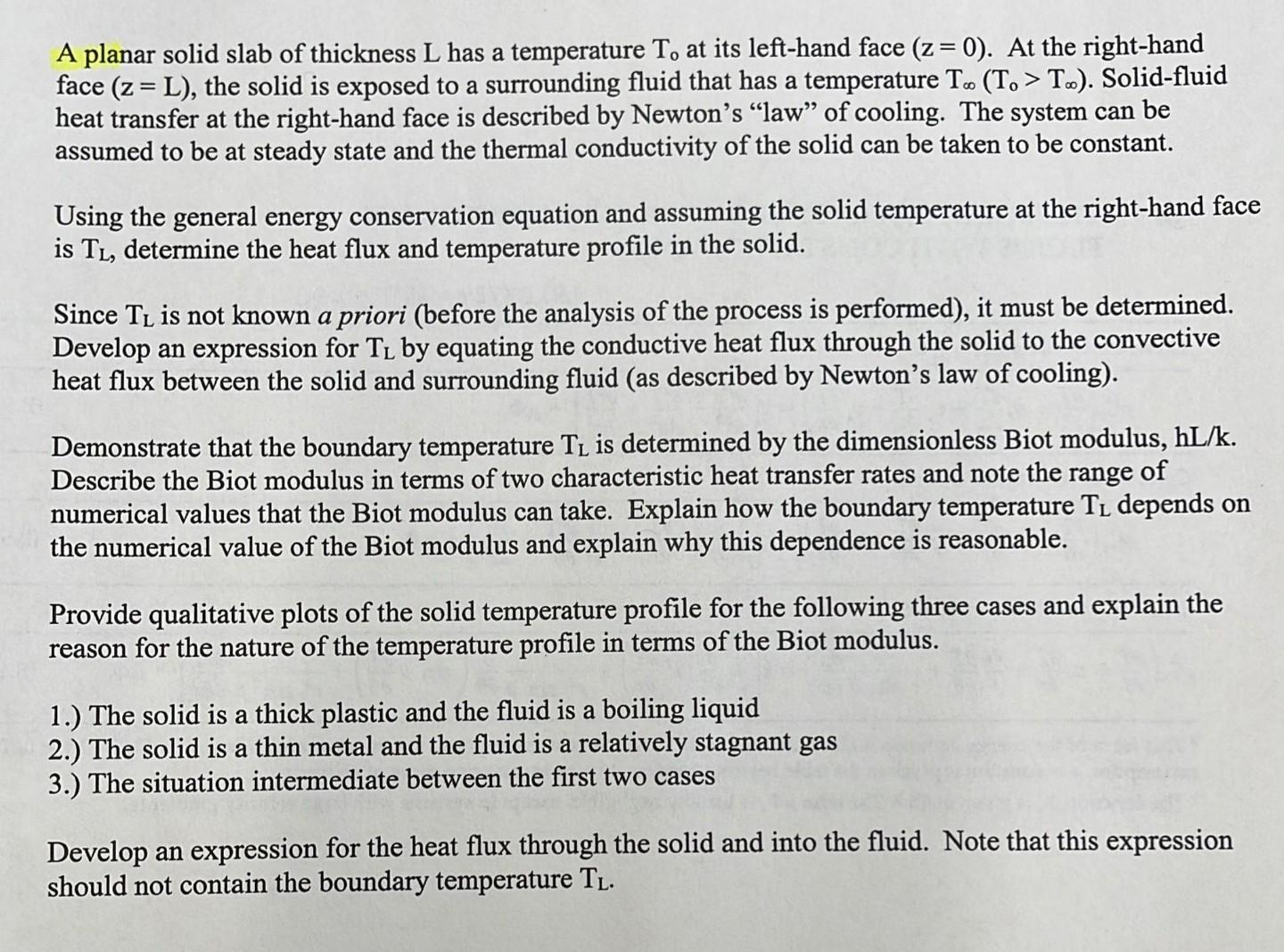
A planar solid slab of thickness L has a temperature To at its left-hand face (z=0). At the right-hand face (z=L), the solid is exposed to a surrounding fluid that has a temperature T(T0>T). Solid-fluid heat transfer at the right-hand face is described by Newton's "law" of cooling. The system can be assumed to be at steady state and the thermal conductivity of the solid can be taken to be constant. Using the general energy conservation equation and assuming the solid temperature at the right-hand face is TL, determine the heat flux and temperature profile in the solid. Since TL is not known a priori (before the analysis of the process is performed), it must be determined. Develop an expression for TL by equating the conductive heat flux through the solid to the convective heat flux between the solid and surrounding fluid (as described by Newton's law of cooling). Demonstrate that the boundary temperature TL is determined by the dimensionless Biot modulus, hL/k. Describe the Biot modulus in terms of two characteristic heat transfer rates and note the range of numerical values that the Biot modulus can take. Explain how the boundary temperature TL depends on the numerical value of the Biot modulus and explain why this dependence is reasonable. Provide qualitative plots of the solid temperature profile for the following three cases and explain the reason for the nature of the temperature profile in terms of the Biot modulus. 1.) The solid is a thick plastic and the fluid is a boiling liquid 2.) The solid is a thin metal and the fluid is a relatively stagnant gas 3.) The situation intermediate between the first two cases Develop an expression for the heat flux through the solid and into the fluid. Note that this expression should not contain the boundary temperature TL
Step by Step Solution
There are 3 Steps involved in it

Get step-by-step solutions from verified subject matter experts
 Study Help