







Question: I need the mathematical formulation and it should clearly provide a descriptive statement for decision variables, objective function, and constraints. I also need the excel
I need the mathematical formulation and it should clearly provide a descriptive statement for decision variables, objective function, and constraints. I also need the excel solver solution. Thanks!
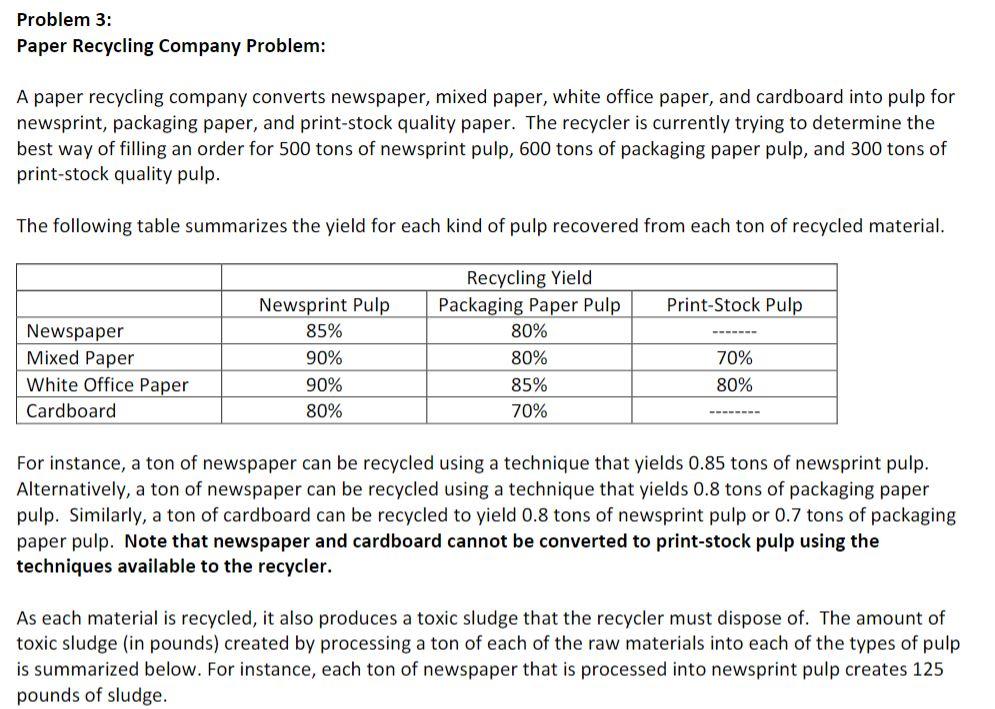
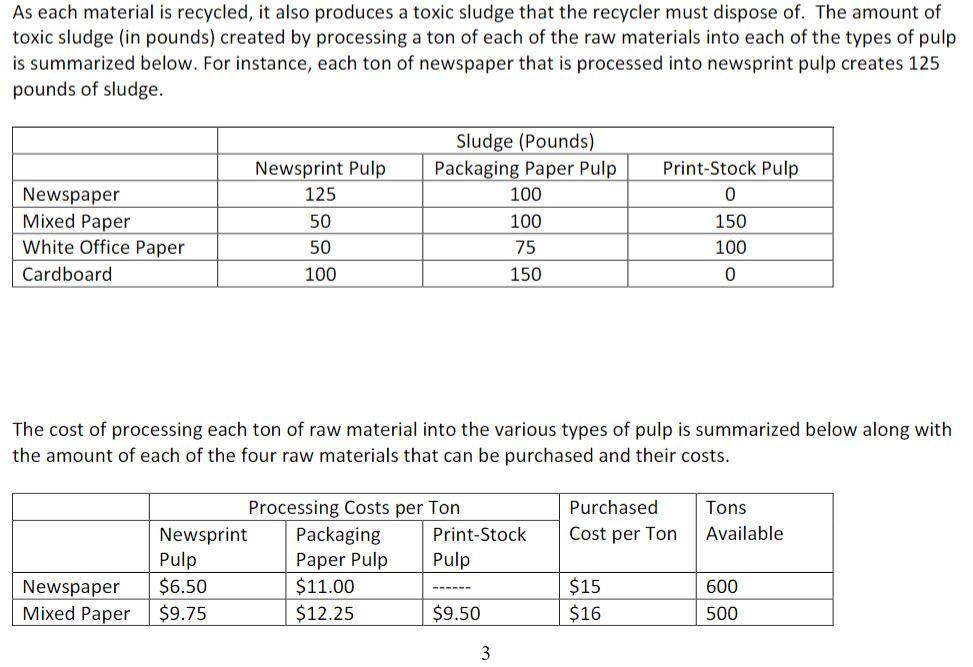
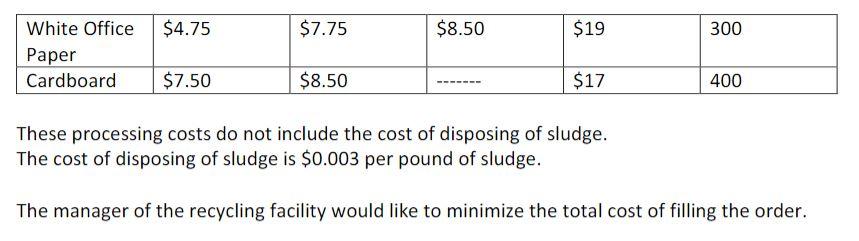
Problem 3: Paper Recycling Company Problem: A paper recycling company converts newspaper, mixed paper, white office paper, and cardboard into pulp for newsprint, packaging paper, and print-stock quality paper. The recycler is currently trying to determine the best way of filling an order for 500 tons of newsprint pulp, 600 tons of packaging paper pulp, and 300 tons of print-stock quality pulp. The following table summarizes the yield for each kind of pulp recovered from each ton of recycled material. Recycling Yield Packaging Paper Pulp Print-Stock Pulp Newsprint Pulp 85% Newspaper 80% Mixed Paper 90% 80% 70% White Office Paper 90% 85% 80% Cardboard 80% 70% For instance, a ton of newspaper can be recycled using a technique that yields 0.85 tons of newsprint pulp. Alternatively, a ton of newspaper can be recycled using a technique that yields 0.8 tons of packaging paper pulp. Similarly, a ton of cardboard can be recycled to yield 0.8 tons of newsprint pulp or 0.7 tons of packaging paper pulp. Note that newspaper and cardboard cannot be converted to print-stock pulp using the techniques available to the recycler. As each material is recycled, it also produces a toxic sludge that the recycler must dispose of. The amount of toxic sludge (in pounds) created by processing a ton of each of the raw materials into each of the types of pulp is summarized below. For instance, each ton of newspaper that is processed into newsprint pulp creates 125 pounds of sludge. As each material is recycled, it also produces a toxic sludge that the recycler must dispose of. The amount of toxic sludge (in pounds) created by processing a ton of each of the raw materials into each of the types of pulp is summarized below. For instance, each ton of newspaper that is processed into newsprint pulp creates 125 pounds of sludge. Sludge (Pounds) Packaging Paper Pulp Newsprint Pulp Print-Stock Pulp Newspaper 125 100 0 Mixed Paper 50 100 150 White Office Paper 50 75 100 Cardboard 100 150 0 The cost of processing each ton of raw material into the various types of pulp is summarized below along with the amount of each of the four raw materials that can be purchased and their costs. Processing Costs per Ton Tons Purchased Cost per Ton Newsprint Packaging Available Print-Stock Pulp Pulp Paper Pulp Newspaper $6.50 $11.00 $15 ------ 600 Mixed Paper $9.75 $12.25 $9.50 $16 500 3 White Office $4.75 $7.75 $8.50 $19 300 Paper Cardboard $7.50 $8.50 $17 400 These processing costs do not include the cost of disposing of sludge. The cost of disposing of sludge is $0.003 per pound of sludge. The manager of the recycling facility would like to minimize the total cost of filling the order. Problem 3: Paper Recycling Company Problem: A paper recycling company converts newspaper, mixed paper, white office paper, and cardboard into pulp for newsprint, packaging paper, and print-stock quality paper. The recycler is currently trying to determine the best way of filling an order for 500 tons of newsprint pulp, 600 tons of packaging paper pulp, and 300 tons of print-stock quality pulp. The following table summarizes the yield for each kind of pulp recovered from each ton of recycled material. Recycling Yield Packaging Paper Pulp Print-Stock Pulp Newsprint Pulp 85% Newspaper 80% Mixed Paper 90% 80% 70% White Office Paper 90% 85% 80% Cardboard 80% 70% For instance, a ton of newspaper can be recycled using a technique that yields 0.85 tons of newsprint pulp. Alternatively, a ton of newspaper can be recycled using a technique that yields 0.8 tons of packaging paper pulp. Similarly, a ton of cardboard can be recycled to yield 0.8 tons of newsprint pulp or 0.7 tons of packaging paper pulp. Note that newspaper and cardboard cannot be converted to print-stock pulp using the techniques available to the recycler. As each material is recycled, it also produces a toxic sludge that the recycler must dispose of. The amount of toxic sludge (in pounds) created by processing a ton of each of the raw materials into each of the types of pulp is summarized below. For instance, each ton of newspaper that is processed into newsprint pulp creates 125 pounds of sludge. As each material is recycled, it also produces a toxic sludge that the recycler must dispose of. The amount of toxic sludge (in pounds) created by processing a ton of each of the raw materials into each of the types of pulp is summarized below. For instance, each ton of newspaper that is processed into newsprint pulp creates 125 pounds of sludge. Sludge (Pounds) Packaging Paper Pulp Newsprint Pulp Print-Stock Pulp Newspaper 125 100 0 Mixed Paper 50 100 150 White Office Paper 50 75 100 Cardboard 100 150 0 The cost of processing each ton of raw material into the various types of pulp is summarized below along with the amount of each of the four raw materials that can be purchased and their costs. Processing Costs per Ton Tons Purchased Cost per Ton Newsprint Packaging Available Print-Stock Pulp Pulp Paper Pulp Newspaper $6.50 $11.00 $15 ------ 600 Mixed Paper $9.75 $12.25 $9.50 $16 500 3 White Office $4.75 $7.75 $8.50 $19 300 Paper Cardboard $7.50 $8.50 $17 400 These processing costs do not include the cost of disposing of sludge. The cost of disposing of sludge is $0.003 per pound of sludge. The manager of the recycling facility would like to minimize the total cost of filling the order
Step by Step Solution
There are 3 Steps involved in it

Get step-by-step solutions from verified subject matter experts
 Study Help