



Question: I need the quizes solved correctly 1. Consider a non-dividend-paying share with price St at time t (in years) in a market with continuously compounded
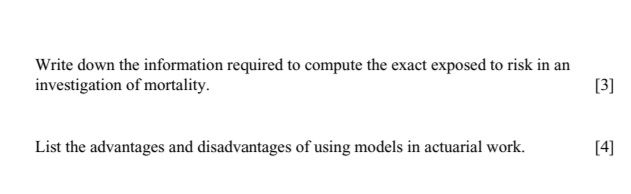
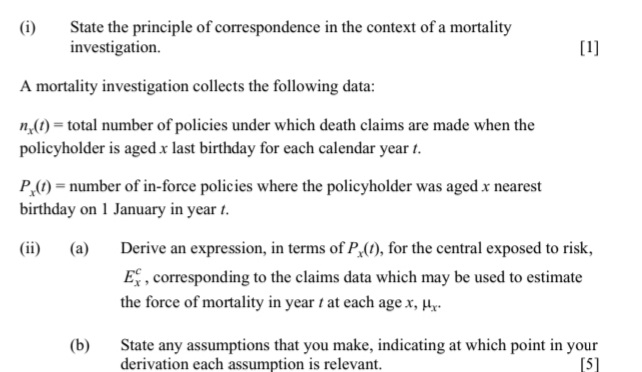
I need the quizes solved correctly
1. Consider a non-dividend-paying share with price St
at time t (in years) in a market
with continuously compounded risk-free rate of interest r.
(i) Show that the fair price at t = 0 of a forward contract on the share maturing at
time T is K = S0erT. [5]
A share is currently worth S0 = ?20. The continuously compounded risk-free rate of
interest is 1% per annum.
(ii) Calculate the fair price at t = 0 of a forward contract written on the share with
delivery at t = 2. [1]
(iii) Give an expression for the value to the investor of the forward contract in part
(ii) at time t 2, in terms of St , t and r. [2]
An investor enters into the above forward contract at time t = 0. At time t = 1 the
risk-free rate of interest has increased to 4% per annum. The share price has not
changed.
(iv) Calculate the value to the investor of the forward contract at t = 1. [1]
(v) Determine each of the following Greeks for the contract value at time t
2. A portfolio of insurance policies has two types of claims:
Loss amounts for Type I claims are exponentially distributed with mean 120.
Loss amounts for Type II claims are exponentially distributed with mean 110.
25% of claims are Type I, and 75% are Type II.
(i) Calculate the mean and variance of the loss amount for a randomly chosen
claim. [3]
An actuary wants to model randomly chosen claims using an exponential
distribution as an approximation.
(ii) Explain whether this is a good approximation
3.
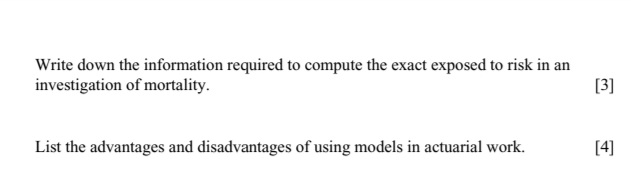
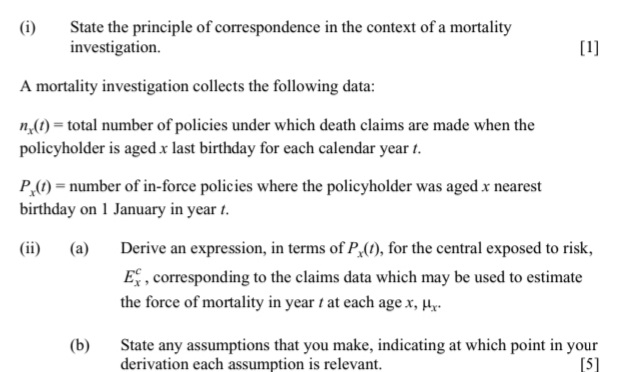
Write down the information required to compute the exact exposed to risk in an investigation of mortality. [3] List the advantages and disadvantages of using models in actuarial work. [4](i) State the principle of correspondence in the context of a mortality investigation. [1] A mortality investigation collects the following data: n,(1) = total number of policies under which death claims are made when the policyholder is aged x last birthday for each calendar year . P (1) = number of in-force policies where the policyholder was aged x nearest birthday on 1 January in year t. (ii) (a) Derive an expression, in terms of P (1), for the central exposed to risk, Ex , corresponding to the claims data which may be used to estimate the force of mortality in year / at each age x, Hy. (b) State any assumptions that you make, indicating at which point in your derivation each assumption is relevant. [5]
Step by Step Solution
There are 3 Steps involved in it

Get step-by-step solutions from verified subject matter experts