







Question: I need this exercise to be implemented in MATLAB. (Not Simulink) EXAMPLE 2.1. This example illustrates the ability of the adaptive linear combi- ner, trained
I need this exercise to be implemented in MATLAB. (Not Simulink)
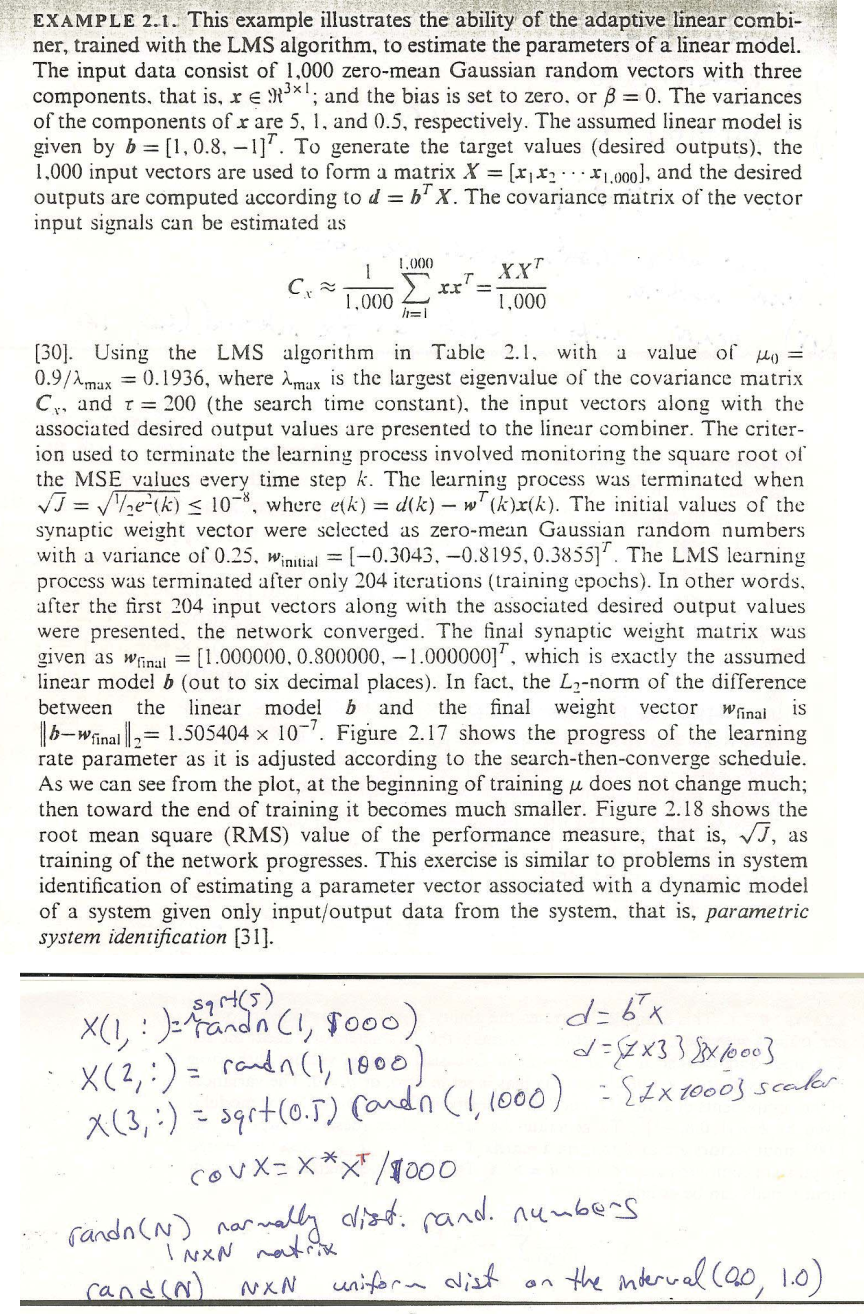
EXAMPLE 2.1. This example illustrates the ability of the adaptive linear combi- ner, trained with the LMS algorithm, to estimate the parameters of a linear model. The input data consist of 1,000 zero-mean Gaussian random vectors with three components, that is, re R3xl; and the bias is set to zero, or B = 0. The variances of the components of r are 5, 1, and 0.5, respectively. The assumed linear model is given by b = [1,0.8, -1]. To generate the target values (desired outputs), the 1,000 input vectors are used to form a matrix X = (x ? ... $1,000), and the desired outputs are computed according to d=b'x. The covariance matrix of the vector input signals can be estimated as 1.000 C Irx= XXT 1,000 1,000 h=1 [30]. Using the LMS algorithm in Table 2.1, with a value of Ho = 0.9/Amax = 0.1936, where Imax is the largest eigenvalue of the covariance matrix Cy, and t = 200 (the search time constant), the input vectors along with the associated desired output values are presented to the linear combiner. The criter- ion used to terminate the learning process involved monitoring the square root of the MSE values every time step k. The learning process was terminated when VJ = leik)
Step by Step Solution
There are 3 Steps involved in it

Get step-by-step solutions from verified subject matter experts
 Study Help