Question: I need to write an essay. Please help. Should include 1.) A set of propositions and a thesis 2.) A set of argumentative body paragraphs
I need to write an essay. Please help.
Should include
1.) A set of propositions and a thesis
2.) A set of argumentative body paragraphs well-supported by relevant evidence
3.) A well-structured introduction that contains a framing, an introduction of core terms and/or concepts, and a roadmap.
4.) A conclusion that contains a summary of your arguments and a broadening of the paper either by way of a connection to another text that you did not use as evidence in the body of the paper or a conceptual connection to another idea. I recommend the first method.
5.) A counter-claim either in as one of your body paragraphs (stand-alone) or as part of one of your body paragraphs to add nuance to the argument.
Structure Requirements
The essay must include a clear thesis statement and the essay should logically and cogently set about proving the said statement. The thesis statement must be underlined.Each and every argumentative proposition made in the service of proving the thesis must be supported with textual evidence. These can be both direct quotes and paraphrasing, but should not only be the latter. The essay should have a balanced series of paragraphs, none noticeably shorter or longer than the others, however, there is no specific paragraph number requirement. Usually for an essay of this length 3 or 4 body paragraphs is typical.
Evidence and Argumentation requirements
The essay as a whole must build to be one argument for yourthesis, your central claim. Remember that among other things, but crucially: a thesis is a claim it is reasonable to disagree with not a statement of the obvious i.e. it must be arguable.
Each topic sentence should be an argumentative proposition i.e a claim.
Your essay should address the problem raised in your chosen topic. You will generate not merely plausible but also textually well-supported interpretations (assume that the audience is highly familiar with the texts in question).
Do not use block quotes (long, multi-line quotes), and try to keep quotes on the shorter side, focusing on what you will unpack and analyze in the paper. Around 3 per paragraph is typical, however, a well-supported argument could use several very short quotes. Remember that quotes are not illustrations, you should unpack the quotes and relate them directly to the proposition you are trying to prove to move the argument forward. A paragraph without quotes is a red flag as it means you are not supporting your argument with direct evidence.
Youmustrestrict your citations to our assigned readings: these are not research papers; do not cite secondary sources. Do not include uncited references to secondary sources framed as "common knowledge" however, genuine common knowledge is often fine. This is a subtle distinction, so you might want to check with me if you have a question on this as it pertains to your essay. An example of genuine common knowledge would be that Athena is a goddess of strategic war. Specific events in the Iliad would not be common knowledge.
Citation and Style Requirements
You should include a works cited section at the bottom of your paper. This is not part of your word count. You must cite the paper using the academic style and conventions of a citation style of your choice. This should be an in-text style of citation and should be consistently applied throughout the paper and the works cited. You may choose whichever style is most familiar to you in your major.
The writing style you should use is argumentative, not expository writing. You should use formal argumentative language. You should use plain, clear English that is neither flowery nor overly simplistic.
Prompt:
Make an argument for a common theme of your choice in two texts of your choice. Use a close reading-based approach to support your argument. You should be prepared to frame/justify your choice of theme as significant. I'm choosing to Chinese Philosophy texts and doing this prompt: (The relationship between human emotions and rationality in achieving moral behavior.) I will upload the two texts:
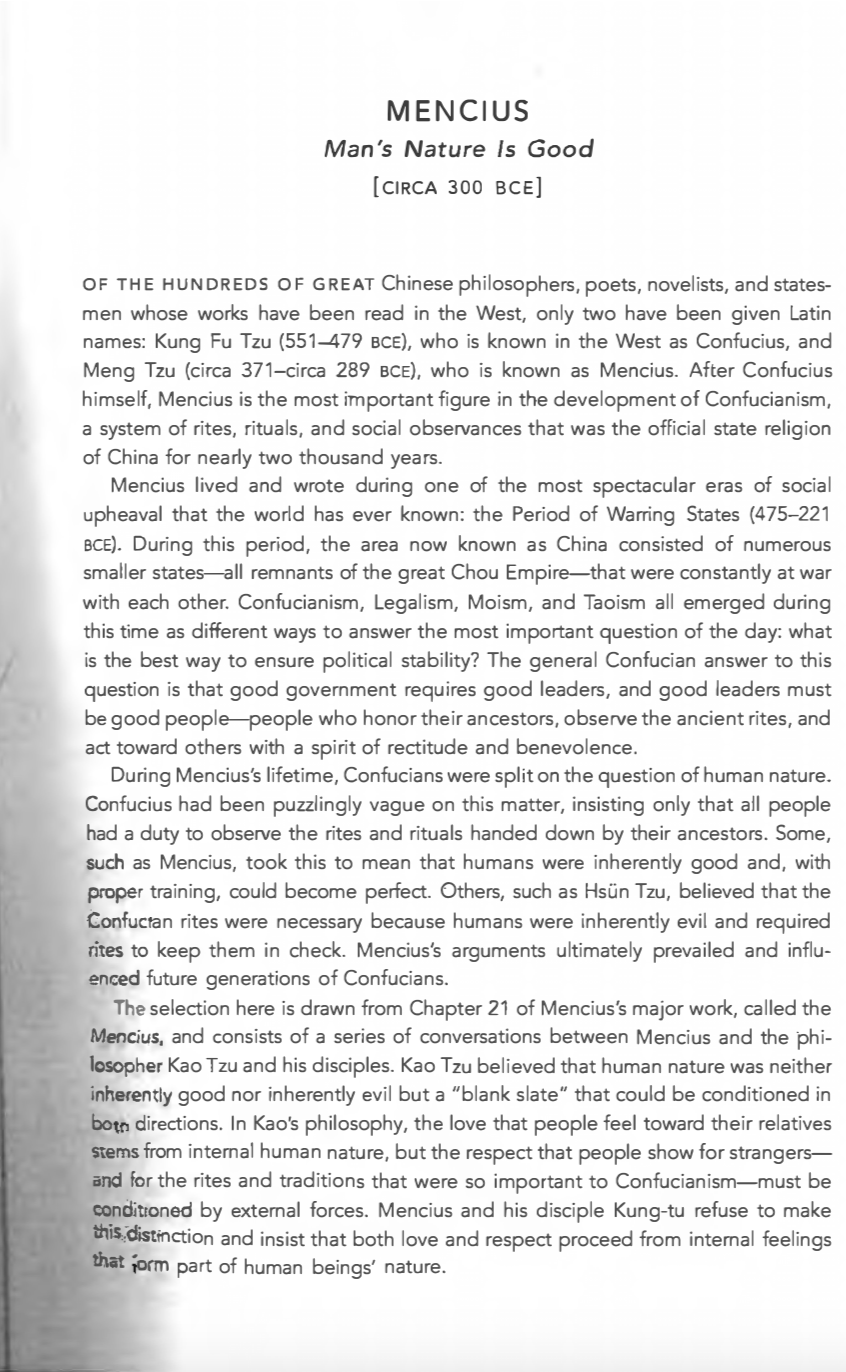
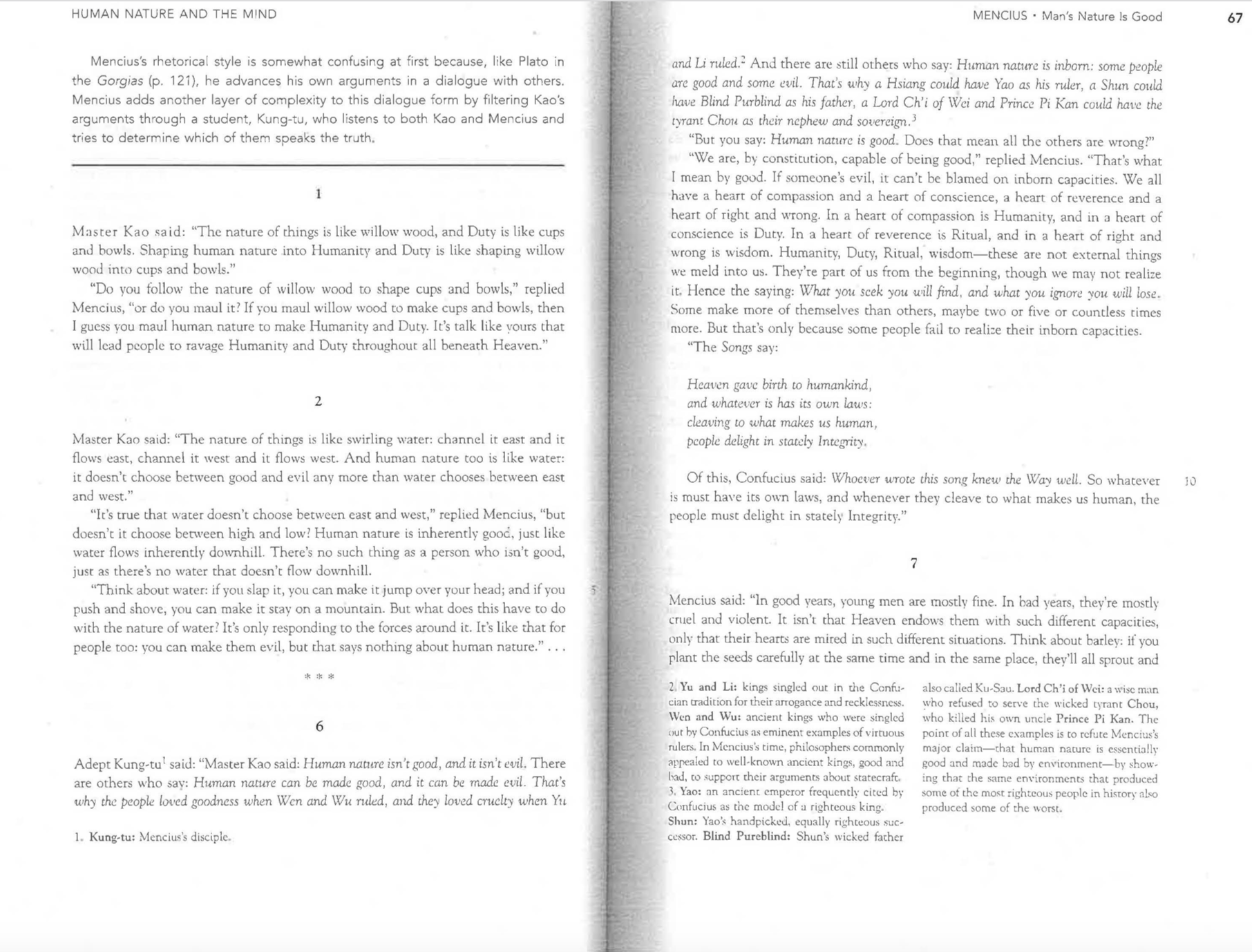
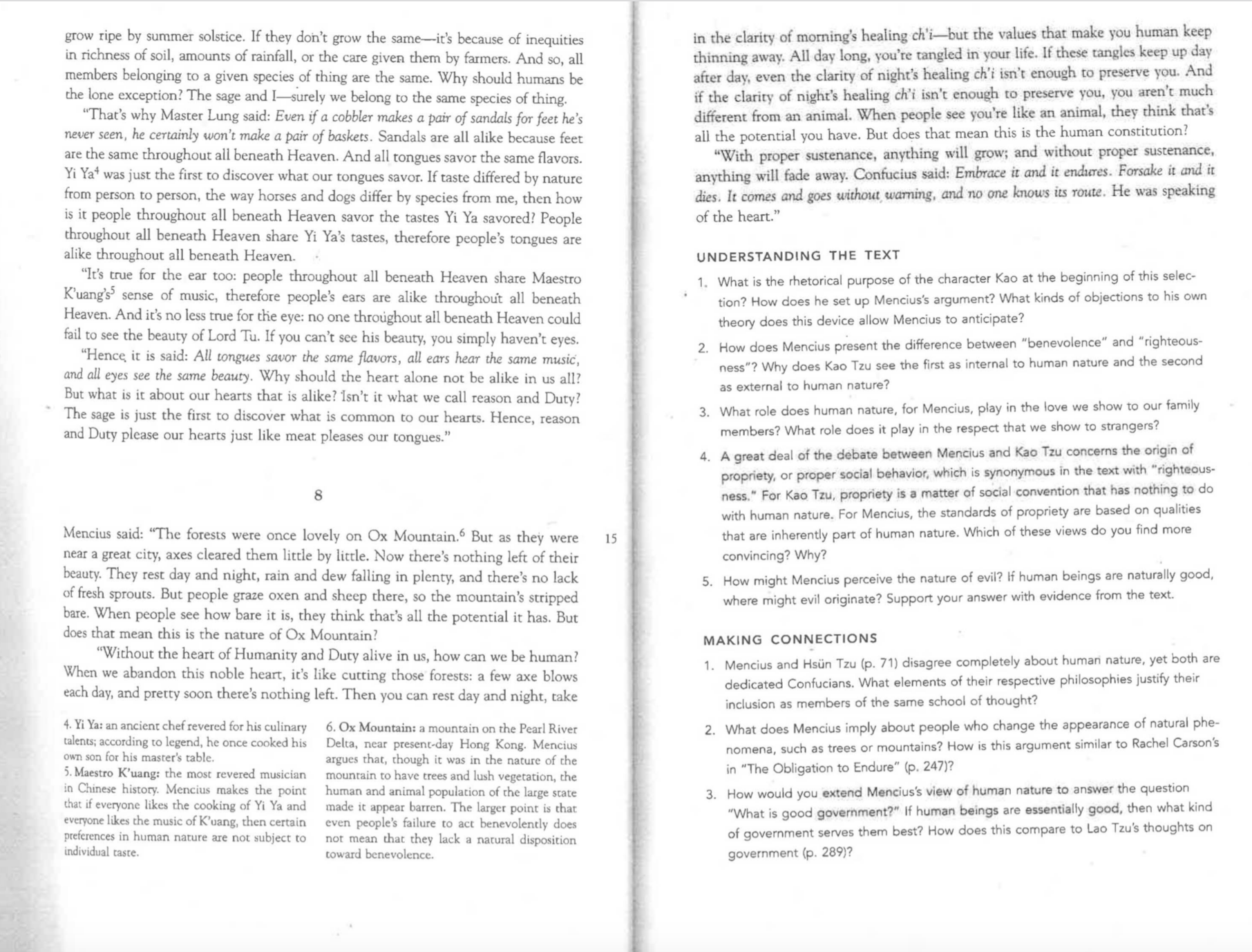
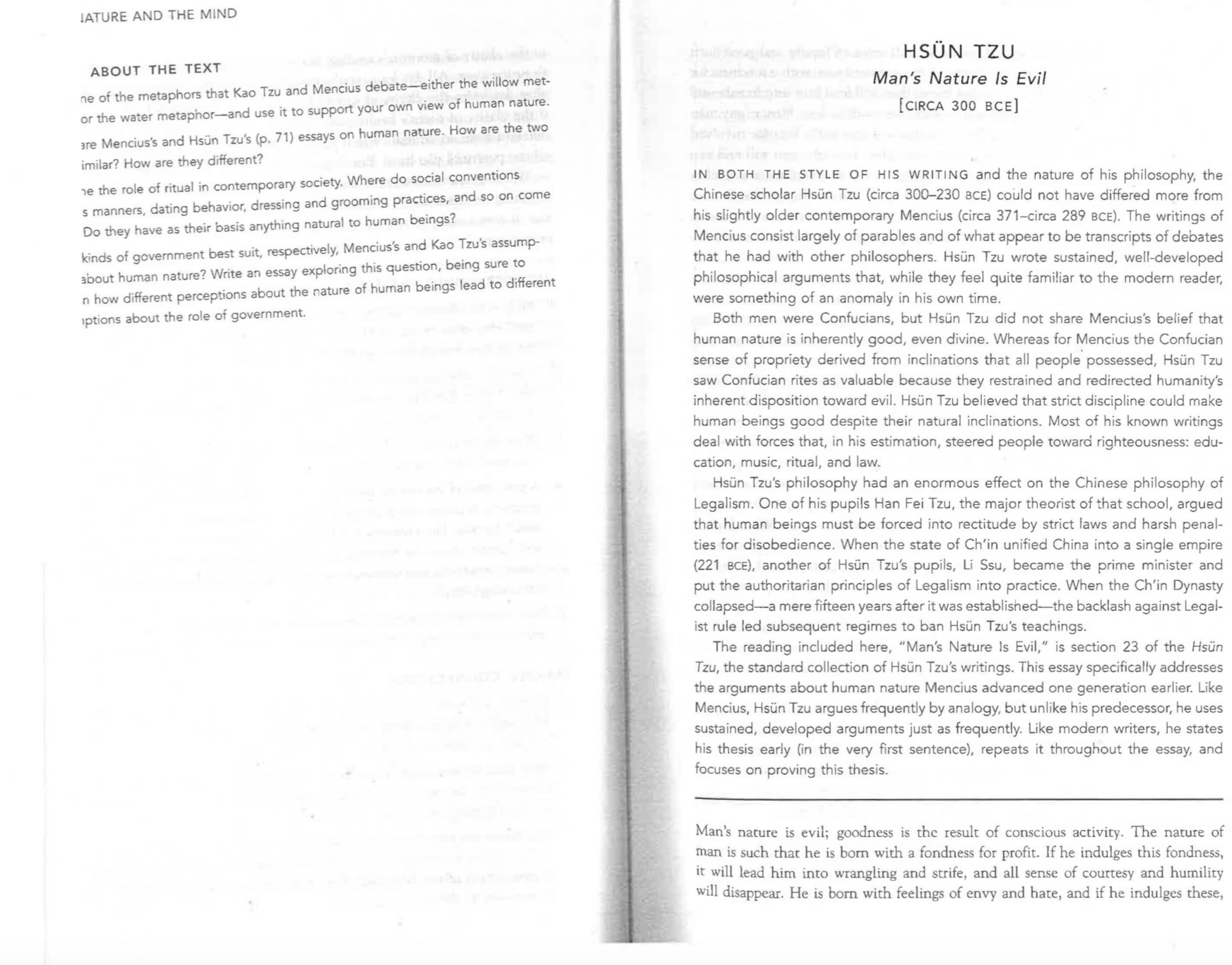
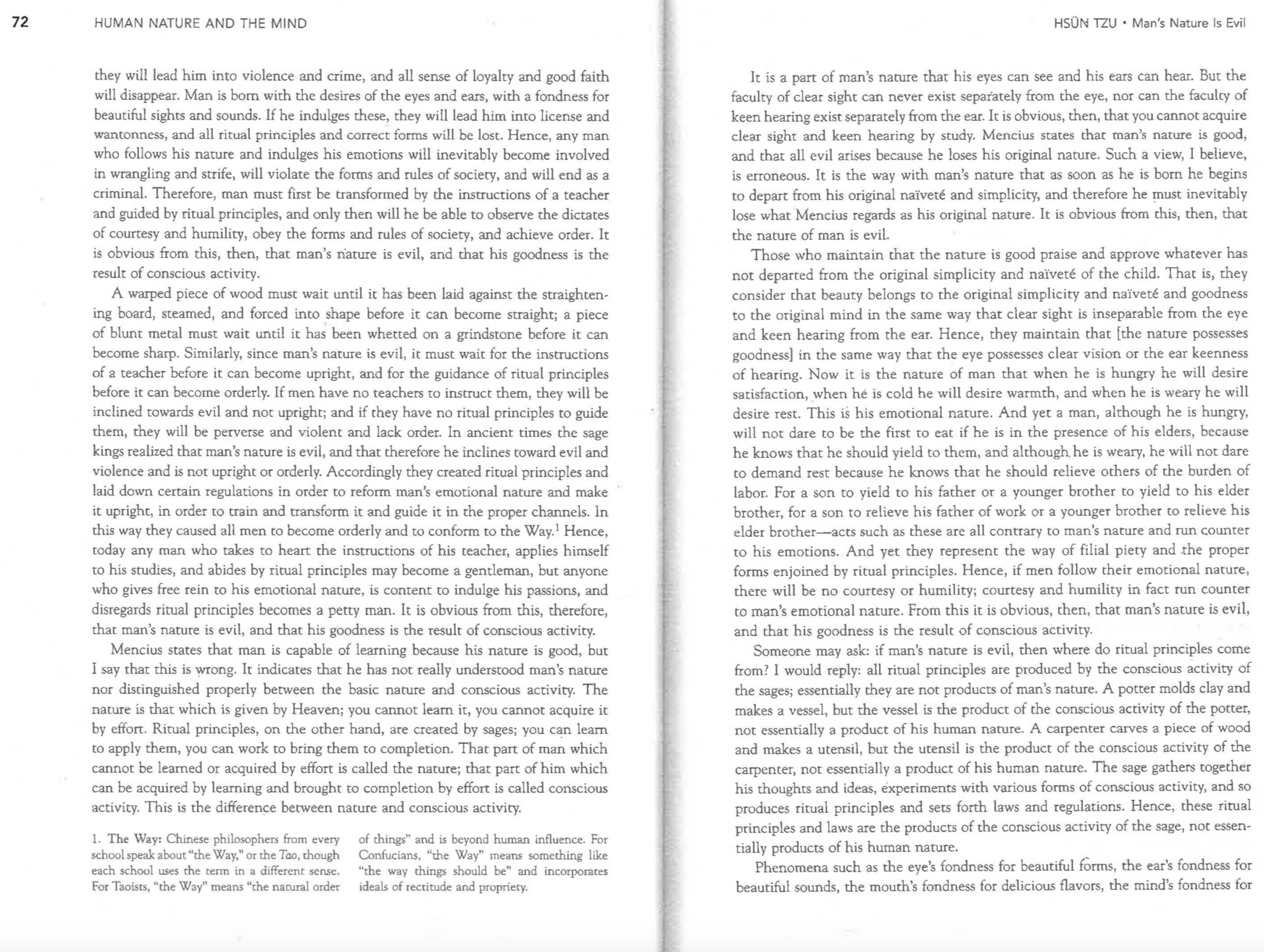
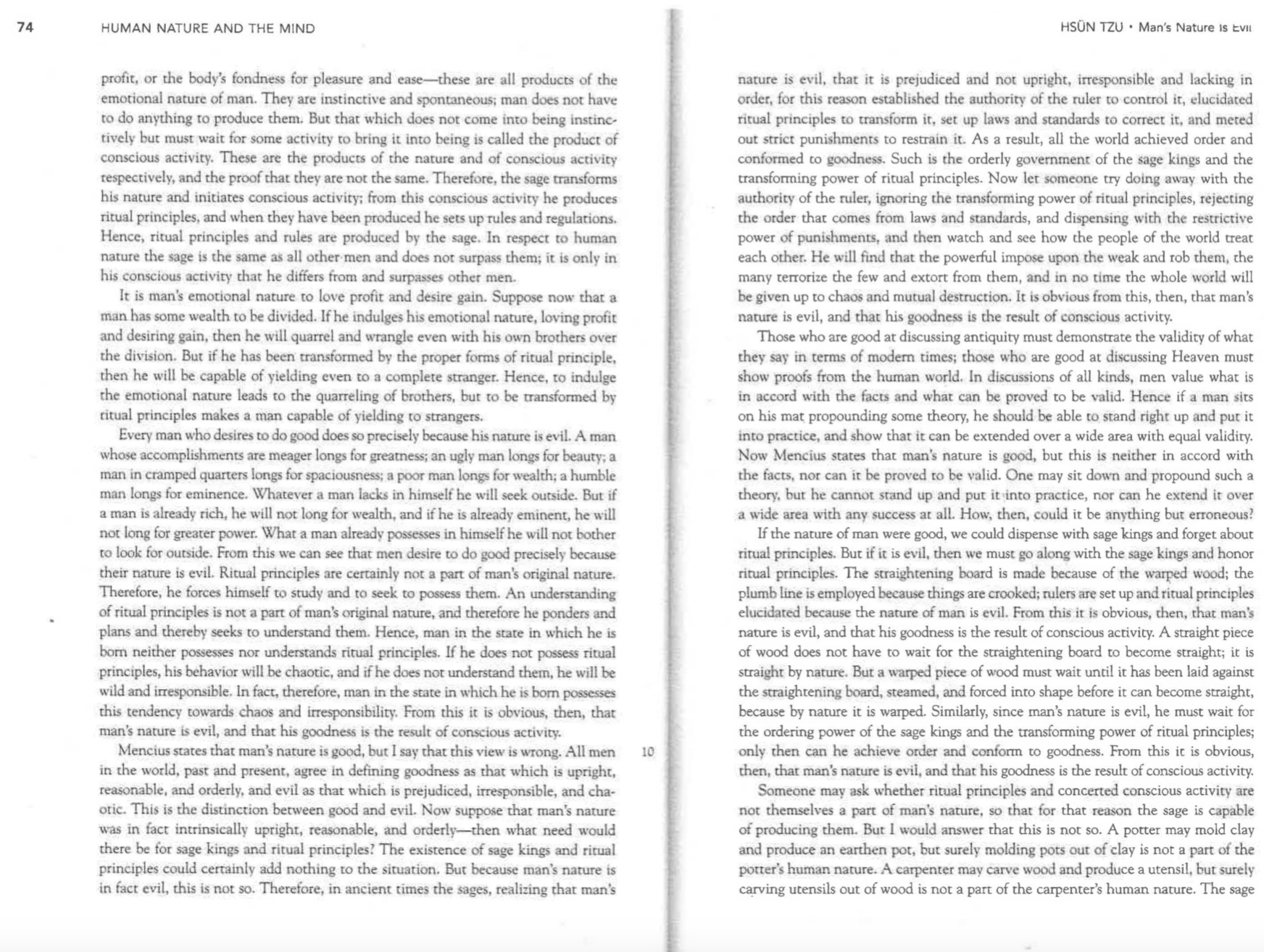
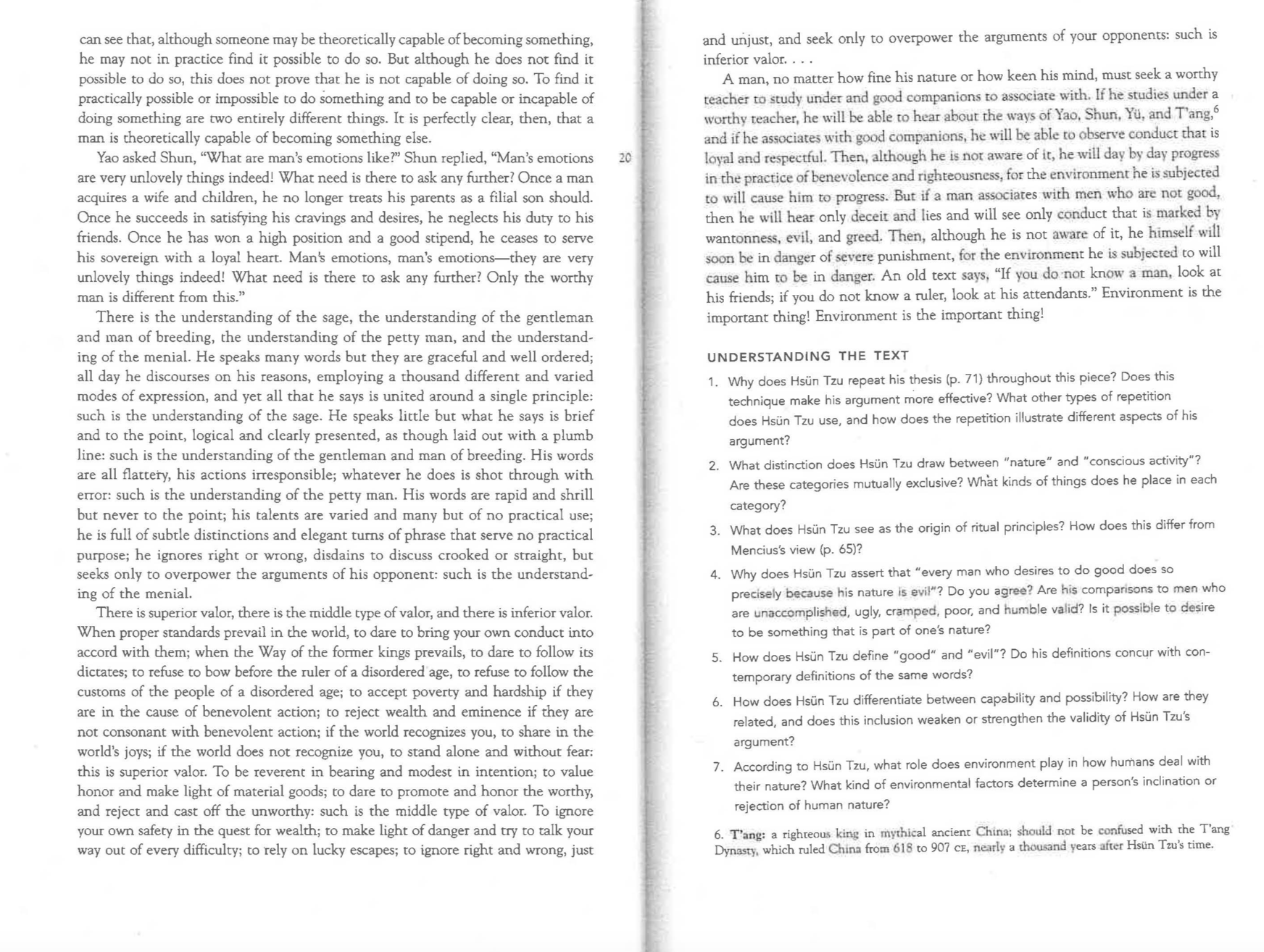
MENCIUS Man's Nature Is Good [CIRCA 300 BCE] OF THE HUNDREDS OF GREAT Chinese philosophers, poets, novelists, and states- men whose works have been read in the West, only two have been given Latin names: Kung Fu Tzu (551-479 BCE), who is known in the West as Confucius, and Meng Tzu (circa 371-circa 289 BCE), who is known as Mencius. After Confucius himself, Mencius is the most important figure in the development of Confucianism, a system of rites, rituals, and social observances that was the official state religion of China for nearly two thousand years. Mencius lived and wrote during one of the most spectacular eras of social upheaval that the world has ever known: the Period of Warring States (475-221 BCE). During this period, the area now known as China consisted of numerous smaller states-all remnants of the great Chou Empire-that were constantly at war with each other. Confucianism, Legalism, Moism, and Taoism all emerged during this time as different ways to answer the most important question of the day: what is the best way to ensure political stability? The general Confucian answer to this question is that good government requires good leaders, and good leaders must be good people-people who honor their ancestors, observe the ancient rites, and act toward others with a spirit of rectitude and benevolence. During Mencius's lifetime, Confucians were split on the question of human nature. Confucius had been puzzlingly vague on this matter, insisting only that all people had a duty to observe the rites and rituals handed down by their ancestors. Some, such as Mencius, took this to mean that humans were inherently good and, with proper training, could become perfect. Others, such as Hsun Tzu, believed that the Confucian rites were necessary because humans were inherently evil and required rites to keep them in check. Mencius's arguments ultimately prevailed and influ- enced future generations of Confucians. The selection here is drawn from Chapter 21 of Mencius's major work, called the Mencius, and consists of a series of conversations between Mencius and the phi- losopher Kao Tzu and his disciples. Kao Tzu believed that human nature was neither inherently good nor inherently evil but a "blank slate" that could be conditioned in both directions. In Kao's philosophy, the love that people feel toward their relatives stems from internal human nature, but the respect that people show for strangers- and for the rites and traditions that were so important to Confucianism-must be conditioned by external forces. Mencius and his disciple Kung-tu refuse to make this distinction and insist that both love and respect proceed from internal feelings that form part of human beings' nature.HUMAN NATURE AND THE MIND Mencius's rhetorical style is somewhat confusing at first because, like Plato in the Gorgias (p. 121), he advances his own arguments in a dialogue with others. Mencius adds another layer of complexity to this dialogue form by filtering Kao's arguments through a student, Kung-tu, who listens to both Kao and Mencius and tries to determine which of them speaks the truth. Master Kao said: \"The nature of things is like willow wood, and Duty is like cups and bowls. Shaping human nature into Humanity and Duty is like shaping willow wood into cups and bowls.\" \"Do you follow the nature of willow wood to shape cups and bowls,\" replied Mencius, \"or do you maul it? If you maul willow wood to make cups and bowls, then I guess you maul human nature to make Humanity and Duty. It's talk like vours that will lead people to ravage Humanity and Duty throughout all beneath Heaven.\" 2 Master Kao said: \"The nature of things is like swirling water: channel it east and it flows east, channel it west and it flows west. And human nature too is like water: it doesn't choose between good and evil any more than water chooses between east and west.\" \"It's true that water doesn't choose between east and west,\" replied Mencius, \"but doesn't it choose berween high and low? Human nature is inherently good, just like water flows inherently downhill. There's no such thing as a person who isn't good, just as there's no water that doesn't flow downhill. \"Think about water: if you slap it, you can make it jump over your head; and if you push and shove, you can make it stay on a mountain. But what does this have to do with the nature of water? It's only responding to the forces around it. It's like that for people too: you can make them evil, but that says nothing about human nature.\" . . . * ko 6 Adept Kung-tu' said: \"Master Kao said: Human nature isn't good, and it isn't evil. There are others who say: Human nature can be made good, and it can be made evil. That's why the people loved goodness when Wen and Wi ruled, and they loved cruclty when Yu 1. Kung-tu: Mencius's disciple. MENCIUS - Man's Nature Is Good and Li ruled* And there are still others who say: Hiuman nature is inbomn: some people are good and some evil. That's why a Hsiang could have Yao as his ruler, a Shun could have Blind Purblind as his father, a Lord Ch'i of Wei and Prince Pi Kan could have the tyrant Chow as their nephew and sovereign.? \"But you say: Human naturc is good. Does that mean all the others are wrong?\" \"We are, by constitution, capable of being good,\" replied Mencius. \"That's what [ mean by good. If someone's evil, it can't be blamed on inborn capacities. We all have a heart of compassion and a heart of conscience, a heart of reverence and a heart of right and wrong. In a heart of compassion is Humanity, and in a heart of conscience is Duty. In a heart of reverence is Ritual, and in a heart of right and wrong is wisdom. Humanity, Duty, Ritual, wisdomthese are not external things we meld into us. They're part of us from the beginning, though we may not realize it. Hence the saying: What you scek you will find, and what you ignore you will lose. Some make more of themselves than others, maybe two or five or countless rimes more. But that's only because some people fail to realize their inborn capacities. \"The Songs say: Heaven gave birth to humankind, and whatever is has its own laws: cleaving to what makes us human, people delight in stately Integrity. Of this, Confucius said: Whoever wrote this song knew the Way well. So whatever is must have its own laws, and whenever they cleave to what makes us human, the people must delight in stately Integrity.\" Mencius said: \"In good years, young men are mostly fine. In bad years, they're mostly cruel and violent. It isn't thar Heaven endows them with such different capacities, only that their hearts are mired in such different situations. Think about barley: if you plant the seeds carefully at the same time and in the same place, they'll all sprout and 2. Yu and Li: kings singled out in the Confu- cian tradition for their arrogance and recklessness. Wen and Wu: ancient kings who were singled out by Confucius as eminent examples of virtuous. rulers. In Mencius's time, philosophers commonly appealed to well-known ancient kings, good and ~ bad, to support their arguments about statecraft. 3. Yao: an ancient emperor frequently cited by Confucius as the model of a righteous king. Shun: Yao's handpicked, equally righteous suc- cessor. Blind Pureblind: Shun's wicked father also calied Ku-Sau. Lord Ch'i of Wei: a wise man who refused to serve the wicked tyrant Chou, who killed his own uncle Prince Pi Kan. The point of all these examples is to refute Mencius's major claimthat human nature is essentially good and made bad by environmentby show- ing that the same environments that produced some of the most righteous people in history also produced some of the worst. 67 o gy arl gg\\gx P grow ripe by surmer solstice. If they don't grow the sameit's because of inequities in richness of soil, amounts of rainfall, or the care given them by farmers. And so, all members belonging to a given species of thing are the same. Why should humans be the lone exception? The sage and [surely we belong to the same species of thing. \"That's why Master Lung said: Even if a cobbler makes a pair of sandals for feet he's never seen, he certainly won't make a pair of baskets. Sandals are all alike because feet are the same throughout all beneath Heaven. And all tongues savor the same flavors. Yi Ya* was just the first to discover what our tongues savor. If taste differed by nature from person to person, the way horses and dogs differ by species from me, then how is it people throughout all beneath Heaven savor the tastes Yi Ya savored? People throughout all beneath Heaven share Yi Yas tastes, therefore people's tongues are alike throughout all beneath Heaven. \"It's true for the ear too: people throughout all beneath Heaven share Maestro Kuang's sense of music, therefore people's ears are alike throughout all beneath Heaven. And it's no less true for thie eye: no one throtghout ail beneath Heaven could fail o see the beauty of Lord Tu. If you can't see his beauty, you simply haven't eyes. \"Hence, it is said: All tongues savor the same flavors, all ears hear the same music, and all eyes see the same beauty. Why should the heart alone not be alike in us all? But what is it about our hearts that is alike? Isn't it what we call reason and Duty? The sage is just the first to discover what is common to our hearts. Hence, reason and Duty please our hearts just like meat pleases our tongues.\" 8 Mencius said: \"The forests were once lovely on Ox Mountain. Bur as they were near a great city, axes cleared them little by little. Now there's nothing left of their beauty. They rest day and night, rain and dew falling in plenty, and there's no lack of fresh sprouts. But people graze oxen and sheep there, so the mountain's stripped bare. When people see how bare it is, they think that's all the potential it has. But does that mean this is the nature of Ox Mountain? \"Without the heart of Humanity and Duty alive in us, how can we be human? When we abandon this noble hearr, it's like cutting those forests: a few axe blows each day, and pretty soon there's nothing left. Then you can rest day and night, take 4. Yi Ya: an ancient chef revered for his culinary 6. Ox Mountain: a mountain on the Pearl River talents; according to legend, he once cooked his Delta, near present-day Hong Kong. Mencius own son for his master's table. argues that, though it was in the nature of the 5. Maestro K'uang: the most revered musician mountain to have trees and lush vegeration, the in Chinese history. Mencius makes the point human and animal population of the large state that if everyone likes the cooking of Yi Yaand made it appear barren. The larger poin is that everyone likes the music of K'vang, then certain ~ even people's failure to act benevolently does preferences in human narure are not subject to nor mean that they lack a narural disposition individual taste. toward benevolence. 15 in the clarity of moming's healing ch'ibut the values that make you human keep thinning away. All day long, you're tangled in your life. If these tangles keep up day after day, even the clarity of night's healing ch'i isn't enough to preserve vc:vu. ::: if the clarity of night's healing ch'i isn't enough to preserve you, you are.nt m : different from an animal. When people see you're like an animal, they dur_\\k that's all the potential you have. But does that mean this is the human constitution? \"With proper sustenance, anything will grow; and without proper sustenance, anything will fade away. Confucius said: Embrace it and it endures. Forsake it am.iu dies. It comes and goes without wamning, and no one knows its route. He was speaking of the heart.\" UNDERSTANDING THE TEXT 1. What is the rhetorical purpose of the character Kao at the beginning of this selec- tion? How does he set up Mencius's argument? What kinds of objections to his own theory does this device allow Mencius to anticipate? 2. How does Mencius prsent the difference between \"benevolence\" and \"righteous- ness\"? Why does Kao Tzu see the first as internal to human nature and the second as external to human nature? 3. What role does human nature, for Mencius, play in the love we show to our family members? What role does it play in the respect that we show to strangers? 4. A great deal of the debate between Mencius and Kao Tzu concerns Ih.- o'r.i?in of propriety, or proper social behavior, which is synonymous in the text with rlrghuaus- ness.\" For Kao Tzu, propriety is a matter of social convention that has nothing to do with human nature. For Mencius, the standards of propriety are based on qualities that are inherently part of human nature. Which of these views do you find more convincing? Why? 5. How might Mencius perceive the nature of evil? if human beings are naturally goed, where might evil originate? Support your answer with evidence from the text. MAKING CONNECTIONS 1. Mencius and H-si.'m Tzu (p. 71) disagree completely about human nature, yet bottf are dedicated Confucians. What elements of their respective philosophies justify their inclusion as members of the same school of thought? 2. What does Mencius imply about people who change the appearance of natural phe- nomena, such as trees or mountains? How is this argument similar to Rachel Carson's in \"The Obligation to Endure\" (p. 247)7 3. How would you extend Mencius's view of human nature to answer the question \"What is good government?\" If human beings are essentially good, then what kind of government serves them best? How does this compare to Lao Tzu's thoughts on government (p. 289)7 IATURE AND THE MIND HSUN TZU ABOUT THE TEXT Man's Nature Is Evil ne of the metaphors that Kao Tzu and Mencius debate-either the willow met- or the water metaphor-and use it to support your own view of human nature. [CIRCA 300 BCE] are Mencius's and Hsun Tzu's (p. 71) essays on human nature. How are the two imilar? How are they different? he the role of ritual in contemporary society. Where do social conventions IN BOTH THE STYLE OF HIS WRITING and the nature of his philosophy, the s manners, dating behavior, dressing and grooming practices, and so on come Chinese scholar Hsun Tzu (circa 300-230 BCE) could not have differed more from Do they have as their basis anything natural to human beings? his slightly older contemporary Mencius (circa 371-circa 289 BCE). The writings of Mencius consist largely of parables and of what appear to be transcripts of debates kinds of government best suit, respectively, Mencius's and Kao Tzu's assump- that he had with other philosophers. Hsun Tzu wrote sustained, well-developed about human nature? Write an essay exploring this question, being sure to philosophical arguments that, while they feel quite familiar to the modern reader, n how different perceptions about the nature of human beings lead to different were something of an anomaly in his own time. options about the role of government. Both men were Confucians, but Hsun Tzu did not share Mencius's belief that human nature is inherently good, even divine. Whereas for Mencius the Confucian sense of propriety derived from inclinations that all people possessed, Hsun Tzu saw Confucian rites as valuable because they restrained and redirected humanity's inherent disposition toward evil. Hsun Tzu believed that strict discipline could make human beings good despite their natural inclinations. Most of his known writings deal with forces that, in his estimation, steered people toward righteousness: edu- cation, music, ritual, and law. Hsun Tzu's philosophy had an enormous effect on the Chinese philosophy of Legalism. One of his pupils Han Fei Tzu, the major theorist of that school, argued that human beings must be forced into rectitude by strict laws and harsh penal- ties for disobedience. When the state of Ch'in unified China into a single empire (221 BCE), another of Hsun Tzu's pupils, Li Ssu, became the prime minister and put the authoritarian principles of Legalism into practice. When the Ch'in Dynasty collapsed-a mere fifteen years after it was established-the backlash against Legal- ist rule led subsequent regimes to ban Hsun Tzu's teachings. The reading included here, "Man's Nature Is Evil," is section 23 of the Hsun Tzu, the standard collection of Hsun Tzu's writings. This essay specifically addresses the arguments about human nature Mencius advanced one generation earlier. Like Mencius, Hsun Tzu argues frequently by analogy, but unlike his predecessor, he uses sustained, developed arguments just as frequently. Like modern writers, he states his thesis early (in the very first sentence), repeats it throughout the essay, and focuses on proving this thesis. Man's nature is evil; goodness is the result of conscious activity. The nature of man is such that he is born with a fondness for profit. If he indulges this fondness, it will lead him into wrangling and strife, and all sense of courtesy and humility will disappear. He is born with feelings of envy and hate, and if he indulges these,72 HUMAN NATURE AND THE MIND they will lead him into violence and crime, and all sense of loyalty and good faith will disappear. Man is bom with the desires of the eyes and ears, with a fondness for beautiful sights and sounds. If he indulges these, they will lead him into license and wantonness, and all ritual principles and correct forms will be lost. Hence, any man who follows his nature and indulges his emotions will inevitably become involved in wrangling and strife, will violate the forms and rules of society, and will end as a criminal. Therefore, man must first be transformed by the instructions of a teacher and guided by ritual principles, and only then will he be able to observe the dictates of courtesy and humility, obey the forms and rules of society, and achieve order. It is obvious from this, then, that man's nature is evil, and that his goodness is the result of conscious activiry. A warped piece of wood must wait until it has been laid against the straighten- ing board, steamed, and forced into shape before it can become straight; a piece of blunt metal must wait until it has been whetted on a grindstone before it can become sharp. Similarly, since man's nature is evil, it must wait for the instructions of a teacher before it can become upright, and for the guidance of ritual principles before it can become orderly. If men have no teachers to instruct them, they will be inclined towards evil and not upright; and if they have no ritual principles to guide them, they will be perverse and violent and lack order. In ancient times the sage kings realized that man's nature is evil, and thar therefore he inclines toward evil and violence and is not upright or orderly. Accordingly they created ritual principles and laid down certain regulations in order to reform man's emotional nature and make it upright, in order to train and transform it and guide it in the proper channels. In this way they caused all men to become orderly and to conform to the Way.! Hence, today any man who takes to heart the instructions of his teacher, applies himself to his studies, and abides by ritual principles may become a gentleman, but anycne who gives free rein to his emotional nature, is content to indulge his passions, and disregards ritual principles becomes a petty man. It is obvious from this, therefore, that man's narure is evil, and that his goodness is the result of conscious activity. Mencius states that man is capable of learning because his nature is good, but I say thar this is wrong. It indicates that he has not really understood man's nature nor distinguished properly between the basic nature and conscious activity. The nature is that which is given by Heaven; you cannot leamn it, you cannot acquire it by effort. Ritual principles, on the other hand, are created by sages; you can learn to apply them, you can work to bring them to completion. That part of man which cannot be leamed or acquired by effort is called the nature; that part of him which can be acquired by learning and brought to completion by effort is called conscious activicy. This is the difference berween nature and conscious activity. 1. The Way: Chinese philosophers from every of things\" and is beyond human influence. For school speak about \"the Way,\" or the Tao, though ~ Confucians, \"the Way\" means something like each school uses the term in a different sense. \"the way things should be\" and incorporares For Taoists, \"the Way\" means \"the nactural order ideals of rectitude and propriety. HSUN TZU Men's Nature s Evil It is a parr of man's nature that his eyes can see and his ears can hear. But the faculry of clear sight can never exist separately from the eye, nor can the faculry of keen hearing exist separately from the ear. [t is obvious, then, that you cannot acquire clear sight and keen hearing by study. Mencius states that man's nature is good, and thar all evil arises because he loses his original nature. Such a view, I believe, is erroneous. It is the way with man's nature that as soon as he is born he begins to depart from his original naivet and simplicity, and therefore he must inevitably lose what Mencius regards as his original nature. It is obvious from this, then, that the nature of man is evil. Those who maintain that the nature is good praise and approve whatever has not departed from the original simplicity and naivet of the child. That is, they consider rhat beauty belongs to the original simplicity and naivet and goodness to the original mind in the same way that clear sight is inseparable from the eye and keen hearing from the ear. Hence, they maintain that [the nature possesses goodness] in the same way that the eye possesses clear vision or the ear keenness of hearing. Now it is the nature of man that when he is hungry he will desire satisfaction, when h is cold he will desire warmth, and when he is weary he will desire rest. This is his emotional nature. And yet a man, although he is hungry, will not dare to be the first to eat if he is in the presence of his elders, because he knows that he should yield to them, and although he is weary, he will not dare to demand rest because he knows that he should relieve others of the burden of labor. For a son to yield to his father or a younger brother to yield to his elder brother, for a son to relieve his father of work or a younger brother to relieve his elder brotheracts such as these are all contrary to man's nature and run counter to his emotions. And yet they represent the way of filial piety and the proper forms enjoined by ritual principles. Hence, if men follow their emotional nature, there will be no courtesy or humility; courtesy and humility in fact run counter to man's emotional nature. From this it is cbvious, then, that man's nature is evil, and that his goodness is the result of conscious activity. Someone may ask: if man's nature is evil, then where do ritual principles come from? 1 would reply: all ritual principles are produced by the conscious activity of the sages; essentially they are not products of man's nature. A potter molds clay and makes a vessel, but the vessel is the product of the conscious activity of the potter, not essentially a product of his human nature. A carpenter carves a piece of wood and makes a utensil, but the utensil is the product of the conscious activity of the carpenter, not essentially a product of his human nature. The sage gathers together his thoughts and ideas, experiments with various forms of conscious activity, and so produces ritual principles and sets forth laws and regulations. Hence, these ritual principles and laws are the products of the conscious activity of the sage, not essen- tially products of his human narure. Phenomena such as the eye's fondness for beautiful forms, the ear's fondness for beauriful sounds, the mouth's fondness for delicious flavors, the mind's fondness for 74 HUMAN NATURE AND THE MIND profit, or the body's fondness for pleasure and easethese are all products of the emotional nature of man. They are instinctive and spontaneous; man does not have to do anything to produce them. But that which does not come into being instinc- tively but must wait for some activity to bring it into being is called the product of conscious activity. These are the products of the nature and of conscious activity respectively, and the proof that they are not the same. Therefore, the sage transforms his nature and initiates conscious activity; from this conscious activity he produces ritual principles, and when they have been produced he sets up rules and regulations. Hence, ritual principles and rules are produced by the sage. In respect to human nature the sage is the same as all other-men and does nor surpass them; it is only in his conscious activity that he differs from and surpasses other men. It is man's emotional nature to love profit and desire gain. Suppose now thar a man has some wealth to be divided. If he indulges his emotional nature, loving profit and desiring gain, then he will quarrel and wrangle even with his own brothers over the division. But if he has been transformed by the proper forms of ritual principle, then he will be capable of yielding even to a complete stranger. Hence, o indulge the emotional nature leads to the quarreling of brothers, but to be transformed by titual principles makes a man capable of yielding to strangers. Every man who desires to do good does so precisely because his nature is evil. A man whose accomplishments are meager longs for greatness; an ugly man longs for beauty; a man in cramped quarters longs for spaciousness; a poor man longs for wealth; a humble man longs for eminence. Whatever a man lacks in himself he will seek outside. But if a man is already rich, he will not long for wealth, and if he is already eminent, he will not long for greater power. What a man already possesses in himself he will not bother 1o look for ourside. From this we can see that men desire to do good precisely because their nature is evil. Ritual principles are certainly not a part of man's original nature. Therefore, he forces himself to study and to seek to possess them. An understanding of ritual principles is not a part of man's original nature, and therefore he ponders and plans and thereby seeks to understand them. Hence, man in the state in which he is bomn neither possesses nor understands ritual principles. If he does nort possess ritual principles, his behavior will be chaotic, and if he does not understand them, he will be wild and irresponsible. In fact, therefore, man in the state in which he is bomn possesses this tendency towards chaos and irresponsibility. From this it is obvious, then, that man's nature s evil, and that his goodness is the result of conscious activity. Mencius states that man's nature is good, but | say thar this view is wrong. All men in the world, past and present, agree in defining goodness as that which is upright, reasonable, and orderly, and evil as that which is prejudiced, irresponsible, and cha- otic. This is the distinction between good and evil. Now suppose that man's nature was in fact intrinsically upright, reasonable, and orderlythen what need would there be for sage kings and ritual principles? The existence of sage kings and ritual principles could certainly add nothing to the situation. But because man's nature is in fact evil, this is not so. Therefore, in ancient times the sages, realizing thar man's HSUN TZU * Man's Nature Is tvi nature is evil, that it is prejudiced and not upright, irresponsible and lacking in order, for this reason established the authority of the ruler to conrrol ir, elucidated ritual principles to transform it, set up laws and standards to correct it, and meted out strict punishments to restrain it. As a result, all the world achieved order and conformed to goodness. Such is the orderly government of the sage kings and the transforming power of ritual principles. Now let someone try doing away with the authority of the ruler, ignoring the transforming power of ritual principles, rejecting the order that comes from laws and standards, and dispensing with the restrictive power of punishments, and then watch and see how the people of the world treat each other. He will find that the powerful impose upon the weak and rob them, the many terrorize the few and extort from them, and in no time the whole world will be given up to chaos and mutual destruction. It is obvious from this, then, that man's nature is evil, and that his goodness is the result of conscious activity. Those who are good at discussing antiquity must demonstrate the validity of what they say in terms of modem times; those who are good at discussing Heaven must show proofs from the human world. In discussions of all kinds, men value what is in accord with the facts and what can be proved to be valid. Hence if a man sits on his mat propounding some theory, he should be able to stand right up and put it into practice, and show that it can be extended over a wide area with equal validiry. Now Mencius states thar man's nature is good, but this is neither in accord with the facts, nor can it be proved ro be valid. One may sit down and propound such a theory, bur he cannot stand up and put itinto practice, nor can he extend it over a wide area with any success ar all. How, then, could it be anything but erroneous? If the nature of man were good, we could dispense with sage kings and forget about ritual principles. But if it is evil, then we must go along with the sage kings and honor ritual principles. The straightening board is made because of the warped wood; the plumb line is employed because things are crooked; rulers are set up and ritual principles elucidated because the nature of man is evil. From this it is obvious, then, that man's nature is evil, and that his goodness is the result of conscious activity. A straight piece of wood does not have to wait for the straightening board to become straight; it is straight by nature. But a warped piece of wood must wait until it has been laid against the straightening board, steamed, and forced into shape before it can become straight, because by nature it is warped. Similarly, since man's nature is evil, he must wair for the ordering power of the sage kings and the transforming power of ritual principles; only then can he achieve order and conform to goodness. From this it is obvious, then, that man's nature is evil, and that his goodness is the result of conscious activity. Someone may ask whether ritual principles and concerted conscious activity are not themselves a part of man's nature, so that for that reason the sage is capable of producing them. But I would answer that this is not so. A potter may mold clay and produce an earthen pot, but surely molding pots ourt of clay is not a part of the portter's human nature. A carpenter may carve wood and produce a utensil, but surely carving utensils out of wood is not a part of the carpenter's human narture. The sage 76 HUMAN NATURE AND THE MIND stands in the same relation to ritual principles as the potter to the things he molds and produces. How, then, could ritual principles and concerted conscious activity be a part of man's basic human nature? As far as human nature goes, the sages Yao and Shun possessed the same nature as the tyrant Chieh or Robber Chih, and the gentleman possesses the same nature as the petty man.? Would you still maintain, then, that ritual principles and concerted conscious activity are a part of man''s nature! If you do so, then what reason is there to pay any particular honor to Yao, Shun, or the gentleman? The reason people honor Yao, Shun, and the gentleman is that they are able to transform their nature, apply themselves to conscious activity, and produce ritual principles. The sage, then, must stand in the same relation to ritual principles as the potter to the things he molds and produces. Looking at it this way, how could ritual principles and concerted conscious activity be a part of man's nature? The reason people despise Chieh, Robber Chih, or the petty man is that they give free rein to their nature, follow their emotions, and are content to indulge their passions, so that their conduct is marked by greed and contentiousness. Therefore, it is clear that man's nature is evil, and that his goodness is the result of conscious activity. Heaven did not bestow any particular favor upon Tseng Tzu, Min Tzu-ch'ien, or Hsiao-i that it withheld from other men.? And yet these three men among all others proved most capable of carrying out their duties as sons and winning fame for their filial piety. Why? Because of their thorough attention to ritual principles. Heaven has not bestowed any particular favor upon the inhabitants of Ch'i and Lu which it has withheld from the people of Ch'in.* And yet when it comes to observing the duties of father and son and the separation of roles berween husband and wife, the inhabitants of Ch'in cannot match the filial reverence and respect for proper form which marks the people of Ch'i and Lu. Why? Because the people of Ch'in give free rein to their emotional nature, are content to indulge their passions, and are careless of ritual principles. It is cerminlynotductoanydifferenceinhumannammbemeenrhemogmu;s. The man in the street can become a Yii. What does this mean? What made the sage emperor Yii a Yg, I would reply, was the fact that he practiced benevolence L Gentleman: the category representing the ideal human being in the Confucian system of thought. The gentleman possesses rectirude, benevolence, integrity, honor, and a proper respect for the ancestors and the rites. The oppo- site of a gentleman is a \"perty man.\" The terms do not have any class-based connotations. Yao and Shun: mythical ancient kings advanced by Coniucians as ideals of righteous rulers. Tyrant Chieh or Robber Chih: according to tradition, Chieh was an evil ruler who brought down the great Hsia Dynasty. Robber Chih led a band of nine thousand criminals; legend has it that Confucius once tried in vain to reform him. 3. Tseng Tru, Min Tzu-ch'ien: followers of Confucius who were considered especially right- eous. Not much is known abour Hsiao-i. 4. Ch'i and Lu: areas where Confucianism was very influendial. Ch'in's government was offi- cially anri-Confucian. 5. Yi: che virtuous king and founder of the ancient Hsia Dynasty. \"The man in the street can become a Yi" refers to the assertion, found in section 22 of the Mencius, thac \"all men may be Yaos and Shuns\" (see note 2). HSUN TZU * Man's Nature Is Evil and righteousness and abided by the proper rules and standards. If this is so, then benevolence, righteousness, and proper standards must be based upon principles which can be known and practiced. Any man in the street has the essential facul- ties needed to understand benevolence, righteousness, and proper standards, and the potential ability to put them into practice. Therefore it is clear that he can . become a Yi. Would you maintain that benevolence, righteousness, and proper standards are not based upon any principles that can be known and practiced? If so, then even a Yd could not have understood or practiced them. Or would you maintain that the man in the street does not have the essential faculties nceded to understand them or the potential ability to put them into practice! If so, then you are saying that the man in the street in his family life cannot understand the duties required of a father or a son and in public life cannot comprehend the correct relationship between ruler and subject. But in fact this is not true. Any man in the street can understand the duties required of a father or a son and can comprehend the correct relationship berween ruler and subject. Therefore, it is obvious that the essential faculties needed to understand such ethical principles and the potential ability to put them into practice must be a part of his make-up. Now if he takes these faculties and abilities and applies them to the principles of benevolence and righteousness, which we have already shown to be knowable and practicable, then it is obvious that he can become a Yii. If the man in the:street applies himself to training and study, concentrates his mind and will, and considers and examines things care- fully, continuing his efforts over a long period of time and accumulating good acts without stop, then he can achieve a godlike understanding and form a triad with Heaven and earth. The sage is 2 man who has arrived where he has through the accumulation of good acts. You have said, someone may object, that the sage has arrived where he has through the accumulation of good acts. Why is it, then, that everyone is not able to accumulate good acts in the same way? [ would reply: everyone is capable of doing 50, but not everyone can be made to do so. The petty man is capable of becoming a gentleman, yet he is not willing to do so; the gentleman is capable of becoming a petty man but he is not willing to do so. The petty man and the gentleman are perfectly capable of changing places; the fact that they do not actually do so is what 1 mean when [ say that they are capable of doing so but they cannot be made ro do so. Hence, it is correct to say that the man in the street is capable of becoming a Yii but it is not necessarily correct to say that he will in fact find it possible to do so. Bur although he does not find it possible to do so does not prove that he is incapable of doing so. A person with two feet is theoretically capable of walking to every corner of the earth, although in fact no one has ever found it possible to do so. Similarly, the artisan, the carpenter, the farmer, and the merchant are theoretically capable of exchanging professions, although in actual practice they find it impossible to do so. From this we can see that, although someone may be theoretically capable of becoming something, he may not in practice find it possible to do so. But although he does not find it possible to do so, this does not prove that he is not capable of doing so. To find it practically possible or impossible to do something and to be capable or incapable of doing something are two entirely different things. It is perfectly clear, then, that a man is theoretically capable of becoming something else. Yao asked Shun, \"What are man's emotions like? Shun replied, \"Man's emotions are very unlovely things indeed! What need is there to ask any further? Once a man acquires a wife and children, he no longer treats his parents as a filial son should. Once he succeeds in satisfying his cravings and desires, he neglects his duty to his friends. Once he has won a high position and a good stipend, he ceases to serve his sovereign with a loyal heart. Mans emotions, man's emotionsthey are very unlovely things indeed! What need is there to ask any further? Only the worthy man is different from this.\" There is the understanding of the sage, the understanding of the gentleman and man of breeding, the understanding of the petty man, and the understand- ing of the menial. He speaks many words burt they are graceful and well ordered; all day he discourses on his reasons, employing a thousand different and varied modes of expression, and yet all that he says is united around a single principle: such is the understanding of the sage. He speaks little but what he says is brief and to the point, logical and clearly presented, as though laid out with a plumb line: such is the understanding of the gentleman and man of breeding. His words are all flattery, his actions irresponsible; whatever he does is shot through with error: such is the understanding of the petty man. His words are rapid and shrill but never to the point; his talents are varied and many but of no practical use; he is full of subtle distinctions and elegant turns of phrase that serve no practical purpose; he ignores right or wrong, disdains to discuss crooked or straight, but seeks only to overpower the arguments of his opponent: such is the understand- ing of the menial. There is superior valor, there is the middle type of valor, and there is inferior valor. When proper standards prevail in the world, to dare to bring your own conduct into accord with them; when the Way of the former kings prevails, to dare to follow its dictates; to refuse to bow before the ruler of a disordered age, to refuse to follow the customs of the people of a disordered age; to accept poverty and hardship if they are in the cause of benevolent action; to reject wealth and eminence if they are not consonant with benevolent action; if the world recognizes you, to share in the world's joys; if the world does not recognize you, to stand alone and withourt fear: this is superior valor. To be reverent in bearing and modest in intention; to value honor and make light of material goods; to dare to promote and honor the worthy, and reject and cast off the unworthy: such is the middle type of valor. To ignore your own safety in the quest for wealth; to make light of danger and try to talk your way out of every difficulty; to rely on lucky escapes; to ignore right and wrong, just and unjust, and seek only to overpower the arguments of your opponents: such is inferior valor. . . . A man, no matter how fine his nature or how keen his mind, must seek a worthy teacher to study under and good companions to associate with. If he studies under a worthy teacher, he will be able to hear abour the ways of Yao, Shun, Yd, and Tlang? and if he associates with good companians, he will be able to observe conduct that is loyal and respectful. Then, although he is not aware of it, he will day by day progress in the practice of benevolence and righteousness, for the environment he is subjected to will cause him to progress. But if a man associates with men who are not good, then he will hear only deceit and lies and will see only conduct that is marked by wantonness, evil, and greed. Then, although he is not aware of it, he himself will soon be in danger of severe punishment, for the environment he is subjected to will cause him to be in danger. An old text says, \"If you do-not know 2 man, look at his friends; if you do not know a ruler, look at his attendants.\" Environment is the important thing! Environment is the important thing! UNDERSTANDING THE TEXT 1. Why does Hsiin Tzu repeat his thesis (p. 71) throughout this piece? Does this technique make his argument more effective? What other types of repetition does Hsiin Tzu use, and how does the repetition illustrate different aspects of his argument? 2. What distinction does Hsiin Tzu draw between \"nature\" and "conscious activity"? Are these categories mutually exclusive? What kinds of things does he place in each category? 3. What does Hsiin Tzu see as the origin of ritual principles? How does this differ from Mencius's view (p. 65)? 4. Why does Hsiin Tzu assert that "every man who desires to do good does so precisely because his nature is evil\"? Do you agree? Are his comparisans to men who are unaccomplished, ugly, cramped, poor, and humble valid? Is it possible to desire to be something that is part of one's nature? 5. How does Hsiin Tzu define "good\" and \"evil*? Do his definitions concur with con- temporary definitions of the same words? 6. How does Hsiin Tzu differentiate between capability and possibility? How are they related, and does this inclusion weaken or strengthen the validity of Hsiin Tzu's argument? 7. According to Hsiin Tzu, what role does environment play in how humans deal with their nature? What kind of environmental factors determine a person's inclination or rejection of human nature? 6. T'ang: a righteous king in mythical ancient China; should not be confused with the T'ang Dynasty, which ruled China from 618 to 907 cE, nearly a thousand years after Hsiin Tzu's time
Step by Step Solution
There are 3 Steps involved in it
1 Expert Approved Answer
Step: 1 Unlock
Question Has Been Solved by an Expert!
Get step-by-step solutions from verified subject matter experts
Step: 2 Unlock
Step: 3 Unlock
Students Have Also Explored These Related Business Writing Questions!










 Study Help