







Question: I needed this answer with in 1 hour i will rate your andwer from 10 acc Both parts otherwise dislike will come. 6. [Extra Credits]
I needed this answer with in 1 hour i will rate your andwer from 10 acc
Both parts otherwise dislike will come.
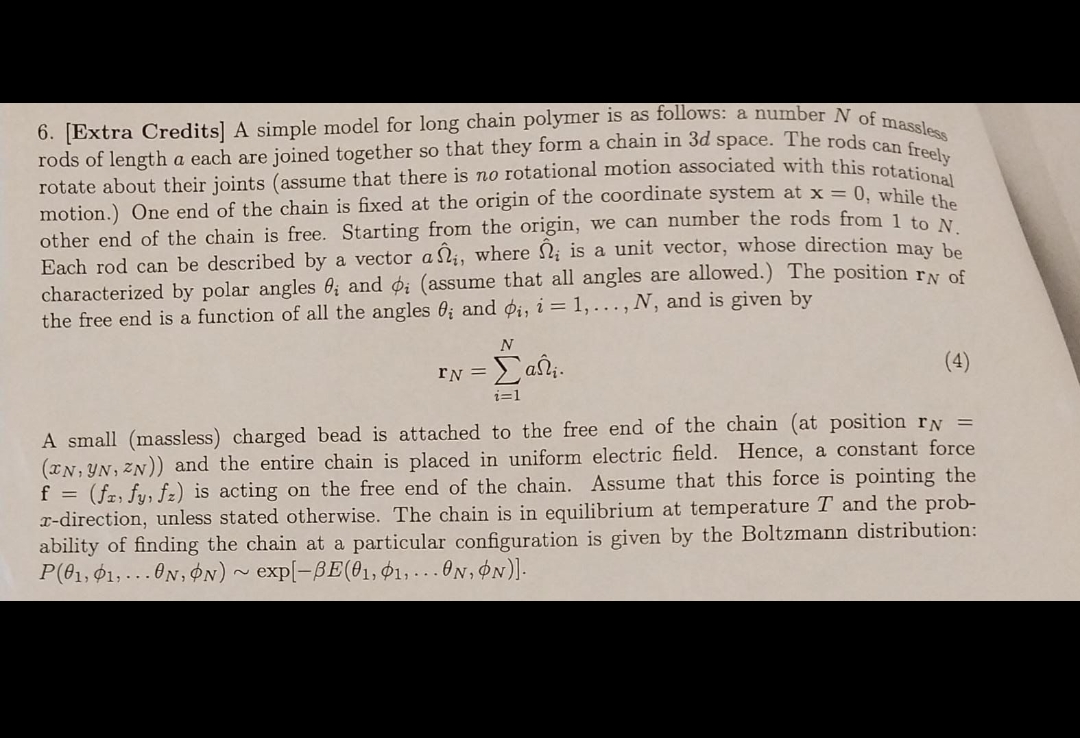
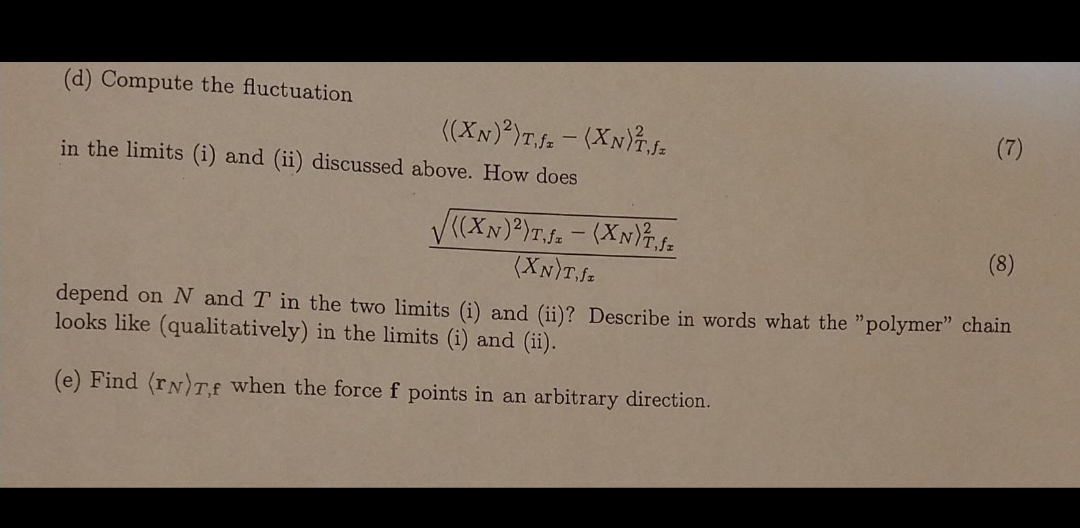
6. [Extra Credits] A simple model for long chain polymer is as follows: a number N of massless rods of length a each are joined together so that they form a chain in 3d space. The rods can freely rotate about their joints (assume that there is no rotational motion associated with this rotational motion.) One end of the chain is fixed at the origin of the coordinate system at x=0, while the other end of the chain is free. Starting from the origin, we can number the rods from 1 to N, Each rod can be described by a vector a^i, where ^i is a unit vector, whose direction may be characterized by polar angles i and i (assume that all angles are allowed.) The position rN of the free end is a function of all the angles i and i,i=1,,N, and is given by rN=i=1Na^i. A small (massless) charged bead is attached to the free end of the chain (at position rN= (xN,yN,zN)) and the entire chain is placed in uniform electric field. Hence, a constant force f=(fx,fy,fz) is acting on the free end of the chain. Assume that this force is pointing the x-direction, unless stated otherwise. The chain is in equilibrium at temperature T and the probability of finding the chain at a particular configuration is given by the Boltzmann distribution: P(1,1,N,N)exp[E(1,1,N,N)] (d) Compute the fluctuation in the limits (i) and (ii) discussed above. (XN)2T,fxXNT,fx2 (7) XNT,fx(XN)2T,fxXNT,fx2 depend on N and T in the two limits (i) and (ii)? Describe in words what the "polymer" chain looks like (qualitatively) in the limits (i) and (ii). (e) Find rNT,f when the force f points in an arbitrary direction. 6. [Extra Credits] A simple model for long chain polymer is as follows: a number N of massless rods of length a each are joined together so that they form a chain in 3d space. The rods can freely rotate about their joints (assume that there is no rotational motion associated with this rotational motion.) One end of the chain is fixed at the origin of the coordinate system at x=0, while the other end of the chain is free. Starting from the origin, we can number the rods from 1 to N, Each rod can be described by a vector a^i, where ^i is a unit vector, whose direction may be characterized by polar angles i and i (assume that all angles are allowed.) The position rN of the free end is a function of all the angles i and i,i=1,,N, and is given by rN=i=1Na^i. A small (massless) charged bead is attached to the free end of the chain (at position rN= (xN,yN,zN)) and the entire chain is placed in uniform electric field. Hence, a constant force f=(fx,fy,fz) is acting on the free end of the chain. Assume that this force is pointing the x-direction, unless stated otherwise. The chain is in equilibrium at temperature T and the probability of finding the chain at a particular configuration is given by the Boltzmann distribution: P(1,1,N,N)exp[E(1,1,N,N)] (d) Compute the fluctuation in the limits (i) and (ii) discussed above. (XN)2T,fxXNT,fx2 (7) XNT,fx(XN)2T,fxXNT,fx2 depend on N and T in the two limits (i) and (ii)? Describe in words what the "polymer" chain looks like (qualitatively) in the limits (i) and (ii). (e) Find rNT,f when the force f points in an arbitrary direction
Step by Step Solution
There are 3 Steps involved in it

Get step-by-step solutions from verified subject matter experts
 Study Help