







Question: I only need part c please Record No. 1 2 3 4 5 6 7 8 9 y -2.241 3.561 2.460 6.313 11.365 5.985 16.971
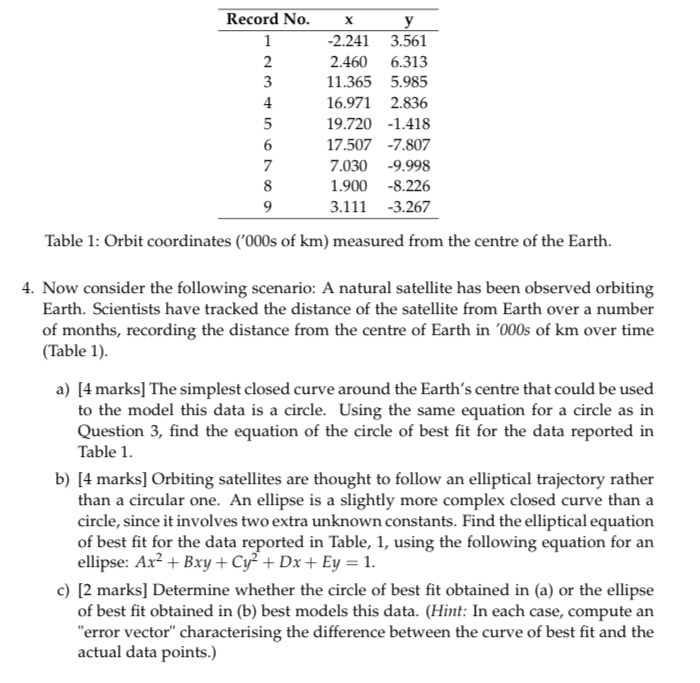
Record No. 1 2 3 4 5 6 7 8 9 y -2.241 3.561 2.460 6.313 11.365 5.985 16.971 2.836 19.720 -1.418 17.507 -7.807 7.030 -9.998 1.900 -8.226 3.111 -3.267 Table 1: Orbit coordinates ('000s of km) measured from the centre of the Earth. 4. Now consider the following scenario: A natural satellite has been observed orbiting Earth. Scientists have tracked the distance of the satellite from Earth over a number of months, recording the distance from the centre of Earth in '000s of km over time (Table 1). a) [4 marks] The simplest closed curve around the Earth's centre that could be used to the model this data is a circle. Using the same equation for a circle as in Question 3, find the equation of the circle of best fit for the data reported in Table 1. b) [4 marks] Orbiting satellites are thought to follow an elliptical trajectory rather than a circular one. An ellipse is a slightly more complex closed curve than a circle, since it involves two extra unknown constants. Find the elliptical equation of best fit for the data reported in Table, 1, using the following equation for an ellipse: Ax? + Bxy + Cy2 +Dx + Ey = 1. c) [2 marks] Determine whether the circle of best fit obtained in (a) or the ellipse of best fit obtained in (b) best models this data. (Hint: In each case, compute an "error vector" characterising the difference between the curve of best fit and the actual data points.) Record No. 1 2 3 4 5 6 7 8 9 y -2.241 3.561 2.460 6.313 11.365 5.985 16.971 2.836 19.720 -1.418 17.507 -7.807 7.030 -9.998 1.900 -8.226 3.111 -3.267 Table 1: Orbit coordinates ('000s of km) measured from the centre of the Earth. 4. Now consider the following scenario: A natural satellite has been observed orbiting Earth. Scientists have tracked the distance of the satellite from Earth over a number of months, recording the distance from the centre of Earth in '000s of km over time (Table 1). a) [4 marks] The simplest closed curve around the Earth's centre that could be used to the model this data is a circle. Using the same equation for a circle as in Question 3, find the equation of the circle of best fit for the data reported in Table 1. b) [4 marks] Orbiting satellites are thought to follow an elliptical trajectory rather than a circular one. An ellipse is a slightly more complex closed curve than a circle, since it involves two extra unknown constants. Find the elliptical equation of best fit for the data reported in Table, 1, using the following equation for an ellipse: Ax? + Bxy + Cy2 +Dx + Ey = 1. c) [2 marks] Determine whether the circle of best fit obtained in (a) or the ellipse of best fit obtained in (b) best models this data. (Hint: In each case, compute an "error vector" characterising the difference between the curve of best fit and the actual data points.)
Step by Step Solution
There are 3 Steps involved in it

Get step-by-step solutions from verified subject matter experts
 Study Help