







Question: I only need the answer for part ( b & C ). I don't need the answer for part (a) 2. a) Explain how a
I only need the answer for part ( b & C ).
I don't need the answer for part (a)
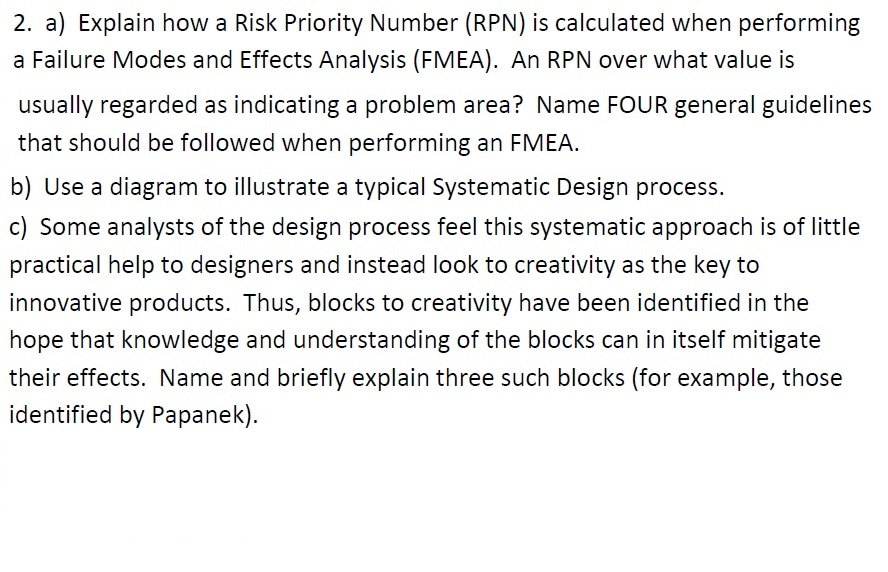
2. a) Explain how a Risk Priority Number (RPN) is calculated when performing a Failure Modes and Effects Analysis (FMEA). An RPN over what value is usually regarded as indicating a problem area? Name FOUR general guidelines that should be followed when performing an FMEA. b) Use a diagram to illustrate a typical Systematic Design process. c) Some analysts of the design process feel this systematic approach is of little practical help to designers and instead look to creativity as the key to innovative products. Thus, blocks to creativity have been identified in the hope that knowledge and understanding of the blocks can in itself mitigate their effects. Name and briefly explain three such blocks (for example, those identified by Papanek). 2. a) Explain how a Risk Priority Number (RPN) is calculated when performing a Failure Modes and Effects Analysis (FMEA). An RPN over what value is usually regarded as indicating a problem area? Name FOUR general guidelines that should be followed when performing an FMEA. b) Use a diagram to illustrate a typical Systematic Design process. c) Some analysts of the design process feel this systematic approach is of little practical help to designers and instead look to creativity as the key to innovative products. Thus, blocks to creativity have been identified in the hope that knowledge and understanding of the blocks can in itself mitigate their effects. Name and briefly explain three such blocks (for example, those identified by Papanek)
Step by Step Solution
There are 3 Steps involved in it

Get step-by-step solutions from verified subject matter experts
 Study Help