







Question: i Preview File Edit View Go Tools Window Help '. MonNoin 9:12PM v Arnold Chapter 15 Class Activity Questions.pdf . O . E Page 4
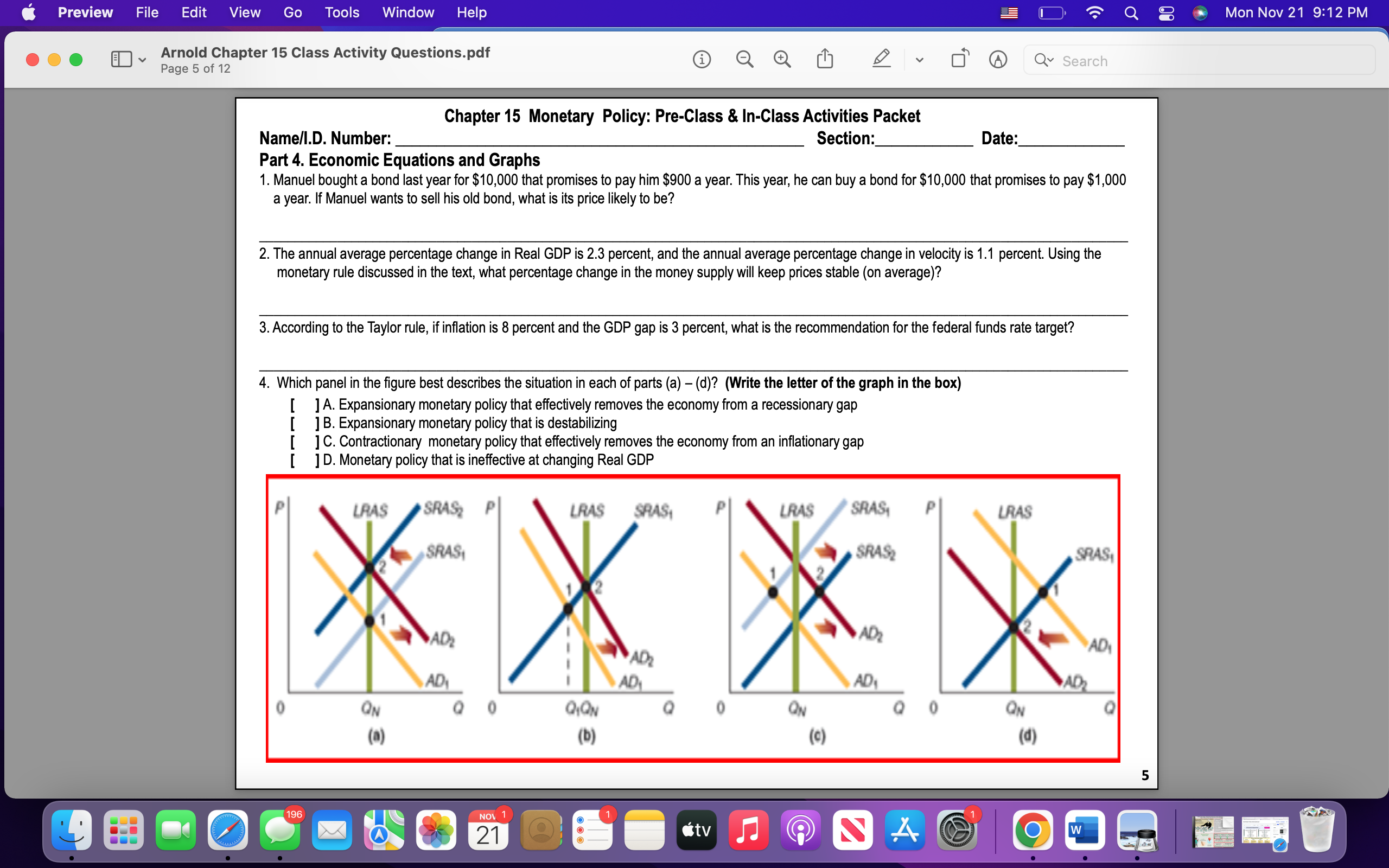
i Preview File Edit View Go Tools Window Help '. MonNoin 9:12PM v Arnold Chapter 15 Class Activity Questions.pdf . O . E Page 4 of 12 Chapter 15 Monetary Policy: Pre-Class & ln-Class Activities Packet Name/LD. Number: Section: Date: Part 3. Discussion Questions and Problems 1. Why is the demand curve for money downward sloping? 2. Explain how the Keynesian transmission mechanism works. 3. Explain how the monetarist transmission mechanism works. 4. Argue the case for and against a monetary rule. 5. How does ination targeting work? 6. According to market monetarists, what problems might arise from a sharp decline in Nominal GDP? 7. What are the differences between Activist and Non-Activist (Rule-Based) monetary policy? 8. The Keynesian transmission mechanism allows the link between the money market and the goods and services market unless this link is broken because of the following reasons: 9. The Taylor rule is a considered to be a middle ground between Activist and Non-Activists. Specify this rule: 10. What is Liquidity Trap? QQ'E'I'SMO i Preview File Edit View Go Tools Window Help ', MonNoin 9:12PM v Arnold Chapter 15 Class Activity Questions.pdf . O . E Page 5 of 12 Chapter 15 Monetary Policy: Pre-Class & ln-Class Activities Packet Name/LD. Number: Section: Date: Part 4. Economic Equations and Graphs 1. Manuel bought a bond last year for $10,000 that promises to pay him $900 a year. This year, he can buy a bond for $10,000 that promises to pay $1,000 a year. If Manuel wants to sell his old bond, what is its price likely to be? 2. The annual average percentage change in Real GDP is 2.3 percent, and the annual average peroentage change in velocity is 1.1 percent. Using the monetary rule discussed in the text, what percentage change in the money supply will keep prices stable (on average)? 3. According to the Taylor rule, if ination is 8 percent and the GDP gap is 3 percent, what is the recommendation for the federal funds rate target? 4. Which panel in the gure best describes the situation in each of parts (a) (d)? (Write the letter of the graph in the box) [ ] A. Expansionary monetary policy that effectively removes the economy from a recessionary gap B. Expansionary monetary policy that is destabilizing [ [ ] C. Contractionary monetary policy that effectively removes the economy from an inationary gap [ ] D. Monetary policy that is ineffective at changing Real GDP gag-W l.io'th1 @'J'ji
Step by Step Solution
There are 3 Steps involved in it

Get step-by-step solutions from verified subject matter experts
 Study Help