







Question: I Question 1: 1. Consider a consumer with the utility function u(x1,x2)=ln(x1)+x2 and the budget constraint p1x1+p2x2=m. Suppose good 1 represents coffee and good 2
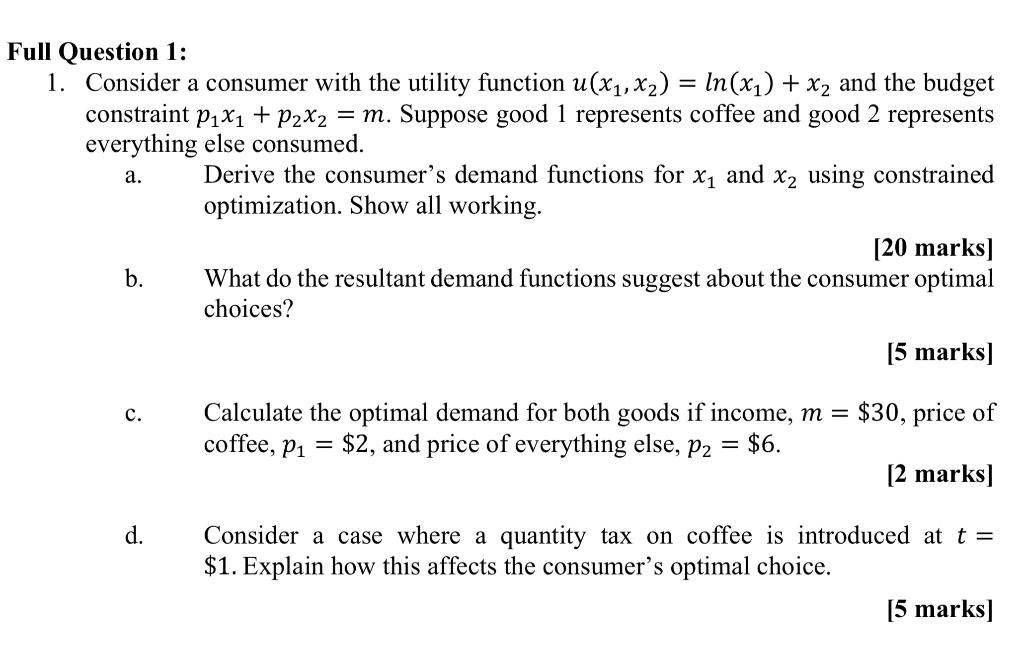
I Question 1: 1. Consider a consumer with the utility function u(x1,x2)=ln(x1)+x2 and the budget constraint p1x1+p2x2=m. Suppose good 1 represents coffee and good 2 represents everything else consumed. a. Derive the consumer's demand functions for x1 and x2 using constrained optimization. Show all working. [20 marks] b. What do the resultant demand functions suggest about the consumer optimal choices? [5 marks] c. Calculate the optimal demand for both goods if income, m=$30, price of coffee, p1=$2, and price of everything else, p2=$6. [2 marks] d. Consider a case where a quantity tax on coffee is introduced at t= $1. Explain how this affects the consumer's optimal choice. [5 marks] I Question 1: 1. Consider a consumer with the utility function u(x1,x2)=ln(x1)+x2 and the budget constraint p1x1+p2x2=m. Suppose good 1 represents coffee and good 2 represents everything else consumed. a. Derive the consumer's demand functions for x1 and x2 using constrained optimization. Show all working. [20 marks] b. What do the resultant demand functions suggest about the consumer optimal choices? [5 marks] c. Calculate the optimal demand for both goods if income, m=$30, price of coffee, p1=$2, and price of everything else, p2=$6. [2 marks] d. Consider a case where a quantity tax on coffee is introduced at t= $1. Explain how this affects the consumer's optimal choice. [5 marks]
Step by Step Solution
There are 3 Steps involved in it

Get step-by-step solutions from verified subject matter experts
 Study Help