







Question: I really need help and guidaince with the java code! please help Here is training data 5.0,3.0,1.6,0.2,Iris-setosa 5.0,3.4,1.6,0.4,Iris-setosa 5.2,3.5,1.5,0.2,Iris-setosa 5.2,3.4,1.4,0.2,Iris-setosa 4.7,3.2,1.6,0.2,Iris-setosa 4.8,3.1,1.6,0.2,Iris-setosa 5.4,3.4,1.5,0.4,Iris-setosa 5.2,4.1,1.5,0.1,Iris-setosa 5.5,4.2,1.4,0.2,Iris-setosa
I really need help and guidaince with the java code! please help
Here is training data
5.0,3.0,1.6,0.2,Iris-setosa 5.0,3.4,1.6,0.4,Iris-setosa 5.2,3.5,1.5,0.2,Iris-setosa 5.2,3.4,1.4,0.2,Iris-setosa 4.7,3.2,1.6,0.2,Iris-setosa 4.8,3.1,1.6,0.2,Iris-setosa 5.4,3.4,1.5,0.4,Iris-setosa 5.2,4.1,1.5,0.1,Iris-setosa 5.5,4.2,1.4,0.2,Iris-setosa 4.9,3.1,1.5,0.1,Iris-setosa 5.0,3.2,1.2,0.2,Iris-setosa 5.5,3.5,1.3,0.2,Iris-setosa 4.9,3.1,1.5,0.1,Iris-setosa 4.4,3.0,1.3,0.2,Iris-setosa 5.1,3.4,1.5,0.2,Iris-setosa 5.0,3.5,1.3,0.3,Iris-setosa 4.5,2.3,1.3,0.3,Iris-setosa 4.4,3.2,1.3,0.2,Iris-setosa 5.0,3.5,1.6,0.6,Iris-setosa 5.1,3.8,1.9,0.4,Iris-setosa 4.8,3.0,1.4,0.3,Iris-setosa 5.1,3.8,1.6,0.2,Iris-setosa 4.6,3.2,1.4,0.2,Iris-setosa 5.3,3.7,1.5,0.2,Iris-setosa 5.0,3.3,1.4,0.2,Iris-setosa 6.6,3.0,4.4,1.4,Iris-versicolor 6.8,2.8,4.8,1.4,Iris-versicolor 6.7,3.0,5.0,1.7,Iris-versicolor 6.0,2.9,4.5,1.5,Iris-versicolor 5.7,2.6,3.5,1.0,Iris-versicolor 5.5,2.4,3.8,1.1,Iris-versicolor 5.5,2.4,3.7,1.0,Iris-versicolor 5.8,2.7,3.9,1.2,Iris-versicolor 6.0,2.7,5.1,1.6,Iris-versicolor 5.4,3.0,4.5,1.5,Iris-versicolor 6.0,3.4,4.5,1.6,Iris-versicolor 6.7,3.1,4.7,1.5,Iris-versicolor 6.3,2.3,4.4,1.3,Iris-versicolor 5.6,3.0,4.1,1.3,Iris-versicolor 5.5,2.5,4.0,1.3,Iris-versicolor 5.5,2.6,4.4,1.2,Iris-versicolor 6.1,3.0,4.6,1.4,Iris-versicolor 5.8,2.6,4.0,1.2,Iris-versicolor 5.0,2.3,3.3,1.0,Iris-versicolor 5.6,2.7,4.2,1.3,Iris-versicolor 5.7,3.0,4.2,1.2,Iris-versicolor 5.7,2.9,4.2,1.3,Iris-versicolor 6.2,2.9,4.3,1.3,Iris-versicolor 5.1,2.5,3.0,1.1,Iris-versicolor 5.7,2.8,4.1,1.3,Iris-versicolor 7.2,3.2,6.0,1.8,Iris-virginica 6.2,2.8,4.8,1.8,Iris-virginica 6.1,3.0,4.9,1.8,Iris-virginica 6.4,2.8,5.6,2.1,Iris-virginica 7.2,3.0,5.8,1.6,Iris-virginica 7.4,2.8,6.1,1.9,Iris-virginica 7.9,3.8,6.4,2.0,Iris-virginica 6.4,2.8,5.6,2.2,Iris-virginica 6.3,2.8,5.1,1.5,Iris-virginica 6.1,2.6,5.6,1.4,Iris-virginica 7.7,3.0,6.1,2.3,Iris-virginica 6.3,3.4,5.6,2.4,Iris-virginica 6.4,3.1,5.5,1.8,Iris-virginica 6.0,3.0,4.8,1.8,Iris-virginica 6.9,3.1,5.4,2.1,Iris-virginica 6.7,3.1,5.6,2.4,Iris-virginica 6.9,3.1,5.1,2.3,Iris-virginica 5.8,2.7,5.1,1.9,Iris-virginica 6.8,3.2,5.9,2.3,Iris-virginica 6.7,3.3,5.7,2.5,Iris-virginica 6.7,3.0,5.2,2.3,Iris-virginica 6.3,2.5,5.0,1.9,Iris-virginica 6.5,3.0,5.2,2.0,Iris-virginica 6.2,3.4,5.4,2.3,Iris-virginica 5.9,3.0,5.1,1.8,Iris-virginica
Now this is the iris testing data
5.1,3.5,1.4,0.2,Iris-setosa 4.9,3.0,1.4,0.2,Iris-setosa 4.7,3.2,1.3,0.2,Iris-setosa 4.6,3.1,1.5,0.2,Iris-setosa 5.0,3.6,1.4,0.2,Iris-setosa 5.4,3.9,1.7,0.4,Iris-setosa 4.6,3.4,1.4,0.3,Iris-setosa 5.0,3.4,1.5,0.2,Iris-setosa 4.4,2.9,1.4,0.2,Iris-setosa 4.9,3.1,1.5,0.1,Iris-setosa 5.4,3.7,1.5,0.2,Iris-setosa 4.8,3.4,1.6,0.2,Iris-setosa 4.8,3.0,1.4,0.1,Iris-setosa 4.3,3.0,1.1,0.1,Iris-setosa 5.8,4.0,1.2,0.2,Iris-setosa 5.7,4.4,1.5,0.4,Iris-setosa 5.4,3.9,1.3,0.4,Iris-setosa 5.1,3.5,1.4,0.3,Iris-setosa 5.7,3.8,1.7,0.3,Iris-setosa 5.1,3.8,1.5,0.3,Iris-setosa 5.4,3.4,1.7,0.2,Iris-setosa 5.1,3.7,1.5,0.4,Iris-setosa 4.6,3.6,1.0,0.2,Iris-setosa 5.1,3.3,1.7,0.5,Iris-setosa 4.8,3.4,1.9,0.2,Iris-setosa 7.0,3.2,4.7,1.4,Iris-versicolor 6.4,3.2,4.5,1.5,Iris-versicolor 6.9,3.1,4.9,1.5,Iris-versicolor 5.5,2.3,4.0,1.3,Iris-versicolor 6.5,2.8,4.6,1.5,Iris-versicolor 5.7,2.8,4.5,1.3,Iris-versicolor 6.3,3.3,4.7,1.6,Iris-versicolor 4.9,2.4,3.3,1.0,Iris-versicolor 6.6,2.9,4.6,1.3,Iris-versicolor 5.2,2.7,3.9,1.4,Iris-versicolor 5.0,2.0,3.5,1.0,Iris-versicolor 5.9,3.0,4.2,1.5,Iris-versicolor 6.0,2.2,4.0,1.0,Iris-versicolor 6.1,2.9,4.7,1.4,Iris-versicolor 5.6,2.9,3.6,1.3,Iris-versicolor 6.7,3.1,4.4,1.4,Iris-versicolor 5.6,3.0,4.5,1.5,Iris-versicolor 5.8,2.7,4.1,1.0,Iris-versicolor 6.2,2.2,4.5,1.5,Iris-versicolor 5.6,2.5,3.9,1.1,Iris-versicolor 5.9,3.2,4.8,1.8,Iris-versicolor 6.1,2.8,4.0,1.3,Iris-versicolor 6.3,2.5,4.9,1.5,Iris-versicolor 6.1,2.8,4.7,1.2,Iris-versicolor 6.4,2.9,4.3,1.3,Iris-versicolor 6.3,3.3,6.0,2.5,Iris-virginica 5.8,2.7,5.1,1.9,Iris-virginica 7.1,3.0,5.9,2.1,Iris-virginica 6.3,2.9,5.6,1.8,Iris-virginica 6.5,3.0,5.8,2.2,Iris-virginica 7.6,3.0,6.6,2.1,Iris-virginica 4.9,2.5,4.5,1.7,Iris-virginica 7.3,2.9,6.3,1.8,Iris-virginica 6.7,2.5,5.8,1.8,Iris-virginica 7.2,3.6,6.1,2.5,Iris-virginica 6.5,3.2,5.1,2.0,Iris-virginica 6.4,2.7,5.3,1.9,Iris-virginica 6.8,3.0,5.5,2.1,Iris-virginica 5.7,2.5,5.0,2.0,Iris-virginica 5.8,2.8,5.1,2.4,Iris-virginica 6.4,3.2,5.3,2.3,Iris-virginica 6.5,3.0,5.5,1.8,Iris-virginica 7.7,3.8,6.7,2.2,Iris-virginica 7.7,2.6,6.9,2.3,Iris-virginica 6.0,2.2,5.0,1.5,Iris-virginica 6.9,3.2,5.7,2.3,Iris-virginica 5.6,2.8,4.9,2.0,Iris-virginica 7.7,2.8,6.7,2.0,Iris-virginica 6.3,2.7,4.9,1.8,Iris-virginica 6.7,3.3,5.7,2.1,Iris-virginica
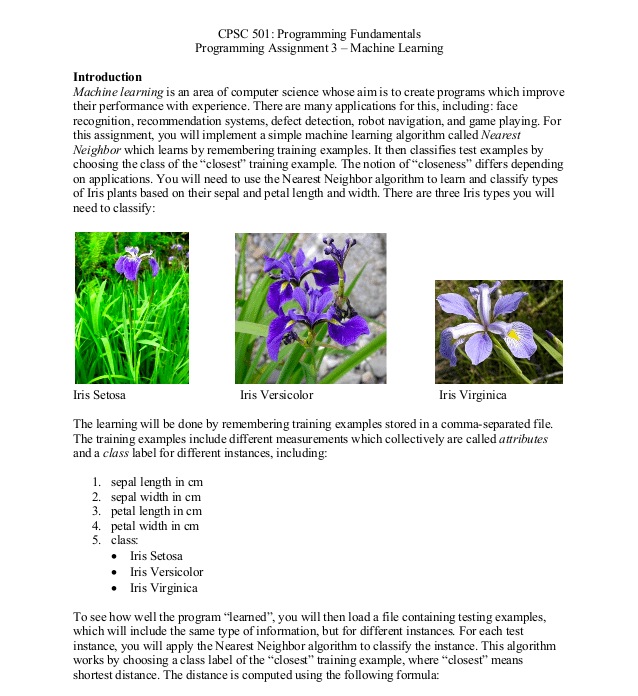
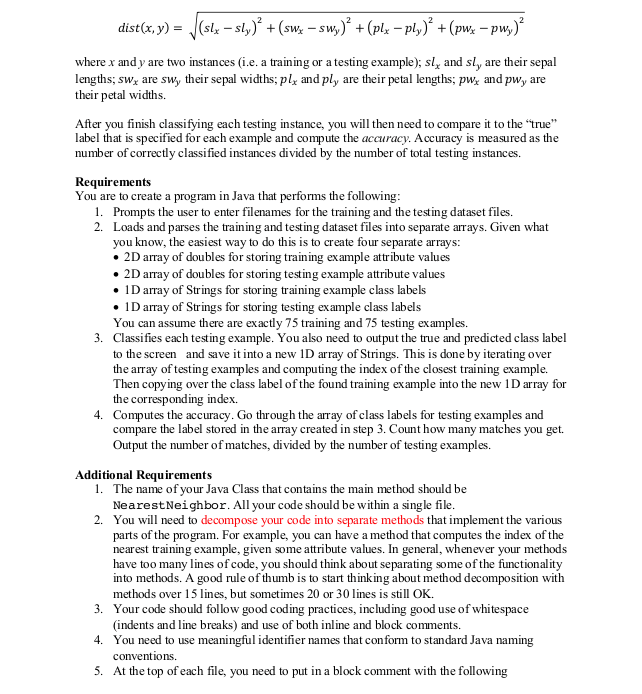
CPSC 501: Programming Fundamentals Programming Assignment 3-Machine Learning Introduction Machine learning is an area of computer science whose aim is to create programs which improve their performance with experience. There are many applications for this, including: face recognition, recommendation systems, defect detection, robot navigation, and game playing. For this assignment, you will implement a simple machine learning algorithm called Nearest Neighbor which learns by remembering training examples. It then classifies test examples by choosing the class of the "closest" on applications. You will need to use the Nearest Neighbor algorithm to leam and classify types of Iris plants based on their sepal and petal length and width. There are three Iris types you will need to classify: training example. The notion of closeness" differs depending Iris Setosa Iris Versicolor Iris Virginica The learning will be done by remembering training examples stored in a comma-separated file. The training examples include different measurements which collectively are called attributes and a class label for different instances, including: l. sepal length in cm 2. sepal width in cm 3. petal length in cm 4. petal width in cm 5. class: Iris Setosa Iris Versicolor Iris Virginica To see how well the program "learned", you will then load a file containing testing examples, which will include the same type of information, but for different instances. For each test instance, you will apply the Nearest Neighbor algorithm to classify the instance. This algorithnm works by choosing a class label of the "closest" training example, where "closes?" means shortest distance. The distance is computed using the following formula: CPSC 501: Programming Fundamentals Programming Assignment 3-Machine Learning Introduction Machine learning is an area of computer science whose aim is to create programs which improve their performance with experience. There are many applications for this, including: face recognition, recommendation systems, defect detection, robot navigation, and game playing. For this assignment, you will implement a simple machine learning algorithm called Nearest Neighbor which learns by remembering training examples. It then classifies test examples by choosing the class of the "closest" on applications. You will need to use the Nearest Neighbor algorithm to leam and classify types of Iris plants based on their sepal and petal length and width. There are three Iris types you will need to classify: training example. The notion of closeness" differs depending Iris Setosa Iris Versicolor Iris Virginica The learning will be done by remembering training examples stored in a comma-separated file. The training examples include different measurements which collectively are called attributes and a class label for different instances, including: l. sepal length in cm 2. sepal width in cm 3. petal length in cm 4. petal width in cm 5. class: Iris Setosa Iris Versicolor Iris Virginica To see how well the program "learned", you will then load a file containing testing examples, which will include the same type of information, but for different instances. For each test instance, you will apply the Nearest Neighbor algorithm to classify the instance. This algorithnm works by choosing a class label of the "closest" training example, where "closes?" means shortest distance. The distance is computed using the following formula
Step by Step Solution
There are 3 Steps involved in it

Get step-by-step solutions from verified subject matter experts
 Study Help