







Question: I really need help solving a -e for question 2 which references the equation in question 1. So I included both problems. Thanks! Demand relationships
I really need help solving a -e for question 2 which references the equation in question 1. So I included both problems. Thanks!
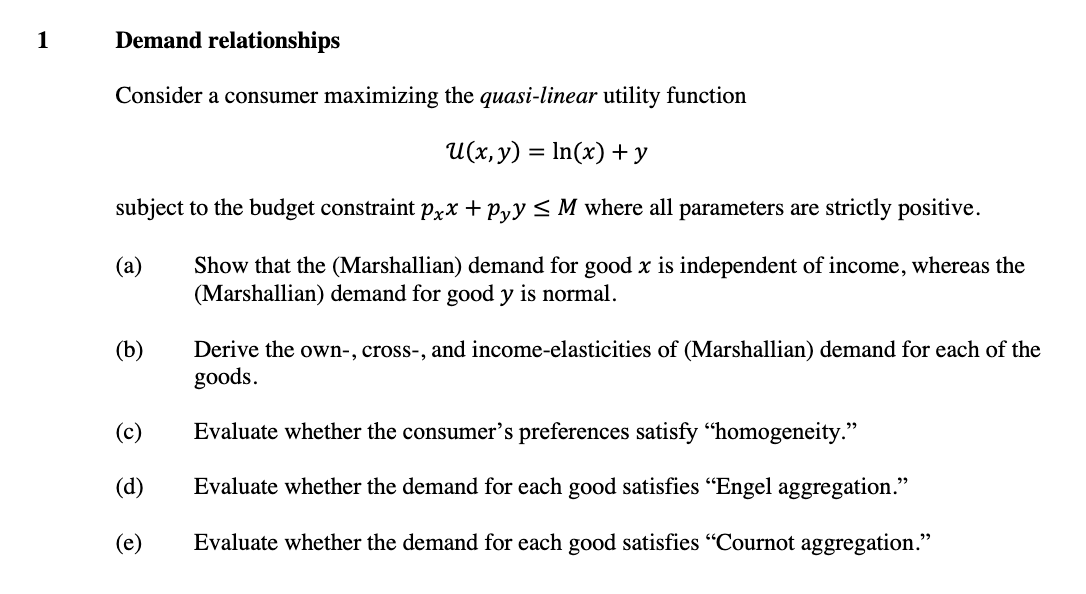
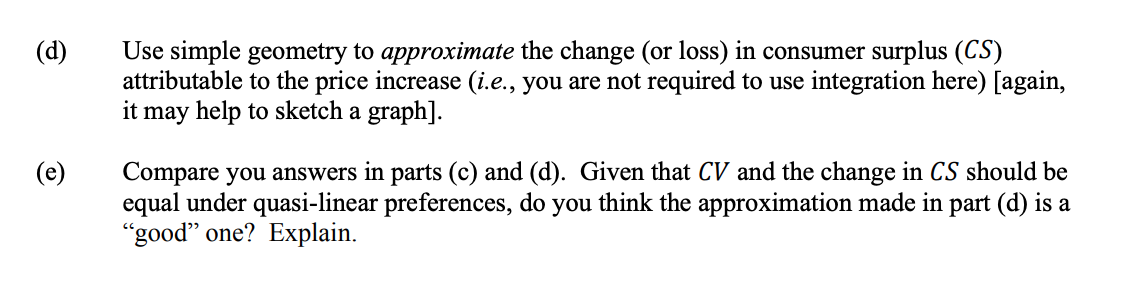
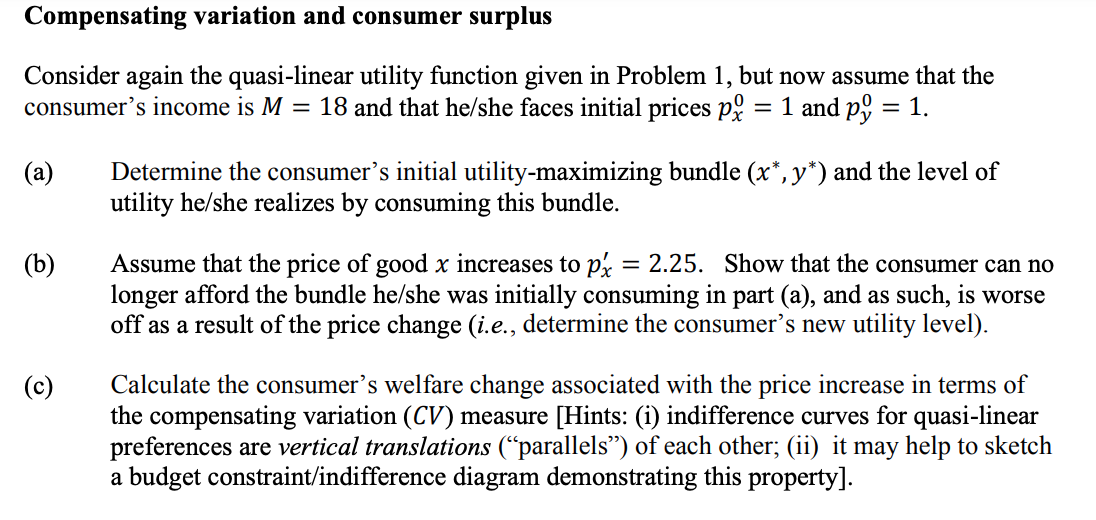
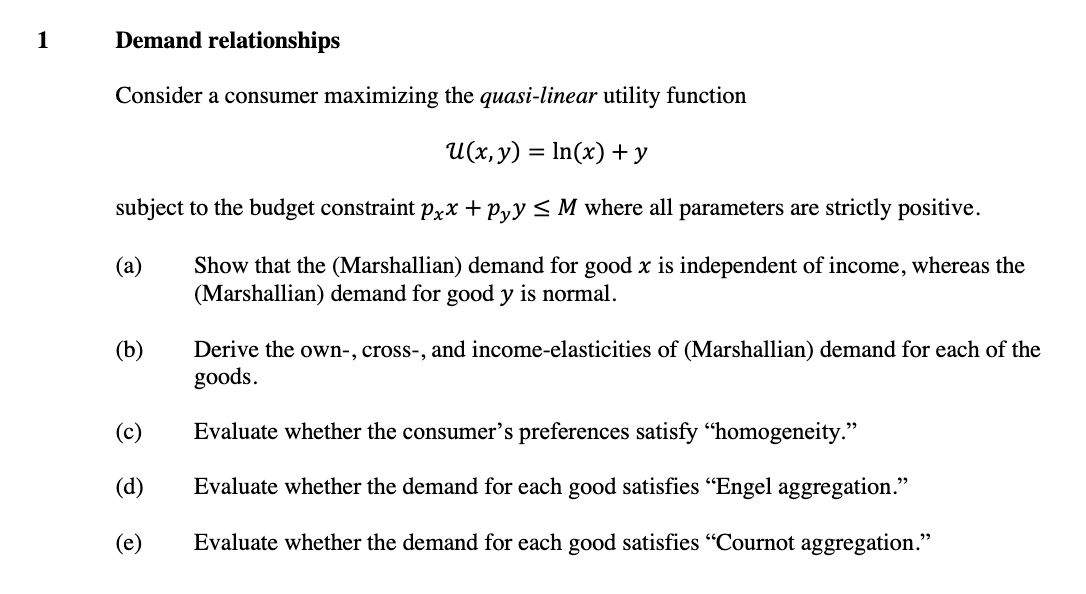
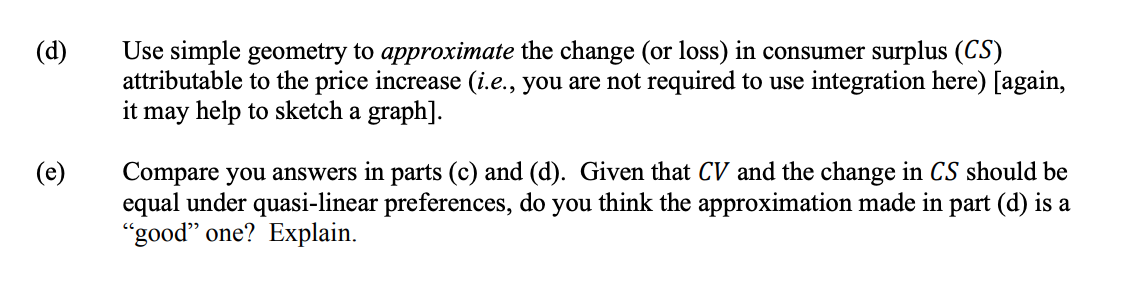
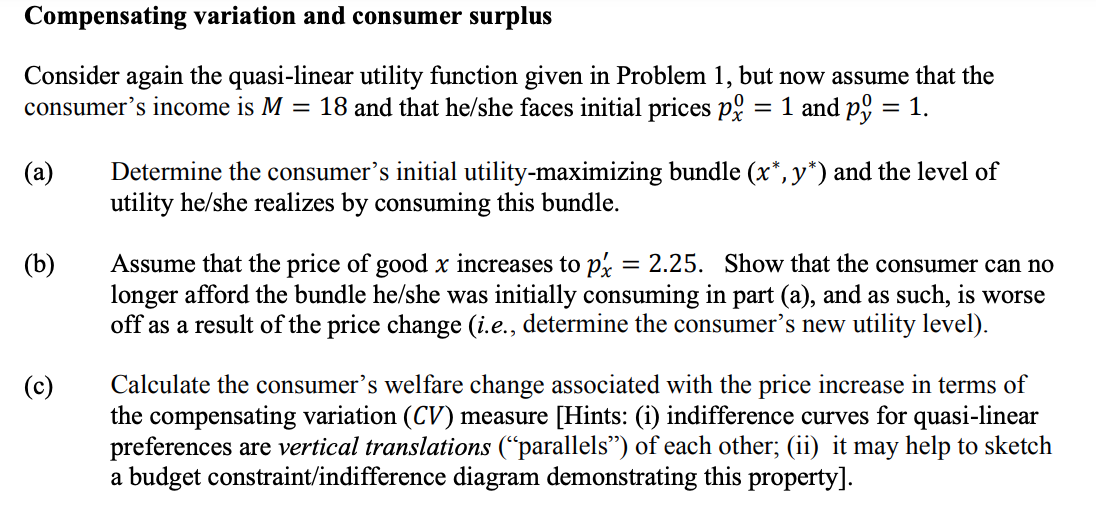
Demand relationships Consider a consumer maximizing the quasi-linear utility function u(x, y) = In(x) +y subject to the budget constraint pxx + pyy - M where all parameters are strictly positive. (a) Show that the (Marshallian) demand for good x is independent of income, whereas the (Marshallian) demand for good y is normal. (b ) Derive the own-, cross-, and income-elasticities of (Marshallian) demand for each of the goods. (c) Evaluate whether the consumer's preferences satisfy "homogeneity." (d) Evaluate whether the demand for each good satisfies "Engel aggregation." (e) Evaluate whether the demand for each good satisfies "Cournot aggregation."((0 Use simple geometry to approximate the change (or loss) in consumer surplus (CS) attributable to the price increase (123., you are not required to use integration here) [again, it may help to sketch a graph]. Compare you answers in parts (c) and (d). Given that CV and the change in C 5 should be equal under quasi-linear preferences, do you think the approximation made in part ((1) is a \"good\" one? Explain. Compensating variation and consumer surplus Consider again the quasi-linear utility function given in Problem 1, but now assume that the consumer's income is M = 18 and that he/she faces initial prices px = 1 and p3, = . (a) Determine the consumer's initial utilitymaximizing bundle (x*, 37*) and the level of utility he/she realizes by consuming this bundle. (b) Assume that the price of good x increases to p; = 2.25. Show that the consumer can no longer afford the bundle he/she was initially consuming in part (a), and as such, is worse off as a result of the price change (i.e., determine the consumer's new utility level). (c) Calculate the consumer's welfare change associated with the price increase in terms of the compensating variation (CV) measure [I-Iints: (i) indifference curves for quasi-linear preferences are vertical translations (\"parallels\") of each other; (ii) it may help to sketch a budget constraint/indifference diagram demonstrating this property]
Step by Step Solution
There are 3 Steps involved in it

Get step-by-step solutions from verified subject matter experts
 Study Help