







Question: I really need help with Simil thank you Submission: Submit the following files. One file for the Simio model: YourName _ HW 3 . spfx
I really need help with Simil thank you Submission: Submit the following files.
One file for the Simio model: YourNameHWspfx This file will have the Simio model and the experiment. Problems and will be in the Simio file.
One file for the report in word for Problem YourNameHWdocx or doc The answer will be based on your Simio model and queueing analyses. If you answer the bonus question, its answer will be in the word file as well.
Credit: points out of the points that can be collected.
Note: This is an individual assignment.
REFER TO THE Homework Report Format for reporting your answers.
DO NOT FORGET to name your files as noted at the top.
Consider the Jackson Network below.
There are three service stations. Each station has servers and the service rate at each station for any server is hour. The numbers on the arcs represent the selection probabilities, which are other arcs have probability
Now, you have the option to add one server to one of the stations. In this assignment, you will use Simio and design an experimentation to decide which station will get the additional server based on the average number of customers in the whole system ie estimation of where denotes the average number of customers in the stationi Basically, we want to answer: "Should station or station or station get the additional server if we want to reduce average number of customers in the network?"
Problem points: Create a Simio model for the above Jackson network. Do not forget to submit the Simio file in your submission. Use a single Model Entity and name the model entity as 'Customer', and the service objects as 'Station 'Station and 'Station and sink objects as 'Exitfrom and 'Exitfrom Use connectors for the links ie do not use paths and be careful with using connectors from exitport of a server object to entryport of a server object. Your 'Exitfrom sink should be for the exit from Station and 'Exitfrom sink should be for the exit from Station NOTE: In defining interarrival and processing time distributions, use minutes as the time unit.
Problem points: Design an experimentation in the same Simio file under the model created in problem to compare the following four scenarios denotes the number of servers in station i:
Scenario The current situation:
Scenario Station gets an additional server:
Scenario Station gets an additional server:
Scenario Station gets an additional server:
As noted previously, you are asked to compare these four scenarios based on one response, which is the average number of customers in the network.
To compare these scenarios based on the specified response, run replications for each scenario, such that each replication has hours warmup and hours actual run time.
Note: you will need to add Reference properties to be able to define different scenarios. Name your
Dashboard
Calendar
To Do
Notifications
Inbox
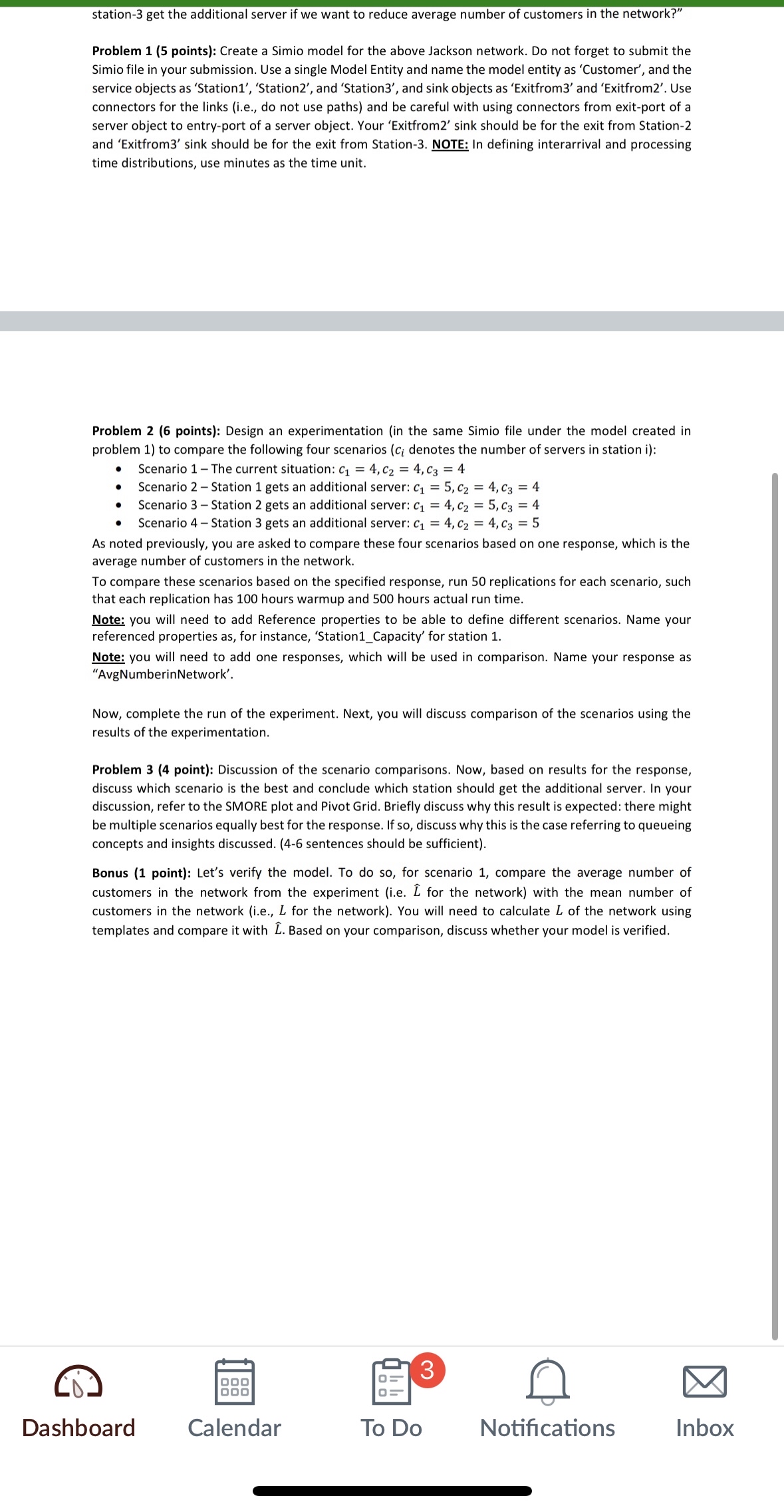
station get the additional server if we want to reduce average number of customers in the network?"
Problem points: Create a Simio model for the above Jackson network. Do not forget to submit the Simio file in your submission. Use a single Model Entity and name the model entity as 'Customer', and the service objects as 'Station 'Station and 'Station and sink objects as 'Exitfrom and 'Exitfrom Use connectors for the links ie do not use paths and be careful with using connectors from exitport of a server object to entryport of a server object. Your 'Exitfrom sink should be for the exit from Station and 'Exitfrom sink should be for the exit from Station NOTE: In defining interarrival and processing time distributions, use minutes as the time unit.
Problem points: Design an experimentation in the same Simio file under the model created in problem to compare the following four scenarios denotes the number of servers in station i:
Scenario The current situation:
Scenario Station gets an additional server:
Scenario Station gets an additional server:
Scenario Station gets an additional server:
As noted previously, you are asked to compare these four scenarios based on one response, which is the average number of customers in the network.
To compare these scenarios based on the specified response, run replications for ea
Step by Step Solution
There are 3 Steps involved in it
1 Expert Approved Answer
Step: 1 Unlock

Question Has Been Solved by an Expert!
Get step-by-step solutions from verified subject matter experts
Step: 2 Unlock
Step: 3 Unlock
 Study Help