







Question: I .REQUIREMENTS 1 You will use the data under each case to construct your own story . You will insert your own assumptions according to
I .REQUIREMENTS
1 You will use the data under each case to construct your own story . You will insert your
own assumptions according to the requirements under each case. You will consider the
needs of parties ( in terms of protection & finance) who is willing to make this trade
successfully. You will suggest 2 trade finance (TF) alternatives/ solutions for each case.
You will write & explain all these 3 cases. ( Pls. see Section III )
2 You are expected to explain in written all the assumptions , estimations you used and
trade finance alternatives /solutions for each case . ( Use explanations , drawings to
explain in detail. )
Each study that includes the explanations, drawings and TF solutions/alternatives
should be unique .
3 You will create a 2-3 paragraph story in written ( minicase to be written by you ) that
explains the trade transaction between the parties. It should contain all the key
sentences that explains every pieces of the trade transactions including the trade
finance solution ( add only 1 TF solution into your story ) In order to create this , you
should have done the first part of the study.
Each case (story) designed by the student should be unique.
4 The assignment will be delivered in written and will be verbally explained as well.
You will record a video and save it as a file for each case . ( for 3 cases seperately)
5 It will be acceptable only if the written part is in your own handwriting ( all explanations
and drawings etc.)
The typed explanations/drawings will not be accepted .
6 Pls. do not copy and paste the explanations and /or figures from a book or a web site
while you are preparing the answers . This will not be accepted. Pls use your own
sentences .
Introduce the story you have created ; the transactions, the parties , the trade cycle ,
which payment terms you have chosen in each transaction in every trade business
referring to data given , which other instruments you have used and why . How do
they support the parties as per the requirements of the parties ( protection and / or
finance) Explain how does it work ? (You should mention all specific details)
8 Your papers and your video files will be loaded into itslearning system under
Assignments , under the file title Final .
9 Pls watch the deadline. No submissions will be accepted after the deadline .
Important Note :
The lecturer has a right to ask some additional verbal explanations from the students after
the submission of the assignments. It is under the discreation of the lecturer. This would be
conducted through teams and will be recorded.
II. GRADING
Pls. refer to the rubric attached to understand how the evaluation is to be made.
III .REQUEST FOR EACH CASE :
You will create a case story ( a scenario) yourself according to the data given for each case .
A) Construction of the case ( analysis and the evaluation of the data )
First , use the data to construct the trade transactions between the parties . Use your
assumptions by using the data given under each case. Explain who are the parties in
this trade , where are they located , the trade cycle you have created and why you
have created in this way . Which payment terms you have chosen ( consider in each
trade business in each case , there are 2 seperate trade transactions ) Why did you
choose them based on data given under each case ? How do they help the parties ( both
exporters and importers ) ? How would it work ? Pros and cons of using these payment
terms you have chosen. Which other financial instruments would help the parties to
trade effectively as per their requirements in each transaction in every case ? How woud
these instrument work ? The trade finance instruments you have chosen must match
the requirements of the parties.
Pls . see that there are 2 seperate trade transactions in each trade business in all 3
cases.
2 TF solutions/alternatives are required for each case. ( pls see the data under each
case )
TF solutions / alternatives : The instruments ( provided through the banks or through
nonbank financial institutions ) that help the parties to make secure trade and helps the
parties to obtain finance whenever is needed by them .
-Pls. add your explanations , drawings , estimations in full
(Explain and draw)
-Pls . use the appropriate trade finance terminology in your explanations and in your
drawings .
B) Construct a 2-3 paragraph story for each case .
That should be based on all your assumptions , analysis and evaluation made in A part
for each case.
Make it a full story that contains the main elements in the trade business . It should
define the trade transactions between the parties and trade finance solution /
alternative you have chosen . You should be able to express yourself in written how
these instruments match the needs of the parties in this trade . ( Pls . integrate into
your story only 1 TF solution/alternative in B part )
It should include all pieces of information that is essential to make one full story .
-Pls refer to rubric to understand how the lecturer will evaluate your assignment .
C) Verbal explanation of the case stories.
You will explain your case story in a video file for each case . ( Use the same story you
have created in part B )
Reading from the text will not be graded .
You are expected to use your own sentences .
The trade finance solution / alternative ( pls see above B ) should be mentioned
/explained in full by matching the requirements of the parties in this trade.
You will verbally explain 3 case stories in seperate video files .
( Pls. use seperate papers and seperate video files for each case and mention which case you
are referring to while you are saving your files before loading into the system)
Please answer the question in an explanatory way.
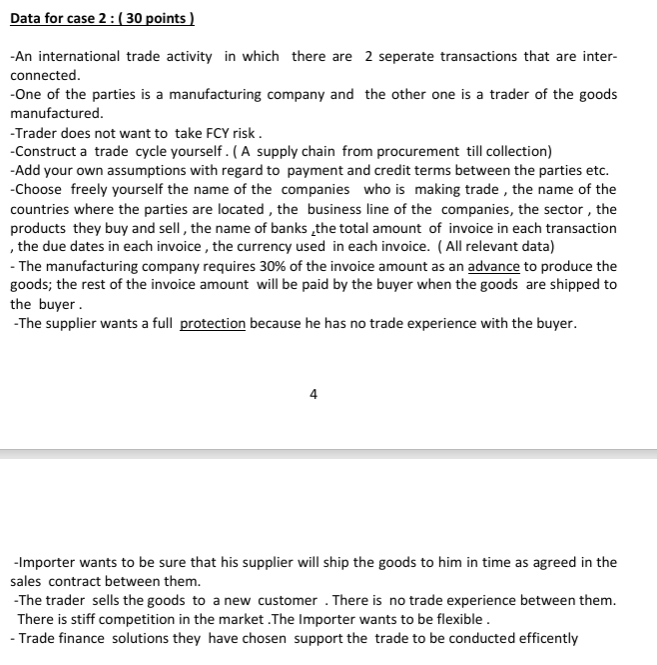
Data for case 2: (30 points) -An international trade activity in which there are 2 seperate transactions that are inter- connected. -One of the parties is a manufacturing company and the other one is a trader of the goods manufactured. -Trader does not want to take FCY risk. - Construct a trade cycle yourself. (A supply chain from procurement till collection) -Add your own assumptions with regard to payment and credit terms between the parties etc. - Choose freely yourself the name of the companies who is making trade , the name of the countries where the parties are located, the business line of the companies, the sector, the products they buy and sell, the name of banks ,the total amount of invoice in each transaction , the due dates in each invoice, the currency used in each invoice. (All relevant data) - The manufacturing company requires 30% of the invoice amount as an advance to produce the goods; the rest of the invoice amount will be paid by the buyer when the goods are shipped to the buyer -The supplier wants a full protection because he has no trade experience with the buyer. -Importer wants to be sure that his supplier will ship the goods to him in time as agreed in the sales contract between them. -The trader sells the goods to a new customer. There is no trade experience between them. There is stiff competition in the market. The Importer wants to be flexible. -Trade finance solutions they have chosen support the trade to be conducted efficently Data for case 2: (30 points) -An international trade activity in which there are 2 seperate transactions that are inter- connected. -One of the parties is a manufacturing company and the other one is a trader of the goods manufactured. -Trader does not want to take FCY risk. - Construct a trade cycle yourself. (A supply chain from procurement till collection) -Add your own assumptions with regard to payment and credit terms between the parties etc. - Choose freely yourself the name of the companies who is making trade , the name of the countries where the parties are located, the business line of the companies, the sector, the products they buy and sell, the name of banks ,the total amount of invoice in each transaction , the due dates in each invoice, the currency used in each invoice. (All relevant data) - The manufacturing company requires 30% of the invoice amount as an advance to produce the goods; the rest of the invoice amount will be paid by the buyer when the goods are shipped to the buyer -The supplier wants a full protection because he has no trade experience with the buyer. -Importer wants to be sure that his supplier will ship the goods to him in time as agreed in the sales contract between them. -The trader sells the goods to a new customer. There is no trade experience between them. There is stiff competition in the market. The Importer wants to be flexible. -Trade finance solutions they have chosen support the trade to be conducted efficentlyStep by Step Solution
There are 3 Steps involved in it

Get step-by-step solutions from verified subject matter experts
 Study Help