Question: I. Section One: Multiple-choice Questions - 20 questions (Total points: 60) This section contains twenty (20) multiple-choice items. Read each item carefully then choose the
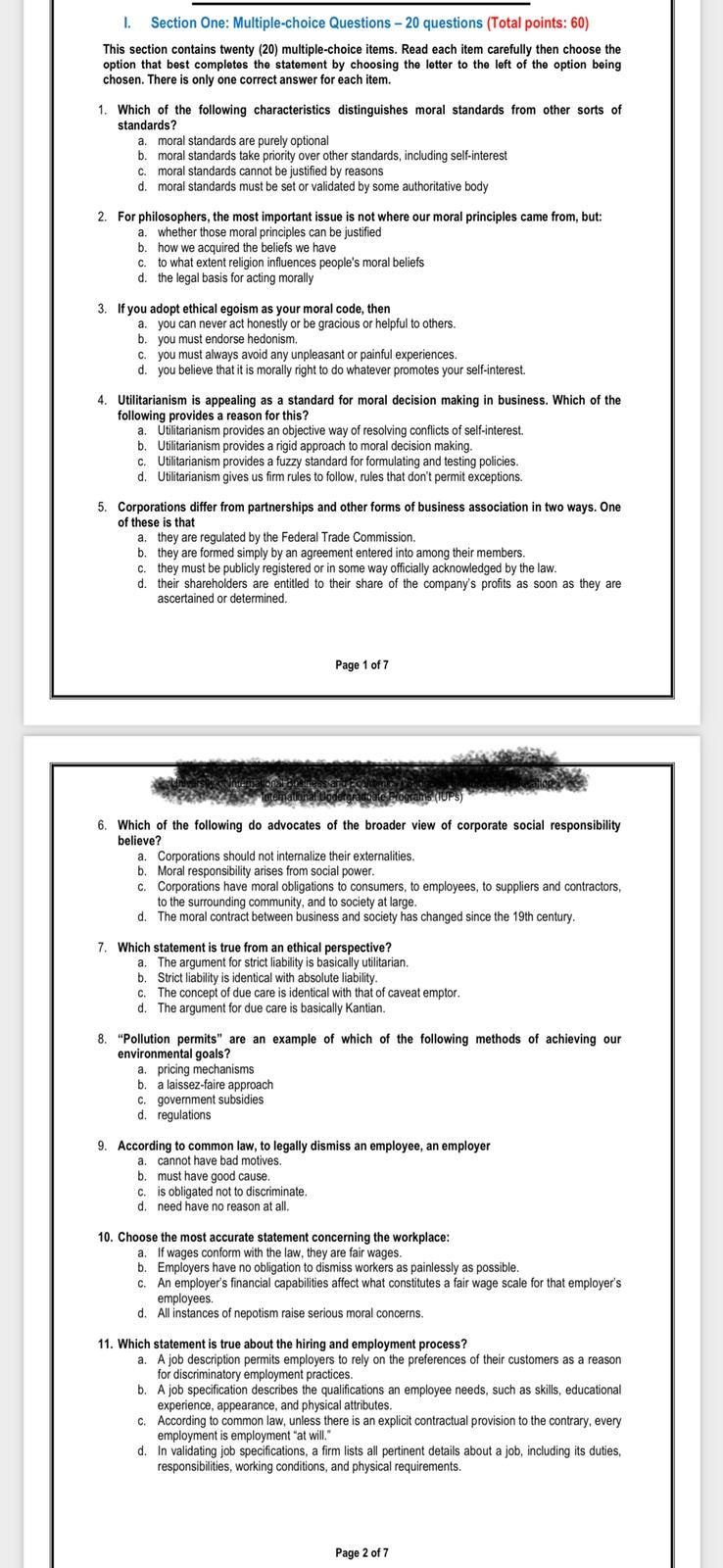
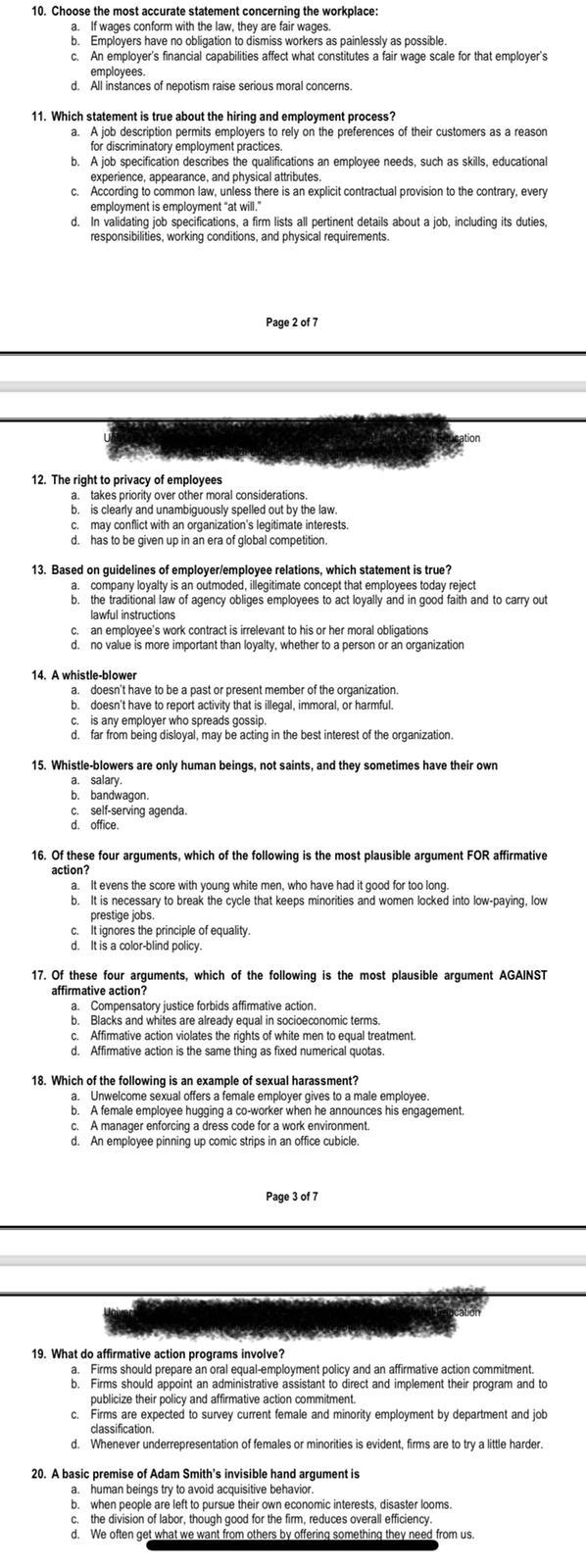
I. Section One: Multiple-choice Questions - 20 questions (Total points: 60) This section contains twenty (20) multiple-choice items. Read each item carefully then choose the option that best completes the statement by choosing the letter to the left of the option being chosen. There is only one correct answer for each item. 1. Which of the following characteristics distinguishes moral standards from other sorts of standards? a. moral standards are purely optional b. moral standards take priority over other standards, including self-interest c. moral standards cannot be justified by reasons d. moral standards must be set or validated by some authoritative body 2. For philosophers, the most important issue is not where our moral principles came from, but: a. whether those moral principles can be justified b how we acquired the beliefs we have c. to what extent religion influences people's moral beliefs d. the legal basis for acting morally 3. If you adopt ethical egoism as your moral code, then a. you can never act honestly or be gracious or helpful to others. b. you must endorse hedonism. c. you must always avoid any unpleasant or painful experiences. d. you believe that it is morally right to do whatever promotes your self-interest. 4. Utilitarianism is appealing as a standard for moral decision making in business. Which of the following provides a reason for this? Utilitarianism provides an objective way of resolving conflicts of self-interest. b. Utilitarianism provides a rigid approach to moral decision making. c. Utilitarianism provides a fuzzy standard for formulating and testing policies. d. Utilitarianism gives us firm rules to follow, rules that don't permit exceptions. 5. Corporations differ from partnerships and other forms of business association in two ways. One of these is that a. they are regulated by the Federal Trade Commission. b. they are formed simply by an agreement entered into among their members. c. they must be publicly registered or in some way officially acknowledged by the law. d. their shareholders are entitled to their share of the company's profits as soon as they are ascertained or determined. Page 1 of 7 Tmenathinaru ograms (IUPS) 6. Which of the following do advocates of the broader view of corporate social responsibility believe? a. Corporations should not internalize their externalities. b. Moral responsibility arises from social power. c. Corporations have moral obligations to consumers, to employees, to suppliers and contractors, to the surrounding community, and to society at large. d. The moral contract between business and society has changed since the 19th century. 7. Which statement is true from an ethical perspective? a. The argument for strict liability is basically utilitarian. b. Strict liability is identical with absolute liability. c. The concept of due care is identical with that of caveat emptor. d. The argument for due care is basically Kantian. 8. "Pollution permits" are an example of which of the following methods of achieving our environmental goals? a. pricing mechanisms b. a laissez-faire approach C. government subsidies d. regulations 9. According to common law, to legally dismiss an employee, an employer a. cannot have bad motives. b. must have good cause. c. is obligated not to discriminate. d. need have no reason at all. 10. Choose the most accurate statement concerning the workplace: a. If wages conform with the law, they are fair wages. b. Employers have no obligation to dismiss workers as painlessly as possible. c. An employer's financial capabilities affect what constitutes a fair wage scale for that employer's employees. d. All instances of nepotism raise serious moral concerns. 11. Which statement is true about the hiring and employment process? a. A job description permits employers to rely on the preferences of their customers as a reason for discriminatory employment practices. b. A job specification describes the qualifications an employee needs, such as skills, educational experience, appearance, and physical attributes. c. According to common law, unless there is an explicit contractual provision to the contrary, every employment is employment "at will." d. In validating job specifications, a firm lists all pertinent details about a job, including its duties, responsibilities, working conditions, and physical requirements. Page 2 of 7 10. Choose the most accurate statement concerning the workplace: a. If wages conform with the law, they are fair wages. b. Employers have no obligation to dismiss workers as painlessly as possible. c. An employer's financial capabilities affect what constitutes a fair wage scale for that employer's employees. d. All instances of nepotism raise serious moral concerns. 11. Which statement is true about the hiring and employment process? a A job description permits employers to rely on the preferences of their customers as a reason for discriminatory employment practices. b. job specification describes the qualifications an employee needs, such as skills, educational experience, appearance, and physical attributes. c. According to common law, unless there is an explicit contractual provision to the contrary, every employment is employment "at will." d. validating job specifications, a firm lists all pertinent details about a job, including its duties, responsibilities, working conditions, and physical requirements. Page 2 of 7 cation a. takes priority over other moral considerations. b. is clearly and unambiguously spelled out by the law. c. may conflict with an organization's legitimate interests. d. has to be given up in an era of global competition. 13. Based on guidelines of employer/employee relations, which statement is true? a. company loyalty is an outmoded, illegitimate concept that employees today reject b. the traditional law of agency obliges employees to act loyally and in good faith and to carry out lawful instructions c. an employee's work contract is irrelevant to his or her moral obligations d. no value is more important than loyalty, whether to a person or an organization 14. A whistle-blower a. doesn't have to be a past or present member of the organization. b. doesn't have to report activity that is illegal, immoral, or harmful. c. is any employer who spreads gossip. d. far from being disloyal, may be acting in the best interest of the organization. 15. Whistle-blowers are only human beings, not saints, and they sometimes have their own a. salary. b. bandwagon. c. self-serving agenda. d. office. 16. Of these four arguments, which of the following is the most plausible argument FOR affirmative action? a. It evens the score with young white men, who have had it good for too long. b. It is necessary to break the cycle that keeps minorities and women locked into low-paying, low prestige jobs. c. It ignores the principle of equality. d. It is a color-blind policy. 17. Of these four arguments, which of the following is the most plausible argument AGAINST affirmative action? a. Compensatory justice forbids affirmative action. b. Blacks and whites are already equal in socioeconomic terms. c. Affirmative action violates the rights of white men to equal treatment. d. Affirmative action is the same thing as fixed numerical quotas. 18. Which of the following is an example of sexual harassment? a. Unwelcome sexual offers a female employer gives to a male employee. b. A female employee hugging a co-worker when he announces his engagement. C. A manager enforcing a dress code for a work environment. d. An employee pinning up comic strips in an office cubicle. Page 3 of 7 19. What do affirmative action programs involve? a. Firms should prepare an oral equal-employment policy and an affirmative action commitment. b. Firms should appoint an administrative assistant to direct and implement their program and to publicize their policy and affirmative action commitment. c. Firms are expected to survey current female and minority employment by department and job classification. d. Whenever underrepresentation of females or minorities is evident, firms are to try a little harder. 20. A basic premise of Adam Smith's invisible hand argument is a. human beings try to avoid acquisitive behavior. b. when people are left to pursue their own economic interests, disaster looms. c. the division of labor, though good for the firm, reduces overall efficiency. d. We often get what we want from others by offering something they need from us. 12. The right to privacy of employees









 Study Help