







Question: I. Solve the following initial value problem over the interval from 1-0 to x = 1, where y(0)-1. Display all your results on the same
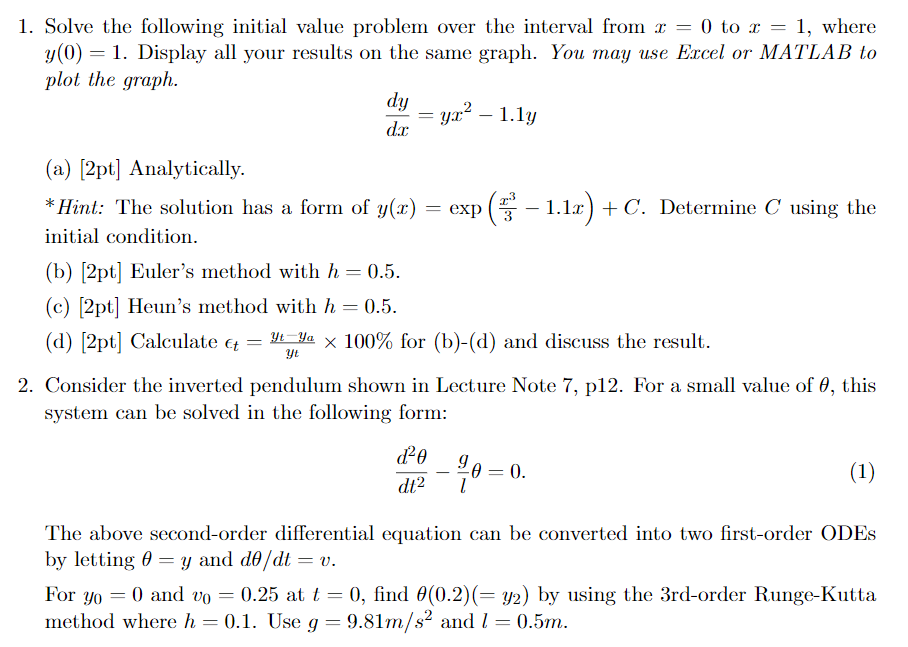
I. Solve the following initial value problem over the interval from 1-0 to x = 1, where y(0)-1. Display all your results on the same graph. You may use Excel or MATLAB to plot the graph. dy d.r = y!" _ 1.ly (a) [2pt] Analytically. *Hint: The solution has a form of y(r) - exp initial condition (b) [2pt Euler's method with h -0.5. (c) [2pt] Heun's method with h -0.5. (d) [2pt] Calculate ct % x 100% for (b)-(d) and discuss the result. (T. ?.lz) + C Determine C using the 2. Consider the inverted pendulum shown in Lecture Note 7, p12. For a small value of ?, this system can be solved in the following form di2 l The above second-order differential equation can be converted into two first-order ODEs by letting 0 -y and d/dt - v. For yo-0 and vo 0.25 at 1-0, find ?(02)(-Y2) by using the 3rd-order Runge-Kutta method whereh0.1. Use g - 9.81m/s2 and0.5m. I. Solve the following initial value problem over the interval from 1-0 to x = 1, where y(0)-1. Display all your results on the same graph. You may use Excel or MATLAB to plot the graph. dy d.r = y!" _ 1.ly (a) [2pt] Analytically. *Hint: The solution has a form of y(r) - exp initial condition (b) [2pt Euler's method with h -0.5. (c) [2pt] Heun's method with h -0.5. (d) [2pt] Calculate ct % x 100% for (b)-(d) and discuss the result. (T. ?.lz) + C Determine C using the 2. Consider the inverted pendulum shown in Lecture Note 7, p12. For a small value of ?, this system can be solved in the following form di2 l The above second-order differential equation can be converted into two first-order ODEs by letting 0 -y and d/dt - v. For yo-0 and vo 0.25 at 1-0, find ?(02)(-Y2) by using the 3rd-order Runge-Kutta method whereh0.1. Use g - 9.81m/s2 and0.5m
Step by Step Solution
There are 3 Steps involved in it

Get step-by-step solutions from verified subject matter experts
 Study Help