







Question: I understand how to find the solution to part a and b, but part c and d is confusing me. Thank you. What is the
I understand how to find the solution to part a and b, but part c and d is confusing me. Thank you.
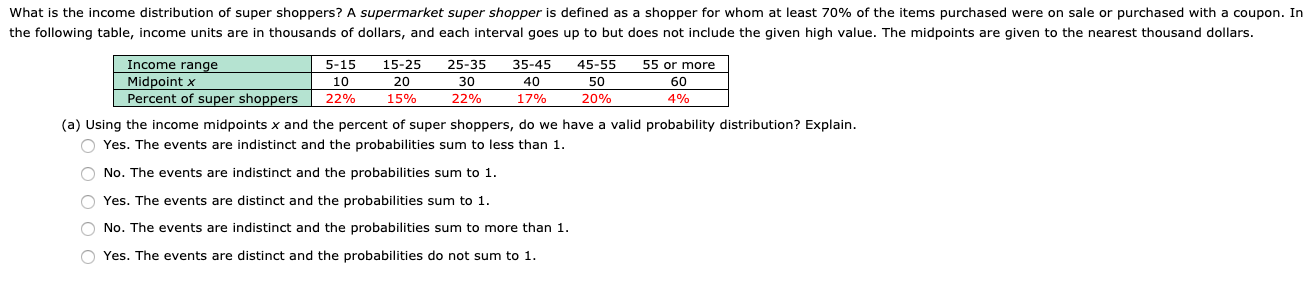
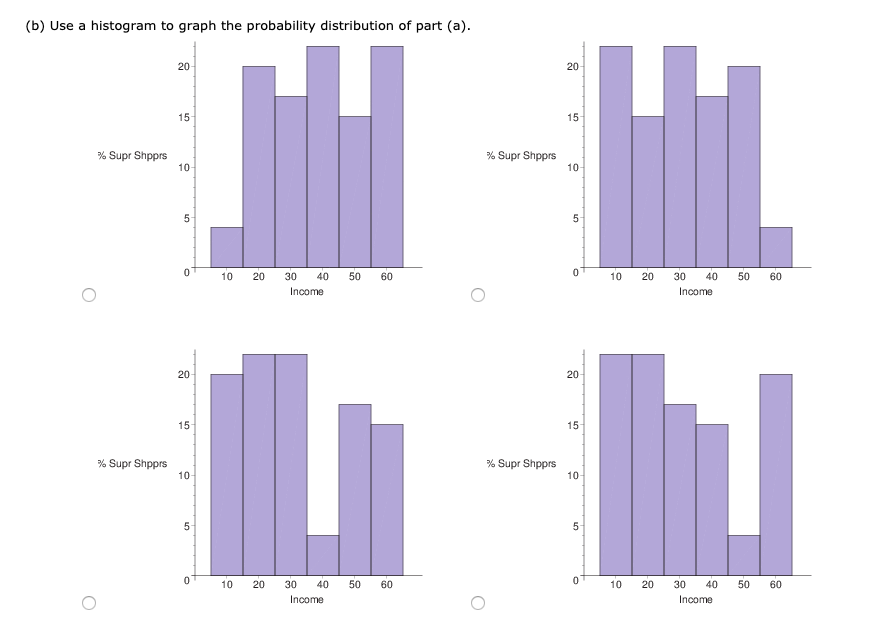

What is the income distribution of super shoppers? A supermarket super shopper is defined as a shopper for whom at least 70% of the items purchased were on sale or purchased with a coupon. In the following table, income units are in thousands of dollars, and each interval goes up to but does not include the given high value. The midpoints are given to the nearest thousand dollars. Income range 5-15 15-25 25-35 35-45 45-55 55 or more Midpoint x 10 20 30 40 50 60 Percent of super shoppers 22% 15% 22% 17% 20% 4% (a) Using the income midpoints x and the percent of super shoppers, do we have a valid probability distribution? Explain. Yes. The events are indistinct and the probabilities sum to less than 1. No. The events are indistinct and the probabilities sum to 1. O Yes. The events are distinct and the probabilities sum to 1. No. The events are indistinct and the probabilities sum to more than 1. Yes. The events are distinct and the probabilities do not sum to 1.(b) Use a histogram to graph the probability distribution of part (a). 20 20 15 15 % Supr Shopprs 10 Supr Shpprs 10- 5 5 10 20 30 40 50 O 60 Income 10 20 30 40 50 O 60 Income 20 20 15 15 % Supr Shpprs 10 % Supr Shpprs 10 5 5 10 20 30 40 50 O 60 Income 10 20 30 40 50 60 O Income(c) Compute the expected Income ,u of a super shopper. (Round 1.urour answer to two decimal places.) [.1 - thousands of dollars (d) Compute the standard deviation :3 for the Income of super shoppers. (Round your answer to two decimal places.) 0 I thousands of dollars
Step by Step Solution
There are 3 Steps involved in it

Get step-by-step solutions from verified subject matter experts
 Study Help