







Question: I want a solution for lab electronics reports solution for lab electronics reports delivery today at 12 o'clock delivery of 12 22/1 Exercise 2 ver
I want a solution for lab electronics reports solution for lab electronics reports delivery today at 12 o'clock delivery
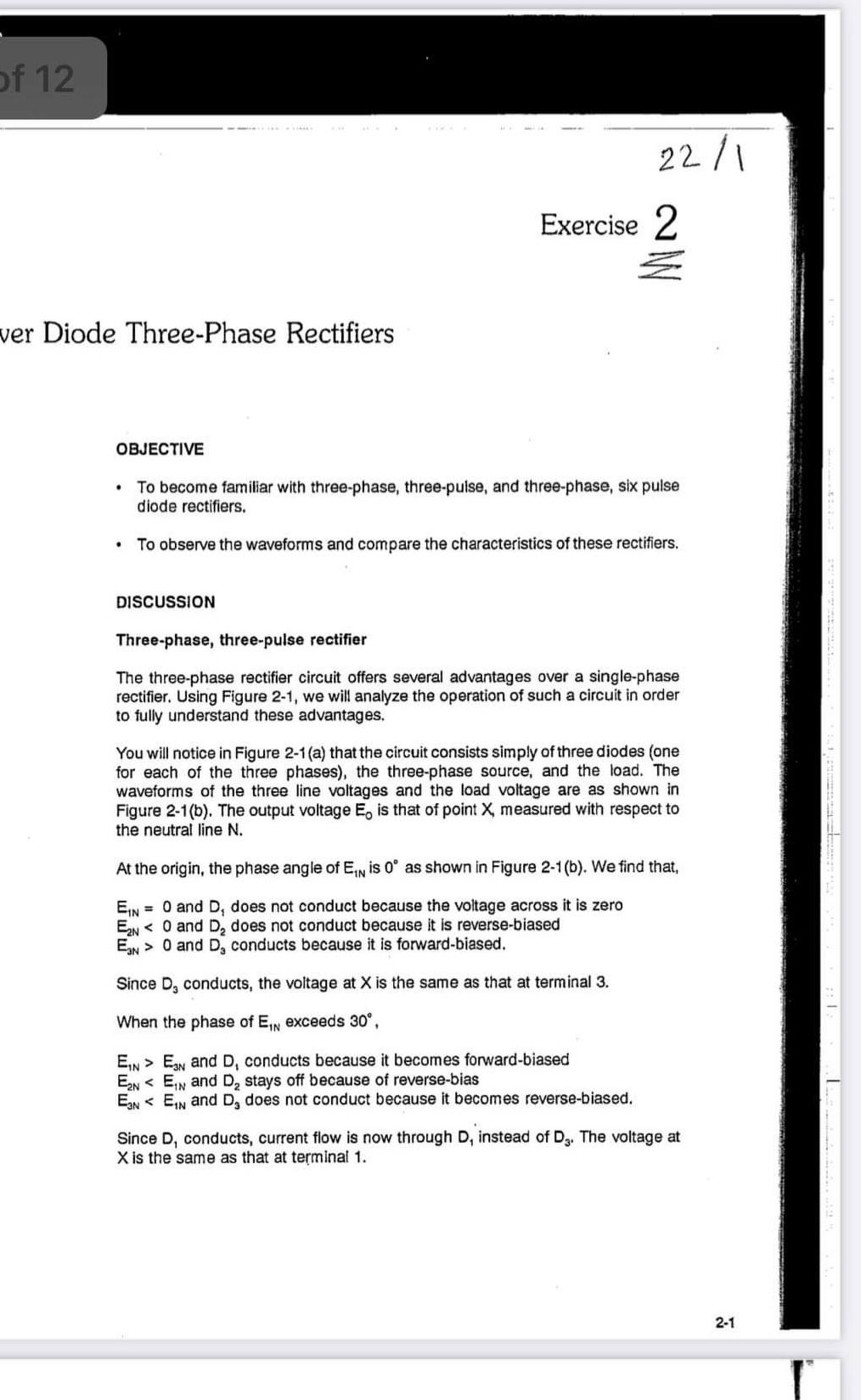
of 12 22/1 Exercise 2 ver Diode Three-Phase Rectifiers OBJECTIVE To become familiar with three-phase, three-puise, and three-phase, six pulse diode rectifiers. To observe the waveforms and compare the characteristics of these rectifiers. DISCUSSION Three-phase, three-pulse rectifier The three-phase rectifier circuit offers several advantages over a single-phase rectifier. Using Figure 2-1, we will analyze the operation of such a circuit in order to fully understand these advantages. You will notice in Figure 2-1(a) that the circuit consists simply of three diodes (one for each of the three phases), the three-phase source, and the load. The waveforms of the three line voltages and the load voltage are as shown in Figure 2-1(b). The output voltage E, is that of point X, measured with respect to the neutral line N. At the origin, the phase angle of Einis 0as shown in Figure 2-1(b). We find that, Ein = 0 and D, does not conduct because the voltage across it is zero EN 0 and D, conducts because it is forward-biased. Since D, conducts, the voltage at X is the same as that at terminal 3. When the phase of E, exceeds 30 EN > Egn and D, conducts because it becomes forward-biased EN 0 and D, conducts because it is forward-biased. Since D, conducts, the voltage at X is the same as that at terminal 3. When the phase of E, exceeds 30 EN > Egn and D, conducts because it becomes forward-biased EN
Step by Step Solution
There are 3 Steps involved in it

Get step-by-step solutions from verified subject matter experts
 Study Help