







Question: I want it to be written in visual code program, in python language. Exercise 3. Multiplication Tables, with functions. Part 3. Implement a function to
I want it to be written in visual code program, in python language.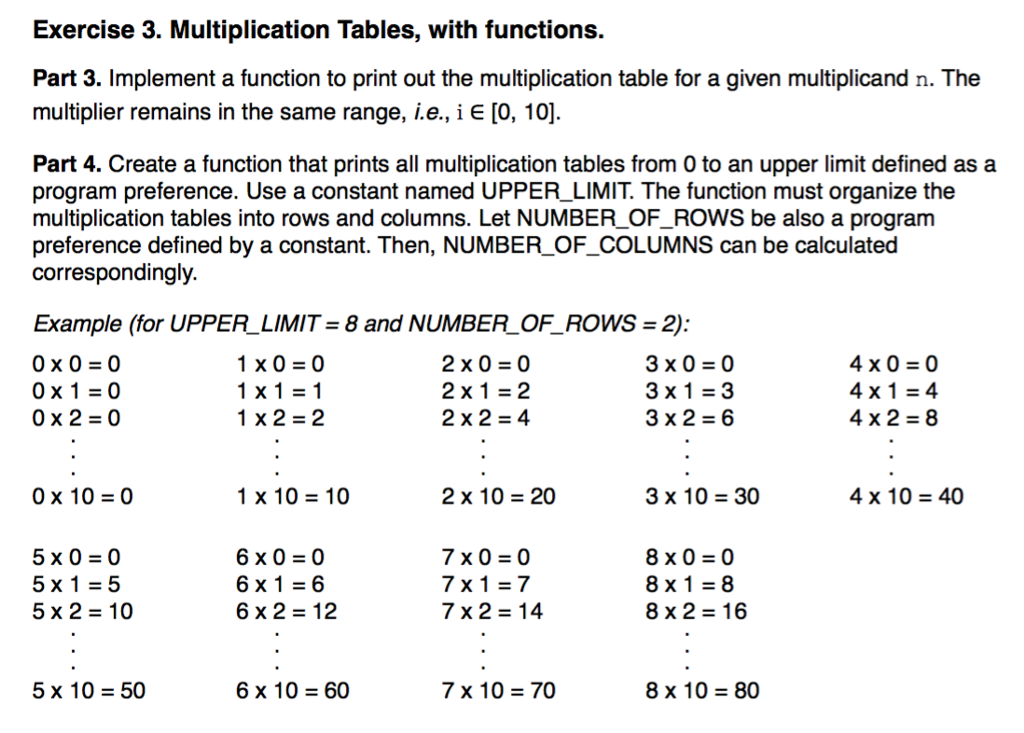
Exercise 3. Multiplication Tables, with functions. Part 3. Implement a function to print out the multiplication table for a given multiplicand n. The multiplier remains in the same range, i.e., iE [0, 10]. Part 4. Create a function that prints all multiplication tables from 0 to an upper limit defined as a program preference. Use a constant named UPPER_LIMIT. The function must organize the multiplication tables into rows and columns. Let NUMBER_OF_ROWS be also a program preference defined by a constant. Then, NUMBER_OF_COLUMNS can be calculated correspondingly. Die Example (for UPPER_LIMIT = 8 and NUMBER_OF_ROWS = 2): 0x0 = 0 1 x 0 = 0 2 x 0 = 0 3 x 0 = 0 Ox 1 = 0 1x1 = 1 2 x 1 = 2 3 x 1 = 3 Ox 2 = 0 1 x 2 = 2 2 x 2 = 4 3 x 2 = 6 4 x 0 = 0 4x1 = 4 4 x 2 = 8 0x 10 = 0 1x 10 = 10 2 x 10 = 20 3 x 10 = 30 4 x 10 = 40 5 x 0 = 0 5x1 = 5 5x2 = 10 6 x 0 = 0 6 x 1 = 6 6 x 2 = 12 7x0 = 0 7x1 = 7 7 x 2 = 14 8 x 0 = 0 8 x 1 = 8 8 x 2 = 16 5 x 10 = 50 6 x 10 = 60 7 x 10 = 70 8 x 10 = 80 Exercise 3. Multiplication Tables, with functions. Part 3. Implement a function to print out the multiplication table for a given multiplicand n. The multiplier remains in the same range, i.e., iE [0, 10]. Part 4. Create a function that prints all multiplication tables from 0 to an upper limit defined as a program preference. Use a constant named UPPER_LIMIT. The function must organize the multiplication tables into rows and columns. Let NUMBER_OF_ROWS be also a program preference defined by a constant. Then, NUMBER_OF_COLUMNS can be calculated correspondingly. Die Example (for UPPER_LIMIT = 8 and NUMBER_OF_ROWS = 2): 0x0 = 0 1 x 0 = 0 2 x 0 = 0 3 x 0 = 0 Ox 1 = 0 1x1 = 1 2 x 1 = 2 3 x 1 = 3 Ox 2 = 0 1 x 2 = 2 2 x 2 = 4 3 x 2 = 6 4 x 0 = 0 4x1 = 4 4 x 2 = 8 0x 10 = 0 1x 10 = 10 2 x 10 = 20 3 x 10 = 30 4 x 10 = 40 5 x 0 = 0 5x1 = 5 5x2 = 10 6 x 0 = 0 6 x 1 = 6 6 x 2 = 12 7x0 = 0 7x1 = 7 7 x 2 = 14 8 x 0 = 0 8 x 1 = 8 8 x 2 = 16 5 x 10 = 50 6 x 10 = 60 7 x 10 = 70 8 x 10 = 80
Step by Step Solution
There are 3 Steps involved in it

Get step-by-step solutions from verified subject matter experts
 Study Help