Question: I want this for case 2. This is a example of case 8. i want it in the same format. thanks, Labor Management Relations Case
I want this for case 2. This is a example of case 8. i want it in the same format.
thanks,
Labor Management Relations
Case 8
Discharge for Fraud
The Issue
The issue at hand is whether the grievant, Mr. Thomas Sax, was discharged for cause and if not what the solution should be.
Timeline of Events
November 10, 2002Sax Injured on the job
November 11, 2002Sax did not work
November 13, 2002Sax reported to Dr. Rooney
November 11, 14, 15, and 16Sax received disability pay
November 16, 2002Sax cleared to return to work
November 24, 2002Sax called in sick
December 9, 2002Sax called in sick
December 16, 2002Sax reinjured on the job
December 17 and 18Sax received disability pay
December 18, 2002Sax telephone in to Company dispensary
December 22, 2002Sax cleared to return to work but called in sick
January 12, 2002Sax discharged
Applicable Contract Provisions
The following provisions are relevant to this case:
ARTICLE 9
Leave of Absence
SECTION 5. SICK LEAVE
1.All employees are eligible for seven (7) days fully paid non-authenticated sick leave each contract year.
ARTICLE 17
Present Benefits
(5) If an employee is disabled by a compensable accident, he or she will be paid eight (8) hours per day at the rate shown in Schedule A hereof during his or her disability up to the eight (8th) regular working day and thereafter such further amounts in addition to the compensation provided by the law as the Company in its discretion deems proper.
Positions
Management
It is the opinion of the Company that Mr. Sax intentionally defrauded the Company it property (wages). They hold that Mr. Sax deliberately ignored Dr. Rooneys instructions for rest, and instead went to work at Hunterdon. The Company claims a loss on wages paid and work hours not performed by Mr. Sax due to the fraudulent disability claim, which is cause for discharge, additionally they find that Mr. Sax deceived the Company in regard to his sick days and therefore this is additional cause for discharge.
Union
It is the opinion of the Union that Mr. Sax did nothing wrong. The Union states that the sick leave provision does not require the employee to actually be sick and the intention of the wording was intentional so as to allow employees to use these days for personal days if needed. The Union additionally hold that since the Company did not demonstrate proof that Mr. Sax was working the same kind of employment at Hunterdon or even the same shifts (with the exception of one) that the disability claim was valid and a Company physician diagnosed and recommended it. The Union also states that collection of compensation benefits while working elsewhere in an unrelated type job is allowed and not deceptive. They want Mr. Sax reinstated with back pay and benefits.
Proposed Solution of Arbitrator
The proposed solutions of this case are in favor of the Company, finding Mr. Saxs discharge justifiably for cause OR a finding in favor of the Union which would reinstate Mr. Sax with back pay and full benefits restored.
Final Decision
The final binding decision is for the Union reinstating the grievant, Mr. Thomas Sax, with back pay and full benefits restored.
Justification for this ruling is as follows:
The provisions regarding sick pay are defined as being non-authenticated and, as per multiple testimonies, these were intentional to allow sick days to be used for personal days. Whether Mr. Sax was honest or not about his health is irrelevant to the case as it pertains to sick leave.
Concerning the disability compensation the state allows employees to collect compensation while working elsewhere in an unrelated job type and this circumstance fits that description. The Company physician diagnosed Mr. Sax and found him to be injured, I see no evidence that he faked or exaggerated his injuries. The Company additionally violated state statutes for discharging an employee for claiming workmens compensation benefits.
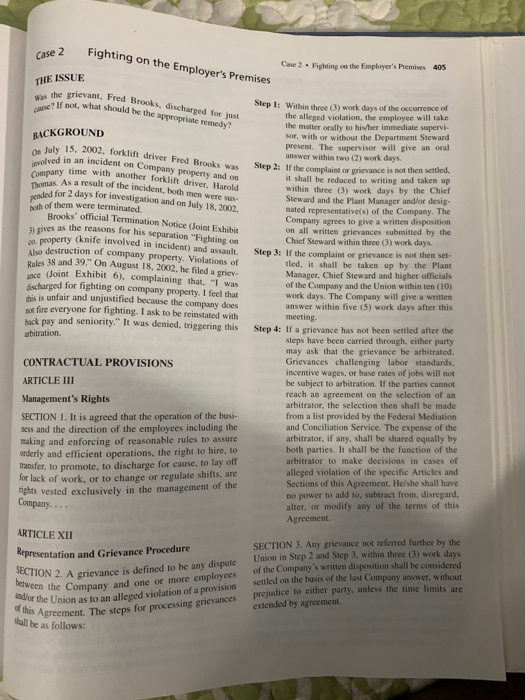
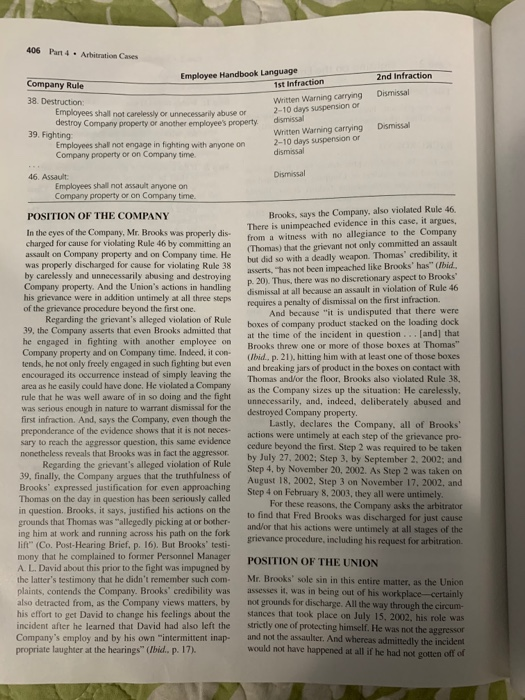
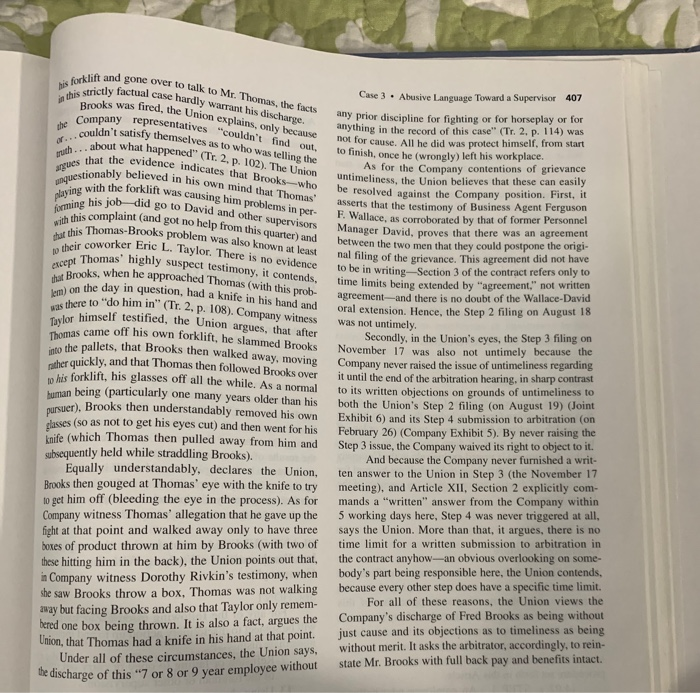
2 Case 2 Fid Fighting on the Employer's Premises Case 2. Fighting on the Employer's Premises 405 THE ISSUE the grievant, Fred Brooks, discharged for just Il not, what should be the appropriate remedy? ce? If not, whe BACKGROUND involved in an in aly 15, 2002, forklift driver Fred Brooks was wed in an incident on Company property and on any time with another forklift driver. Harold mas. As a result of the incident, both men were sus for 2 days for investigation and on July 18 2002 w of them were terminated Brooks' official Termination Notice Joint Exhibit as the reasons for his separation "Fighting on property (knife involved in incident and assi destruction of company property. Violations of les 38 and 39." On August 18, 2002, he filed a griev e Joint Exhibit 6). complaining that, "I was ischarged for fighting on company property. I feel that his is unfair and unjustified because the company does pot fire everyone for fighting. I ask to be reinstated with fuck pay and seniority. It was denied, triggering this arbitration s Step 1: Within three (3) work days of the occurrence of the alleged violation, the employee will take the matter orally to higher immediate supervi- sor, with or without the Department Steward present. The supervisor will give an oral answer within two (2) work days. Step 2: If the complaint of grievance is not then settled it shall be reduced to writing and taken up within three (3) work days by the Chief Steward and the Plant Manager and/or desig- nated representative(s) of the Company. The Company agrees to give a written disposition on all written grievances submitted by the Chief Steward within three (3) work days. t the complaint or grievance is not then tled, it shall be taken up by the Plant Manager. Chief Steward and higher officials of the Company and the Union within ten (10) work days. The Company will give a written answer within five (5) work days after this meeting. Step 4: If a grievance has not been settled after the steps have been carried through, either party may ask that the grievance be arbitrated. Grievances challenging labor standards, incentive wages, or base rates of jobs will not be subject to arbitration. If the parties cannot reach an agreement on the selection of an arbitrator, the selection then shall be made from a list provided by the Federal Mediation and Conciliation Service. The expense of the arbitrator, if any, shall be shared equally by both parties. It shall be the function of the arbitrator to make decisions in cases of alleged violation of the specific Articles and Sections of this Agreement. He/she shall have no power to add to, subtract from, disregard, alter, or modify any of the terms of this Agreement CONTRACTUAL PROVISIONS ARTICLE III Management's Rights SECTION 1. It is agreed that the operation of the busi- ness and the direction of the employees including the making and enforcing of reasonable rules to assure orderly and efficient operations, the right to hire, to Transfer, to promote, to discharge for cause, to lay off for lack of work, or to change or regulate shifts, are nights vested exclusively in the management of the Company. ... ARTICLE XII Representation and Grievance Procedure SECTION 2. A grievance is defined to be any dispute ween the Company and one or more employees or the Union as to an alleged violation of a provision Is Agreement. The steps for processing grievances SECTION 3. Any grievance not referred further by the Union in Step 2 and Step 3. within three (3) work days of the Company's written disposition shall be considered settled on the basis of the last Company answer, without prejudice to either party, unless the time limits are extended by agreement. hall be as follows: 406 Part. Arbitration Cases Company Rule 2nd Infraction Dismissal Employee Handbook Language 1st Infraction 38. Destruction: Written Warning carrying Employees shall not carelessly or unnecessarily abuse or 2-10 days suspension of destroy Company property or another employee's property. dismissal 39. Fighting Written Warning carrying Employees shall not engage in fighting with anyone on 2-10 days suspension or Company property or on Company time dismissal Dismissal Dismissal 46. Assault Employees shall not assault anyone on Company property or on Company time. POSITION OF THE COMPANY In the eyes of the Company, Mr. Brooks was properly dis- charged for cause for violating Rule 46 by committing an assault on Company property and on Company time. He was properly discharged for cause for violating Rule 38 by carelessly and unnecessarily abusing and destroying Company property. And the Union's actions in handling his grievance were in acklition untimely at all three steps of the grievance procedure beyond the first one. Regarding the grievant's alleged violation of Rule 39, the Company asserts that even Brooks admitted that he engaged in fighting with another employee on Company property and on Company time. Indeed, it con- tends, he not only freely engaged in such fighting but even encouraged its occurrence instead of simply leaving the area as he easily could have done. He violated a Company rule that he was well aware of in so doing and the fight was serious enough in nature to warrant dismissal for the first infraction. And, says the Company, even though the preponderance of the evidence shows that it is not neces sary to reach the aggressor question, this same evidence nonetheless reveals that Brooks was in fact the aggressor Regarding the grievant's alleged violation of Rule 39. finally, the Company argues that the truthfulness of Brooks' expressed justification for even approaching Thomas on the day in question has been seriously called in question. Brooks, it says, justified his actions on the grounds that Thomas was "allegedly picking at or bother- ing him at work and running across his path on the fork lift (Co. Post-Hearing Brief, p. 16), But Brooks' testi- mony that he complained to former Personnel Manager A. L. David about this prior to the fight was impugned by the latter's testimony that he didn't remember such com plaints, contends the Company. Brooks' credibility was also detracted from, as the Company views matters, by his effort to get David to change his feelings about the incident after he learned that David had also left the Company's employ and by his own intermittent inap- propriate laughter at the hearings" (Ibid. p. 17). Brooks, says the Company, also violated Rule 46. There is unimpeached evidence in this case, it argues, from a witness with no allegiance to the Company (Thomas) that the grievant not only committed an assault but did so with a deadly weapon. Thomas' credibility, it asserts, "has not been impeached like Brooks' has" (Ibid. p. 20). Thus, there was no discretionary aspect to Brooks dismissal at all because an assault in violation of Rule 46 requires a penalty of dismissal on the first infraction And because it is undisputed that there were boxes of company product stacked on the loading dock at the time of the incident in question ... [and] that Brooks threw one or more of those boxes at Thomas" (Ibid., p. 21). hitting him with at least one of those boxes and breaking jars of product in the boxes on contact with Thomas and/or the floor, Brooks also violated Rule 38 as the Company sizes up the situation: He carelessly. unnecessarily, and, indeed, deliberately abused and destroyed Company property. Lastly, declares the Company, all of Brooks actions were untimely at each step of the grievance pro- cedure beyond the first. Step 2 was required to be taken by July 27, 2002: Step 3, by September 2, 2002; and Step 4, by November 20, 2002. As Step 2 was taken on August 18, 2002, Step 3 on November 17, 2002, and Step 4 on February 8, 2003, they all were untimely. For these reasons, the Company asks the arbitrator to find that Fred Brooks was discharged for just cause and/or that his actions were untimely at all stages of the grievance procedure, including his request for arbitration POSITION OF THE UNION Mr. Brooks' sole sin in this entire matter, as the Union assesses it was in being out of his workplace certainly not grounds for discharge. All the way through the circum- stances that took place on July 15, 2002, his role was strictly one of protecting himself. He was not the aggressor and not the assaulter. And whereas admittedly the incident would not have happened at all if he had not gotten off of Nis forklift and in this strictly factu Brooks was fired, th e n and gone over to talk to Mr. Thomas, the facts wly factual case hardly warrant his discharge. was fired, the Union explains, only because mpany representatives couldn't find out dn't satisfy themselves as to who was telling the bout what happened" (Tr. 2. p. 102). The Union at the evidence indicates that Brooks-who onably believed in his own mind that Thomas' with the forklift was causing him problems in per obdid go to David and other supervisors rec only the evid. appenedles as could playing with the for the Company or... couldn't fruith... about satisfy therlatives plains, discharge argues that the aquestionablu indi: 2 was our forklift we his owns that the US the with this 80 to Dalsing him that who that this Thom to their coworker except Thomas thar Brooks, wi Case 3. Abusive Language Toward a Supervisor 407 any prior discipline for fighting or for horseplay or for anything in the record of this case" (Tr. 2. p. 114) was not for cause. All he did was protect himself, from start to finish, once he (wrongly) left his workplace. As for the Company contentions of grievance untimeliness, the Union believes that these can easily be resolved against the Company position. First, it asserts that the testimony of Business Agent Ferguson E. Wallace, as corroborated by that of former Personnel Manager David, proves that there was an agreement between the two men that they could postpone the origi- nal filing of the grievance. This agreement did not have to be in writing Section 3 of the contract refers only to time limits being extended by "agreement," not written agreement and there is no doubt of the Wallace-David oral extension. Hence, the Step 2 filing on August 18 Manager D this complaint (and got no help from this from this quarter) and Thomas-Brooks problem was also known at least coworker Eric L. Taylor. There is no evidence Thomas' highly suspect testimony, it contends, voks, when he approached Thomas (with this prob on the day in question, had a knife in his hand and bere to do him in" (Tr. 2, p. 108). Company witness of himself testified, the Union argues, that after was there to "do him in Taylor himself testified hand and was not untimely. Thomas came off his own forklift, he sla to the pallets, that Brooks then walked a Slammed Brooks other quickly, and that Thomas then follow away, moving followed Brooks over no his forklift, his glasses off all the wh all the while. As a normal human being (particularly one many years older than his pursuer). Brooks then understandably removed his own classes (so as not to get his eyes cut) and then went for his knife (which Thomas then pulled away from him and subsequently held while straddling Brooks). Equally understandably, declares the Union, Brooks then gouged at Thomas' eye with the knife to try to get him off (bleeding the eye in the process). As for Company witness Thomas' allegation that he gave up the fight at that point and walked away only to have three boxes of product thrown at him by Brooks (with two of these hitting him in the back), the Union points out that, in Company witness Dorothy Rivkin's testimony, when she saw Brooks throw a box, Thomas was not walking away but facing Brooks and also that Taylor only remem- bered one box being thrown. It is also a fact, argues the Union, that Thomas had a knife in his hand at that point. Under all of these circumstances, the Union says, me discharge of this "7 or 8 or 9 year employee without Secondly, in the Union's eyes, the Step 3 filing on November 17 was also not untimely because the Company never raised the issue of untimeliness regarding it until the end of the arbitration hearing, in sharp contrast to its written objections on grounds of untimeliness to both the Union's Step 2 filing (on August 19) Joint Exhibit 6) and its Step 4 submission to arbitration (on February 26) (Company Exhibit 5). By never raising the Step 3 issue, the Company waived its right to object to it. And because the Company never furnished a writ- ten answer to the Union in Step 3 (the November meeting), and Article XII, Section 2 explicitly com- mands a "written" answer from the Company within 5 working days here, Step 4 was never triggered at all, says the Union. More than that, it argues, there is no time limit for a written submission to arbitration in the contract anyhow- an obvious overlooking on some- body's part being responsible here, the Union contends because every other step does have a specific time limit. For all of these reasons, the Union views the Company's discharge of Fred Brooks as being without just cause and its objections as to timeliness as being without merit. It asks the arbitrator, accordingly, to rein. state Mr. Brooks with full back pay and benefits intact









 Study Help