







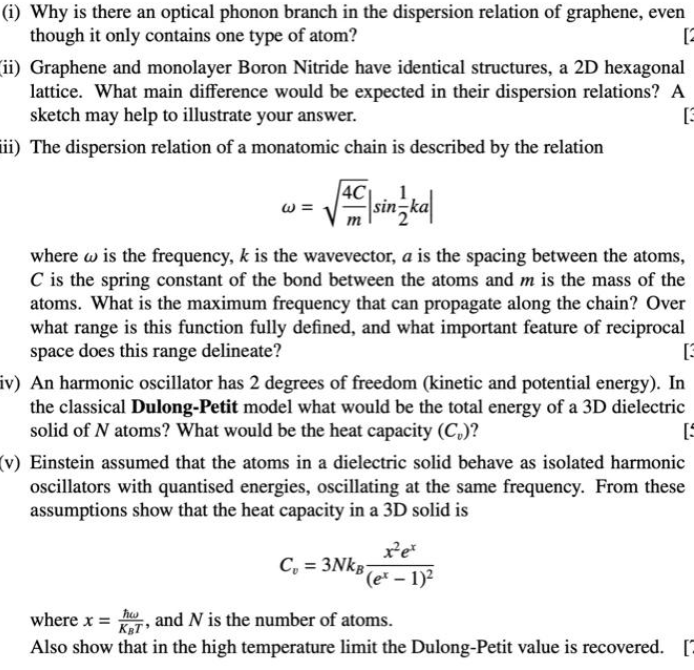
Question: ( i ) Why is there an optical phonon branch in the dispersion relation of graphene, even though it only contains one type of atom?
i Why is there an optical phonon branch in the dispersion relation of graphene, even
though it only contains one type of atom?
ii Graphene and monolayer Boron Nitride have identical structures, a D hexagonal
lattice. What main difference would be expected in their dispersion relations? A
sketch may help to illustrate your answer.
iii The dispersion relation of a monatomic chain is described by the relation
where is the frequency, is the wavevector, is the spacing between the atoms,
is the spring constant of the bond between the atoms and is the mass of the
atoms. What is the maximum frequency that can propagate along the chain? Over
what range is this function fully defined, and what important feature of reciprocal
space does this range delineate?
iv An harmonic oscillator has degrees of freedom kinetic and potential energy In
the classical DulongPetit model what would be the total energy of a D dielectric
solid of atoms? What would be the heat capacity
v Einstein assumed that the atoms in a dielectric solid behave as isolated harmonic
oscillators with quantised energies, oscillating at the same frequency. From these
assumptions show that the heat capacity in a D solid is
where and is the number of atoms.
Also show that in the high temperature limit the DulongPetit value is recovered.
Step by Step Solution
There are 3 Steps involved in it
1 Expert Approved Answer
Step: 1 Unlock

Question Has Been Solved by an Expert!
Get step-by-step solutions from verified subject matter experts
Step: 2 Unlock
Step: 3 Unlock
 Study Help