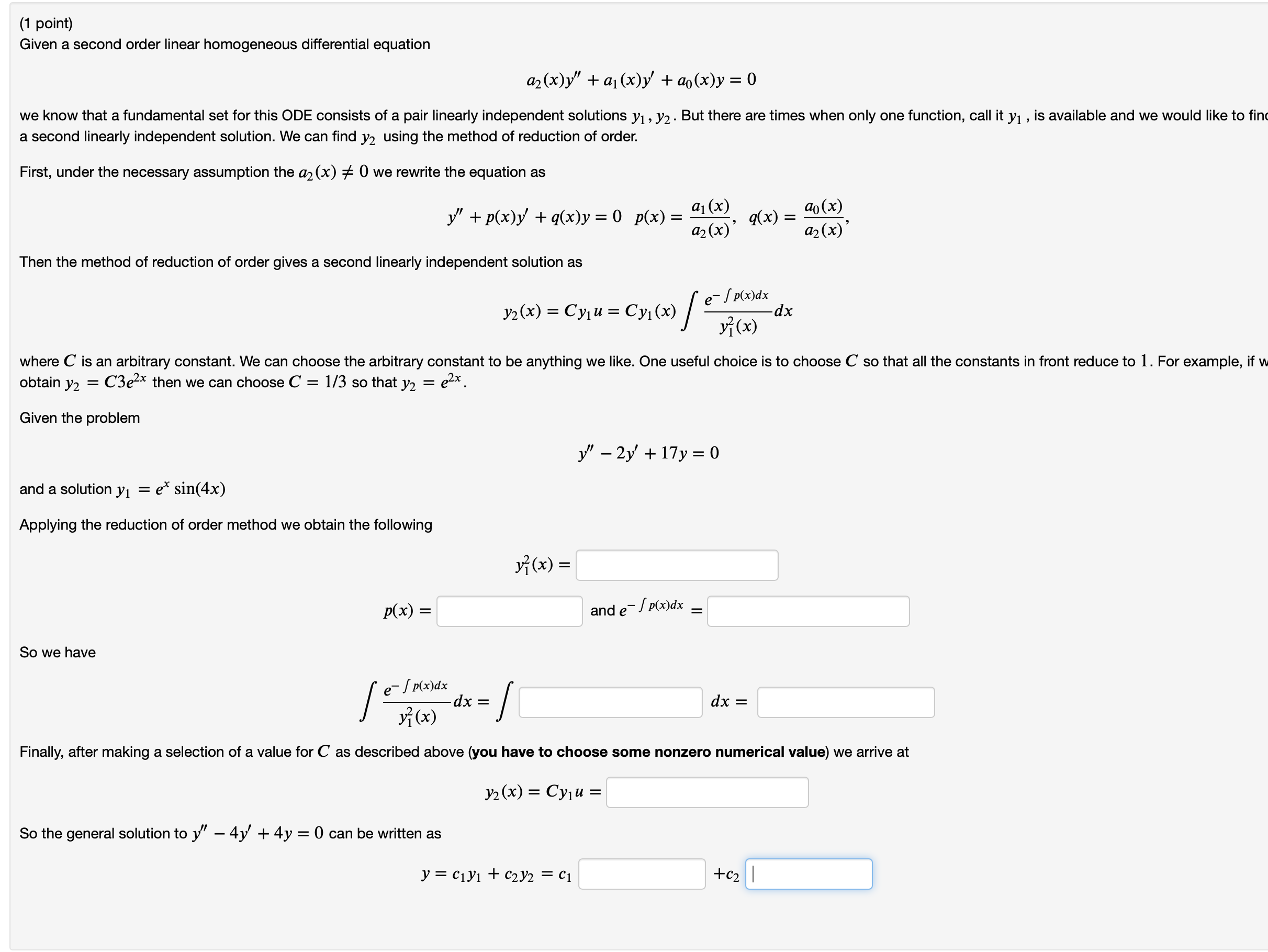
Question: I will attach the two questions below thank you so much for your help! need them asap please! (1 point) Given a second order linear

I will attach the two questions below thank you so much for your help! need them asap please!
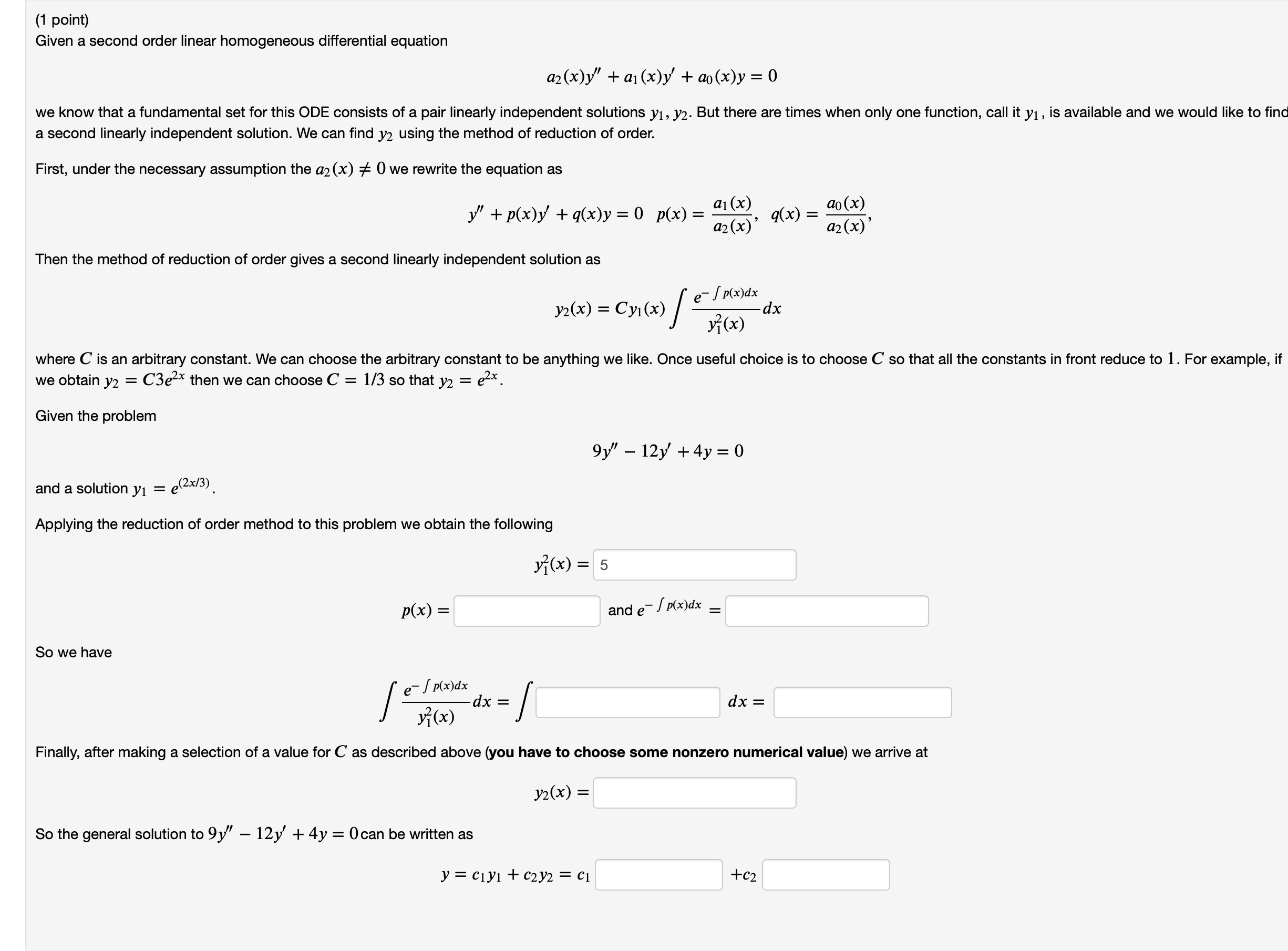
I will attach the two questions below thank youI will attach the two questions below thank you
(1 point) Given a second order linear homogeneous differential equation @0032\" + a1(X))/ + ao(X)y = 0 we know that a fundamental set for this ODE consists of a pair linearly independent solutions y1, y2. But there are times when only one function, call it y1, is available and we would like to find a second linearly independent solution. We can find y2 using the method of reduction of order. First, under the necessary assumption the a2(x) 7E 0 we rewrite the equation as y" +p(x>;/ +q = \"1"\" 400 = \"0"\" a2(x)' 02(X)' Then the method of reduction of order gives a second linearly independent solution as where C is an arbitrary constant. We can choose the arbitrary constant to be anything we like. Once useful choice is to choose C so that all the constants in front reduce to 1. For example, if we obtain y2 = C3e2" then we can choose C = 1/3 so that y2 = ez". Given the problem 9y'_12y +4y=0 and a solution y1 = e(2"'3). Applying the reduction of order method to this problem we obtain the following yx) = 5 p(x) = and e' hood" = So we have 6 fp(x)dx d / d x = x = yf(x) Finally, after making a selection of a value for C as described above (you have to choose some nonzero numerical value) we arrive at y2(x) = $0 the general solution to 9V 12y' + 4y = Ocan be written as y = Clyl + an = 01 +62 (1 point) Given a second order linear homogeneous differential equation a2(X)y\" + a1(X)y' + ao(x)y = 0 we know that a fundamental set for this ODE consists of a pair linearty independent solutions yl , yz. But there are times when only one function, call it yl , is available and we would like to fint a second linearly independent solution. We can find yz using the method of reduction of order. First, under the necessary assumption the (12 (x) 95 0 we rewrite the equation as y\" +p;/ +q(x)y = 0 p(x) = \"1\

Step by Step Solution

There are 3 Steps involved in it

1 Expert Approved Answer
Step: 1 Unlock blur-text-image

Question Has Been Solved by an Expert!

Get step-by-step solutions from verified subject matter experts

Step: 2 Unlock
Step: 3 Unlock

Students Have Also Explored These Related Mathematics Questions!