







Question: I will definitely rate. Problem 2. Two competing banks each plan to open a branch along the main avenue of a particular city. The avenue
I will definitely rate.
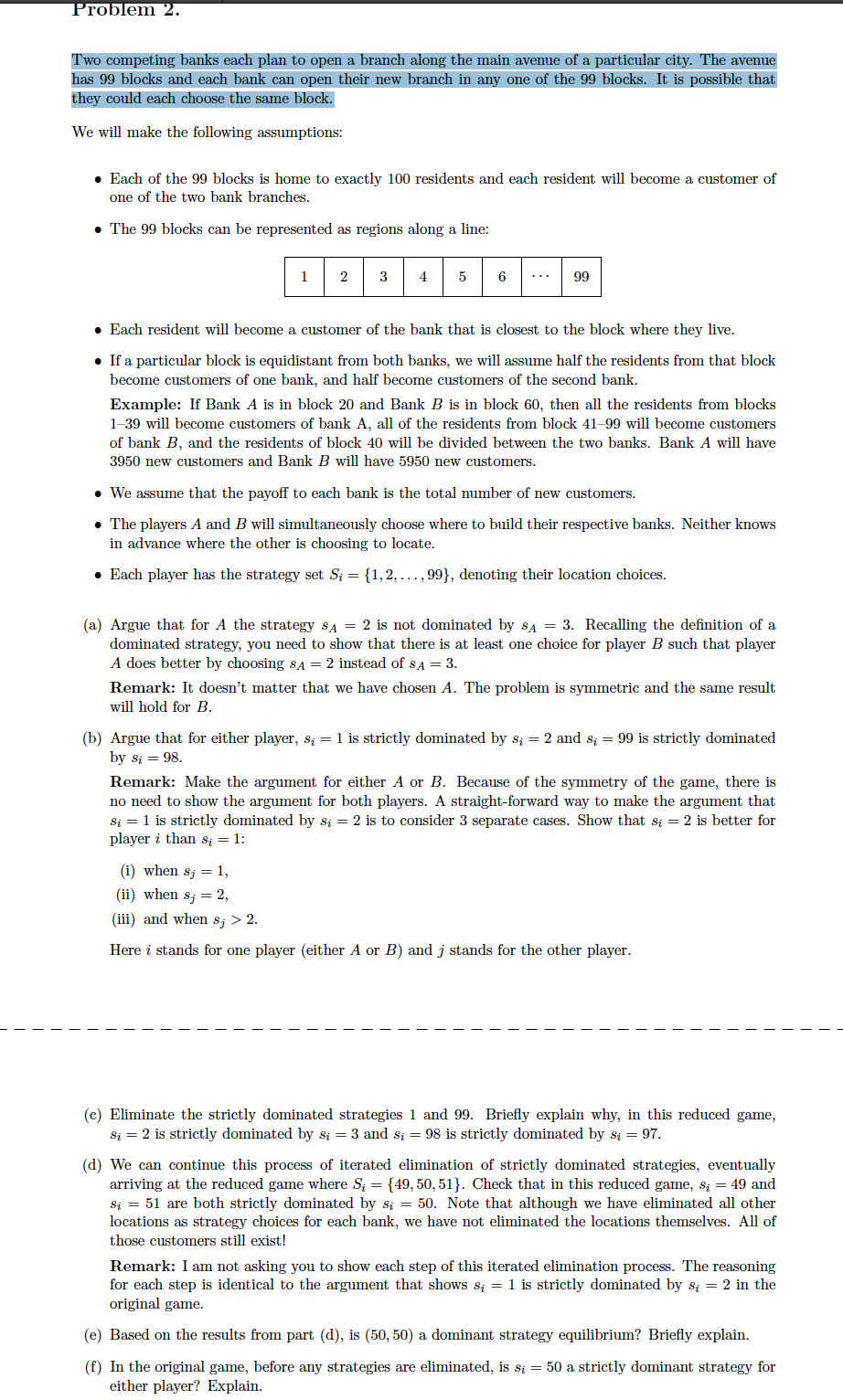
Problem 2. Two competing banks each plan to open a branch along the main avenue of a particular city. The avenue has 99 blocks and each bank can open their new branch in any one of the 99 blocks. It is possible that they could each choose the same block. We will make the following assumptions: . Each of the 99 blocks is home to exactly 100 residents and each resident will become a customer of one of the two bank branches. The 99 blocks can be represented as regions along a line: 1 2 3 4 5 6 99 . Each resident will become a customer of the bank that is closest to the block where they live. If a particular block is equidistant from both banks, we will assume half the residents from that block become customers of one bank, and half become customers of the second bank. Example: If Bank A is in block 20 and Bank B is in block 60, then all the residents from blocks 1-39 will become customers of bank A, all of the residents from block 4199 will become customers of bank B, and the residents of block 40 will be divided between the two banks. Bank A will have 3950 new customers and Bank B will have 5950 new customers. We assume that the payoff to each bank is the total number of new customers. The players A and B will simultaneously choose where to build their respective banks. Neither knows in advance where the other is choosing to locate. Each player has the strategy set Si = {1, 2, ...,99}, denoting their location choices. (a) Argue that for A the strategy sa = 2 is not dominated by sa = 3. Recalling the definition of a dominated strategy, you need to show that there is at least one choice for player B such that player A does better by choosing SA = 2 instead of sA = 3. Remark: It doesn't matter that we have chosen A. The problem is symmetric and the same result will hold for B. (b) Argue that for either player, si = 1 is strictly dominated by si = 2 and si = 99 is strictly dominated by si = 98. Remark: Make the argument for either A or B. Because of the symmetry of the game, there is no need to show the argument for both players. A straight-forward way to make the argument that Si = 1 is strictly dominated by si = 2 is to consider 3 separate cases. Show that si = 2 is better for player i than si = 1: (i) when sj = 1, (ii) when s; = 2, (iii) and when s; > 2. Here i stands for one player (either A or B) and j stands for the other player. (c) Eliminate the strictly dominated strategies 1 and 99. Briefly explain why, in this reduced game, si = 2 is strictly dominated by si = 3 and si = 98 is strictly dominated by si = 97. (d) We can continue this process of iterated elimination of strictly dominated strategies, eventually arriving at the reduced game where S; = {49, 50, 51}. Check that in this reduced game, si = 49 and Si = 51 are both strictly dominated by si = 50. Note that although we have eliminated all other locations as strategy choices for each bank, we have not eliminated the locations themselves. All of those customers still exist! Remark: I am not asking you to show each step of this iterated elimination process. The reasoning for each step is identical to the argument that shows si = 1 is strictly dominated by si = 2 in the original game. (e) Based on the results from part (d), is (50,50) a dominant strategy equilibrium? Briefly explain. (f) In the original game, before any strategies are eliminated, is si = 50 a strictly dominant strategy for either player? Explain. Problem 2. Two competing banks each plan to open a branch along the main avenue of a particular city. The avenue has 99 blocks and each bank can open their new branch in any one of the 99 blocks. It is possible that they could each choose the same block. We will make the following assumptions: . Each of the 99 blocks is home to exactly 100 residents and each resident will become a customer of one of the two bank branches. The 99 blocks can be represented as regions along a line: 1 2 3 4 5 6 99 . Each resident will become a customer of the bank that is closest to the block where they live. If a particular block is equidistant from both banks, we will assume half the residents from that block become customers of one bank, and half become customers of the second bank. Example: If Bank A is in block 20 and Bank B is in block 60, then all the residents from blocks 1-39 will become customers of bank A, all of the residents from block 4199 will become customers of bank B, and the residents of block 40 will be divided between the two banks. Bank A will have 3950 new customers and Bank B will have 5950 new customers. We assume that the payoff to each bank is the total number of new customers. The players A and B will simultaneously choose where to build their respective banks. Neither knows in advance where the other is choosing to locate. Each player has the strategy set Si = {1, 2, ...,99}, denoting their location choices. (a) Argue that for A the strategy sa = 2 is not dominated by sa = 3. Recalling the definition of a dominated strategy, you need to show that there is at least one choice for player B such that player A does better by choosing SA = 2 instead of sA = 3. Remark: It doesn't matter that we have chosen A. The problem is symmetric and the same result will hold for B. (b) Argue that for either player, si = 1 is strictly dominated by si = 2 and si = 99 is strictly dominated by si = 98. Remark: Make the argument for either A or B. Because of the symmetry of the game, there is no need to show the argument for both players. A straight-forward way to make the argument that Si = 1 is strictly dominated by si = 2 is to consider 3 separate cases. Show that si = 2 is better for player i than si = 1: (i) when sj = 1, (ii) when s; = 2, (iii) and when s; > 2. Here i stands for one player (either A or B) and j stands for the other player. (c) Eliminate the strictly dominated strategies 1 and 99. Briefly explain why, in this reduced game, si = 2 is strictly dominated by si = 3 and si = 98 is strictly dominated by si = 97. (d) We can continue this process of iterated elimination of strictly dominated strategies, eventually arriving at the reduced game where S; = {49, 50, 51}. Check that in this reduced game, si = 49 and Si = 51 are both strictly dominated by si = 50. Note that although we have eliminated all other locations as strategy choices for each bank, we have not eliminated the locations themselves. All of those customers still exist! Remark: I am not asking you to show each step of this iterated elimination process. The reasoning for each step is identical to the argument that shows si = 1 is strictly dominated by si = 2 in the original game. (e) Based on the results from part (d), is (50,50) a dominant strategy equilibrium? Briefly explain. (f) In the original game, before any strategies are eliminated, is si = 50 a strictly dominant strategy for either player? Explain
Step by Step Solution
There are 3 Steps involved in it

Get step-by-step solutions from verified subject matter experts
 Study Help