







Question: I will give thumbs up. Please lend some help Instructions (Part 2): You and your partner (2 people maximum) are challenged to develop your own
I will give thumbs up. Please lend some help
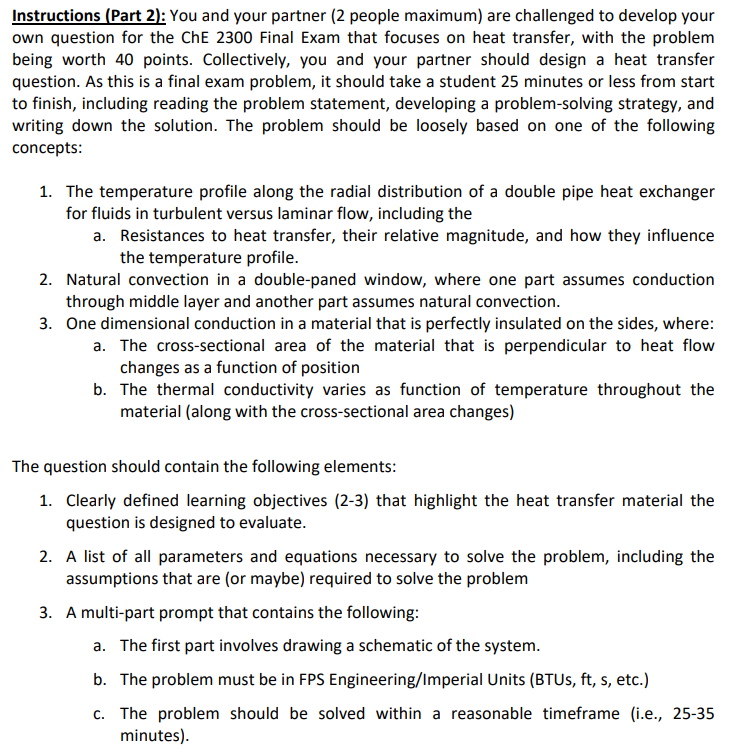
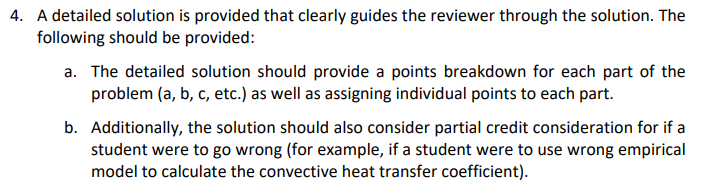
Instructions (Part 2): You and your partner (2 people maximum) are challenged to develop your own question for the ChE 2300 Final Exam that focuses on heat transfer, with the problem being worth 40 points. Collectively, you and your partner should design a heat transfer question. As this is a final exam problem, it should take a student 25 minutes or less from start to finish, including reading the problem statement, developing a problem-solving strategy, and writing down the solution. The problem should be loosely based on one of the following concepts: 1. The temperature profile along the radial distribution of a double pipe heat exchanger for fluids in turbulent versus laminar flow, including the a. Resistances to heat transfer, their relative magnitude, and how they influence the temperature profile. 2. Natural convection in a double-paned window, where one part assumes conduction through middle layer and another part assumes natural convection. 3. One dimensional conduction in a material that is perfectly insulated on the sides, where: a. The cross-sectional area of the material that is perpendicular to heat flow changes as a function of position b. The thermal conductivity varies as function of temperature throughout the material (along with the cross-sectional area changes) The question should contain the following elements: 1. Clearly defined learning objectives (2-3) that highlight the heat transfer material the question is designed to evaluate. 2. A list of all parameters and equations necessary to solve the problem, including the assumptions that are (or maybe) required to solve the problem 3. A multi-part prompt that contains the following: a. The first part involves drawing a schematic of the system. b. The problem must be in FPS Engineering/Imperial Units (BTUs, ft, s, etc.) c. The problem should be solved within a reasonable timeframe (i.e., 25-35 minutes). 4. A detailed solution is provided that clearly guides the reviewer through the solution. The following should be provided: a. The detailed solution should provide a points breakdown for each part of the problem (a, b, c, etc.) as well as assigning individual points to each part. b. Additionally, the solution should also consider partial credit consideration for if a student were to go wrong (for example, if a student were to use wrong empirical model to calculate the convective heat transfer coefficient). Instructions (Part 2): You and your partner (2 people maximum) are challenged to develop your own question for the ChE 2300 Final Exam that focuses on heat transfer, with the problem being worth 40 points. Collectively, you and your partner should design a heat transfer question. As this is a final exam problem, it should take a student 25 minutes or less from start to finish, including reading the problem statement, developing a problem-solving strategy, and writing down the solution. The problem should be loosely based on one of the following concepts: 1. The temperature profile along the radial distribution of a double pipe heat exchanger for fluids in turbulent versus laminar flow, including the a. Resistances to heat transfer, their relative magnitude, and how they influence the temperature profile. 2. Natural convection in a double-paned window, where one part assumes conduction through middle layer and another part assumes natural convection. 3. One dimensional conduction in a material that is perfectly insulated on the sides, where: a. The cross-sectional area of the material that is perpendicular to heat flow changes as a function of position b. The thermal conductivity varies as function of temperature throughout the material (along with the cross-sectional area changes) The question should contain the following elements: 1. Clearly defined learning objectives (2-3) that highlight the heat transfer material the question is designed to evaluate. 2. A list of all parameters and equations necessary to solve the problem, including the assumptions that are (or maybe) required to solve the problem 3. A multi-part prompt that contains the following: a. The first part involves drawing a schematic of the system. b. The problem must be in FPS Engineering/Imperial Units (BTUs, ft, s, etc.) c. The problem should be solved within a reasonable timeframe (i.e., 25-35 minutes). 4. A detailed solution is provided that clearly guides the reviewer through the solution. The following should be provided: a. The detailed solution should provide a points breakdown for each part of the problem (a, b, c, etc.) as well as assigning individual points to each part. b. Additionally, the solution should also consider partial credit consideration for if a student were to go wrong (for example, if a student were to use wrong empirical model to calculate the convective heat transfer coefficient)
Step by Step Solution
There are 3 Steps involved in it

Get step-by-step solutions from verified subject matter experts
 Study Help