







Question: I will like the answer with multiple accounts, The questions are: 1. Do you believe Zara has done a good job in its Value Chain?
I will like the answer with multiple accounts, The questions are:
1. Do you believe Zara has done a good job in its Value Chain? Please provide your rationale for your yes or no answer.
2. Characterize Zaras strategy based on the Integration Responsiveness grid, i.e. where do they fit?
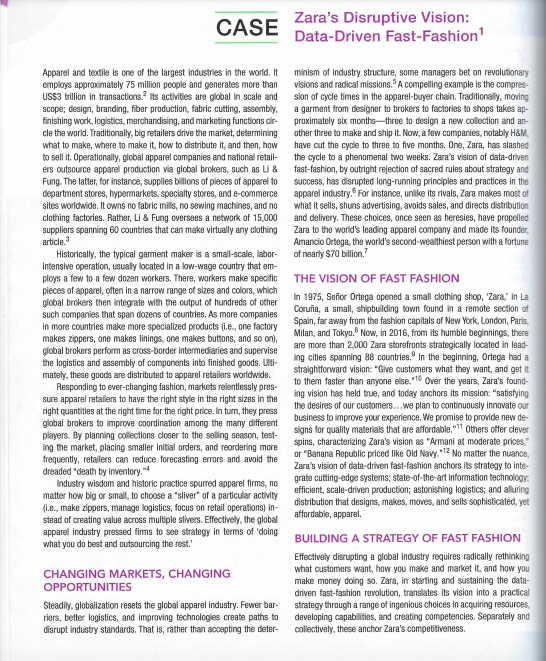
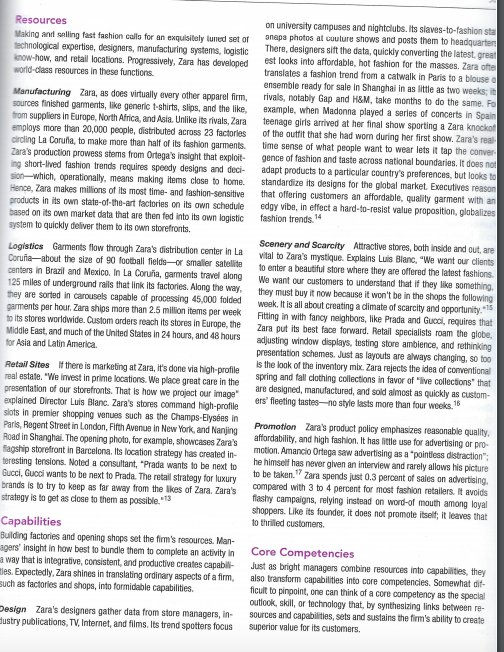
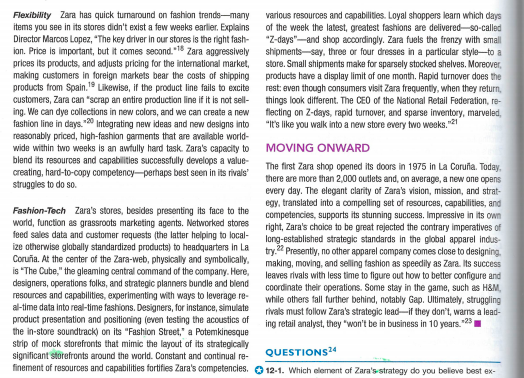
CASE Zara's Disruptive Vision: Data-Driven Fast-Fashion articles Apparel and textile is one of the largest industries in the world. It employs approximately 75 million people and generates more than US$3 trillion in transactions. Its activities are global in scale and scope; design, branding, fiber production, fabric cutting, assembly. finishing work, logistics, merchandising, and marketing functions cir cle the world. Traditionally, big retailers drive the market, determining what to make, where to make it, how to distribute it and then, how to sell it. Operationally, global apparel companies and national retail- ers outsource apparel production via global brokers, such as L & Fung. The latter, for instance, supplies billions of pieces of apparel to department stores, hypermarkets, specialty stores, and e-commerce sites worldwide. It owns no fabric mills, no sewing machines, and no clothing factories. Rather, Li & Fung oversees a network of 15,000 suppliers spanning 60 countries that can make virtually any clothing Historically, the typical garment maker is a small-scale, labor- intensive operation, usually located in a low-wage country that em- ploys a few to a few dozen workers. There, workers make specific pieces of apparel, often in a narrow range of sizes and colors, which global brokers then integrate with the output of hundreds of other such companies that span dozens of countries. As more companies in more countries make more specialized products (.e., one factory makes zippers, one makes linings, one males buttons, and so on), global brokers perform as cross-border intermediaries and supervise the logistics and assembly of components into finished goods. Ulti- mately, these goods are distributed to apparel retailers worldwide. Responding to ever-changing fashion, markets relentlessly pres. sure apparel retailers to have the right style in the right sizes in the right quantities at the right time for the right price. In turn, they press global brokers to improve coordination among the many different players. By planning collections closer to the selling season, test- ing the market, placing smaller initial orders, and reordering more frequently, retailers can reduce forecasting errors and avoid the dreaded "death by inventory4 Industry wisdom and historic practice spurred apparel firms, no matter how big or small, to choose a "sliver of a particular activity (i.e., make zippers, manage logistics, focus on retail operations) in- stead of creating value across multiple slivers. Effectively, the global apparel industry pressed firms to see strategy in terms of doing what you do best and outsourcing the rest.' minism of industry structure, some managers bet on revolutionary visions and radical missions. A compelling example is the compres sion of cyde times in the apparel-buyer chain. Traditionally, moving a garment from designer to brokers to factories to shops takes ap- proximately six months-three to design a new collection and an- ather three to make and ship it. Now, a few companies, notably H&M, have cut the cycle to three to five months. One, Zara, has slashed the cycle to a phenomenal two weeks. Zara's vision of data-driven fast-fashion, by outright rejection of sacred rules about strategy and Success, has disrupted long-running principles and practices in the apparel industry. For instance, unlike its rivals, Zara makes most of what it sells, shuns advertising, avoids sales, and directs distribution and delivery. These choices, once seen as heresies, have propelled Zara to the world's leading apparel company and made its founder, Amancio Ortega, the world's second-wealthiest person with a fortune of nearly $70 billion? THE VISION OF FAST FASHION In 1975, Seor Ortega opened a small clothing shop, Zara," in La Corua, a small, shipbuilding town found in a remote section of Spain, far away from the fashion capitals of New York, London, Paris, Milan, and Tokyo. Now, in 2016, from its humble beginnings, there are more than 2,000 Zara storefronts Strategically located in lead- ing cities spanning 88 countries. In the beginning, Ortega had a straightforward vision: "Glve customers what they want, and get it to them faster than anyone else. 10 Over the years, Zara's found- ing vision has held true, and today anchors its mission: "satisfying the desires of our customers...we plan to continuously innovate our business to improve your experience. We promise to provide new de- signs for quality materials that are affordable." Others offer dever spins, characterizing Zara's vision as "Armani at moderate prices." or "Banana Republic priced like Old Navy.*12 No matter the nuance, Zara's vision of data-driven fast-fashion anchors its strategy to inte- grate cutting-edge systems; state-of-the-art information technology, efficient, scale-driven production; astonishing logistics, and alluring distribution that designs, makes, moves, and sells sophisticated, yet affordable, apparel. BUILDING A STRATEGY OF FAST FASHION Effectively disrupting a global Industry requires radically rethinking what customers want, how you make and market it, and how you make money doing so. Zara, in starting and sustaining the data- driven fast-fashion revolution, translates its vision into a practical strategy through a range of ingenious choices in acquiring resources, developing capabilities, and creating competencies. Separately and collectively, these anchor Zara's competitiveness CHANGING MARKETS, CHANGING OPPORTUNITIES Steadily, globalization resets the global apparel industry. Fewer bar- riers, better logistics, and improving technologies create paths to disrupt industry standards. That is, rather than accepting the deter- Resources Making and selling fast fashion calls for an exquisitely luled set of technological expertise, designers, manufacturing systems, logistic know-how, and retail locations. Progressively, Zara has developed world-class resources in these functions. Manufacturing Zara, as does virtually every other apparel firm, sources finished garments, like generic t-shirts, slios, and the like, from suppliers in Europe, North Africa, and Asia. Unlike its rivals, Zara employs more than 20,000 people, distributed across 23 factories circling La Coruna, to make more than half of its fashion garments Zara's production prowess stems from Ortega's insight that exploit ing short-lived fashion trends requires speedy designs and deci- sion-which, operationally, means making items close to home. Hence, Zara makes millions of its most time and fashion-sensitive products in its own state-of-the-art factories on its own schedule based on its own market data that are then fed into its own logistic system to quickly deliver them to its own storefronts. Logistics Garments flow through Zara's distribution center in La Corunia-about the size of 90 football fields or smaller satellite centers in Brazil and Mexico. In La Corua, garments travel along 125 miles of underground rails that link its factories. Along the way, they are sorted in carousels capable of processing 45,000 folded garments per hour. Zara ships more than 2.5 million items per week to its stores worldwide. Custom orders reach its stores in Europe, the Middle East, and much of the United States in 24 hours, and 48 hours for Asia and Latin America on university campuses and nightclubs. Its slaves-to-fashion sta anapa photos al couture shows and posts them to headquarter There, designers sift the data, quickly converting the latest, grea! est looks into affordable, hot fashion for the masses. Zara otte translates a fashion trend from a catwalk in Paris to a blouse ensemble ready for sale in Shanghai in as little as two weeks; it rivals, notably Gap and H&M, take months to do the same. Fa example, when Madonna played a series of concerts in Spain teenage girls arrived at her final show sporting a Zara knockor of the outfit that she had wom during her first show. Zara's real time sense of what people want to wear lets it tap the conver gence of fashion and taste across national boundaries. It does not adapt products to a particular country's preferences, but looks to standardize its designs for the global market. Executives reason that offering customers an affordable, quality garment with an edgy vibe, in effect a hard-to-resist value proposition, globalizes fashion trends.14 Scenery and Scarcity Attractive stores, both inside and out, are vital to Zara's mystique. Explains Luis Blanc, "We want our clients to enter a beautiful store where they are offered the latest fashions We want our customers to understand that if they like something they must buy it now because it won't be in the shops the following week. It is all about creating a dimate of scarcity and opportunity -15 Fitting in with fancy neighbors, like Prada and Gucci, requires that Zara put its best face forward. Retail specialists roam the globe, adjusting window displays, testing store ambience, and rethinking presentation schemes. Just as layouts are always changing, so too is the look of the inventory mix. Zara rejects the idea of conventional spring and fall clothing collections in favor of "live collections that are designed, manufactured, and sold almost as quickly as custom- ers' fleeting tastes-no style lasts more than four weeks. 18 Retail Sites If there is marketing at Zara, it's done via high-profile real estate. "We invest in prime locations. We place great care in the presentation of our storefronts. That is how we project our image" explained Director Luis Blanc. Zara's stores command high-profile slots in premier shopping venues such as the Champs-Elyses in Paris, Regent Street in London, Fifth Avenue in New York, and Nanjing Road in Shanghai. The opening photo, for example, showcases Zara's Tagship storefront in Barcelona. Its location strategy has created in teresting tensions. Noted a consultant, "Prada wants to be next to Gucci Gucci wants to be next to Prada. The retail strategy for luxury brands is to try to keep as far away from the likes of Zara. Zara's strategy is to get as close to them as possible. 13 Capabilities Building factories and opening shops set the firm's resources. Man- agers' insight in how best to bundle them to complete an activity in a way that is integrative, consistent, and productive creates capabil- mies. Expectedly, Zara shines in translating ordinary aspects of a firm, such as factories and shops, into formidable capabilities. Promotion Zara's product policy emphasizes reasonable quality affordability, and high fashion. It has little use for advertising or pro- motion. Amancio Ortega saw advertising as a pointless distraction": he himself has never given an interview and rarely allows his picture to be taken." Zara spends just 0.3 percent of sales an advertising, compared with 3 to 4 percent for most fashion retailers. It avoids flashy campaigns, relying instead on word-of mouth among loyal shoppers. Like its founder, it does not promote itself; it leaves that to thrilled customers. Core Competencies Just as bright managers combine resources into capabilities, they also transform capabilities into core competencies. Somewhat dif- ficult to pinpoint, one can think of a core competency as the special outlook, skill, or technology that, by synthesizing links between re- sources and capabilities, sets and sustains the firm's ability to create superior value for its customers. Design Zara's designers gather data from store managers, in dustry publications, TV, Internet, and films. Its trend spotters focus
Step by Step Solution
There are 3 Steps involved in it
1 Expert Approved Answer
Step: 1 Unlock

Question Has Been Solved by an Expert!
Get step-by-step solutions from verified subject matter experts
Step: 2 Unlock
Step: 3 Unlock
 Study Help