







Question: I will provide below the original problem and the code I've written. What is my code doing wrong? Traveling Salesperson Problem - - Held -
I will provide below the original problem and the code I've written. What is my code doing wrong?
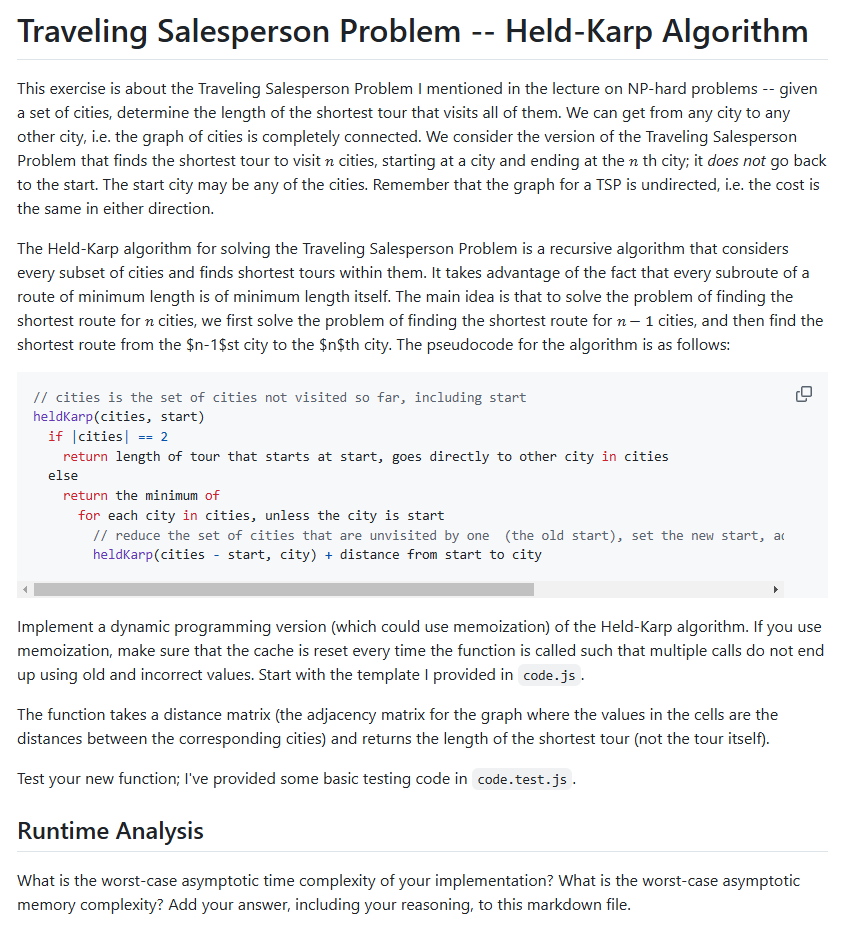
Traveling Salesperson Problem HeldKarp Algorithm
This exercise is about the Traveling Salesperson Problem I mentioned in the lecture on NPhard problems given a set of cities, determine the length of the shortest tour that visits all of them. We can get from any city to any other city, ie the graph of cities is completely connected. We consider the version of the Traveling Salesperson Problem that finds the shortest tour to visit n cities, starting at a city and ending at the n th city; it does not go back to the start. The start city may be any of the cities. Remember that the graph for a TSP is undirected, ie the cost is the same in either direction.
The HeldKarp algorithm for solving the Traveling Salesperson Problem is a recursive algorithm that considers every subset of cities and finds shortest tours within them. It takes advantage of the fact that every subroute of a route of minimum length is of minimum length itself. The main idea is that to solve the problem of finding the shortest route for n cities, we first solve the problem of finding the shortest route for n cities, and then find the shortest route from the $ n$ st city to the $ n $ th city. The pseudocode for the algorithm is as follows:
cities is the set of cities not visited so far, including start
heldKarpcities start
if cities
return length of tour that starts at start, goes directly to other city in cities
else
return the minimum of
for each city in cities, unless the city is start
reduce the set of cities that are unvisited by one the old start set the new start, ac
heldKarpcities start, city distance from start to city
Implement a dynamic programming version which could use memoization of the HeldKarp algorithm. If you use memoization, make sure that the cache is reset every time the function is called such that multiple calls do not end up using old and incorrect values. Start with the template I provided in
The function takes a distance matrix the adjacency matrix for the graph where the values in the cells are the distances between the corresponding cities and returns the length of the shortest tour not the tour itself
Test your new function; l've provided some basic testing code in
Runtime Analysis
What is the worstcase asymptotic time complexity of your implementation? What is the worstcase asymptotic memory complexity? Add your answer, including your reasoning, to this markdown file.
Js code.js
helper function that takes a list of cities, a start city, our distance matrix, and a set used for memoization, to recursively find the shortest path
function hkcities start, distancematrix, memoization
if citieslength
let end;
if cities start
end cities;
else
end cities;
return distancematrixstartend;
create a unique key for our current call of cities and start. got the idea for generating a unique key for each subproblem using this line from chatGPT
let memoizationKey cities.sortjoin start;
if we've already checked this subproblem, ie there already exists a value stored at this key, return that value
if memoizationmemoizationKey undefined
return memoizationmemoizationKey;
initialize our shortest path to infinity
let shortestPath Infinity;
initialize a nel set of cities to be used in recursive call that excludes our current city using a higher order filter function learned in functional
let unmarkedCities cities.filtercity city start;
loop through all cities in our list excluding our start city, as detailed in psuedocode
for let i ; i unmarkedCities.length; i
set our current city to be city at index i
let currentCity unmarkedCitiesi;
let pathDistance hkunmarkedCities currentCity, distancematrix, memoization distancematrixstartcurrentCity;
check if our path is shorter than what is currently the shortest path
if pathDistance shortestPath
if so set shortest path to be this path
shortestPath pathDistance;
memoize this shortest path by adding it to memoization at its unique key
memoizationmemoizationKey shortestPath;
return shortest path
return shortestPath;
function tsphkdistancematrix
initialize a list of cities using the keys along the length of the distance matrix
let cities Arraydistancematrix.lengthkeys;
initialize start to city
let start ;
initialize our memoization object as an empty set
let memoization ;
call our helper function with our initial variabl
Step by Step Solution
There are 3 Steps involved in it
1 Expert Approved Answer
Step: 1 Unlock

Question Has Been Solved by an Expert!
Get step-by-step solutions from verified subject matter experts
Step: 2 Unlock
Step: 3 Unlock
 Study Help