







Question: (i) With care and precision, graph the equilibrium found in (h) using two di agrams. In one diagram illustrate the market equilibrium. In the second
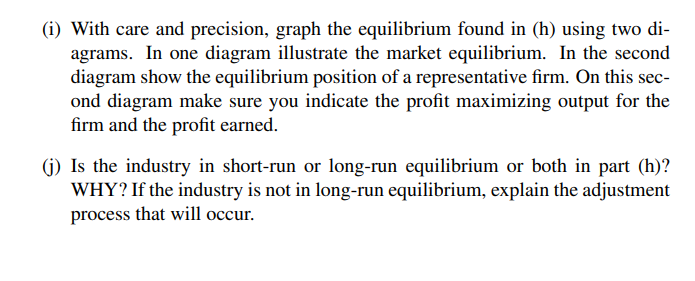
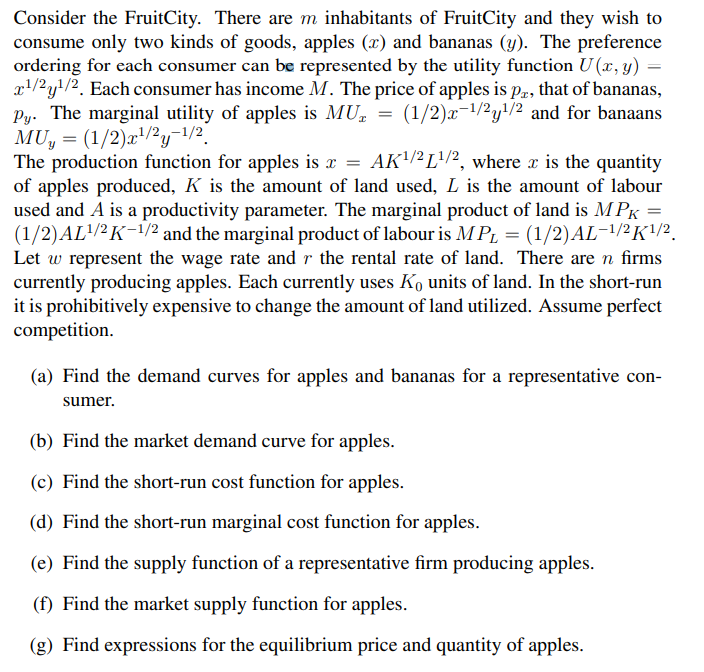
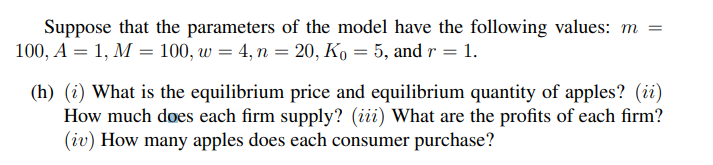
(i) With care and precision, graph the equilibrium found in (h) using two di agrams. In one diagram illustrate the market equilibrium. In the second diagram show the equilibrium position ofa representative rm. On this see ond diagram make sure you indicate the prot maximizing output for the rm and the prot earned. (j) Is the industryr in shortrun or longrun equilibrium or both in part (h)?ll WHY? If the industry is not in longrun equilibrium, explain the adjustment process that will occur. lConsider the FruitCity. There are m. inhabitants of FruitC'ity and they wish to consume only two kinds of goods, apples (.1?) and bananas {y}. The preference ordering for each consumer can be represented by the utility function U (as, y} .rlyl. Each consumer has income 311'. The price of apples is pr, that of bananas, pay. The marginal utility of apples is Mfr} = (1/2jx'1f2y1f2 and for banaans MU, = (1 /2}a;lr'2y'1r'2. The production function for apples is .r = AKHELUQ, where s: is the quantity of apples produced, If is the amount of land used, L is the amount of labour used and A is a productivity parameter. The marginal product of land is 111' P1,; = (MEAL-\"2 Kl and the marginal product of labour is 1'1pr = (MEAL\"EH\"? Let a: represent the wage rate and r the rental rate of land. There are n rms currently producing apples. Each currently uses It}; units of land. In the shortrun it is prohibitively expensive to change the amount of land utilized. Assume perfect competition. (a) Find the demand curves for apples and bananas for a representative con sumer. (b) Find the market demand curve for apples. (c) Find the shortrun cost function for apples. (d) Find the shortrun marginal cost function for apples. (c) Find the supply function of a representative rm producing apples. (f) Find the market supply function for apples. (g) Find expressions for the equilibrium price and quantity of apples. Suppose that the parameters of the model have the following values: m = 100.21 = 1.. M = lllllrul = 4.?1- = 20, K\" = E}, and r = 1. (h) (i) What is the equilibrium price and equilibrium quantityr of apples'? [it] HEW much does each rm supply? [ii-i) What are the prots of each rm'? (it!) How H1311}! apples does each consumer purchase
Step by Step Solution
There are 3 Steps involved in it

Get step-by-step solutions from verified subject matter experts
 Study Help