



Question: I would appreciate some help with his please. Prime Sieve A prime number is an integer greater than 1 that has no positive divisors other
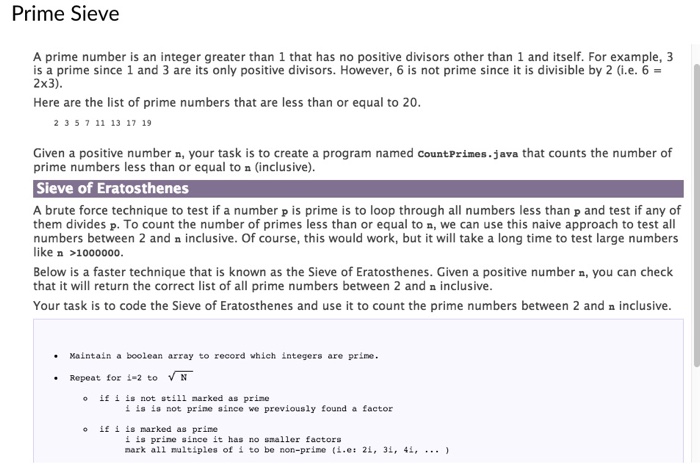
Prime Sieve A prime number is an integer greater than 1 that has no positive divisors other than 1 and itself. For example, 3 is a prime since 1 and 3 are its only positive divisors. However, 6 is not prime since it is divisible by 2 (i.e. 6 2x3). Here are the list of prime numbers that are less than or equal to 20. 2 3 57 11 13 17 19 Given a positive number n, your task is to create a program named countPrimes.java that counts the number of prime numbers less than or equal to n (inclusive) Sieve of Eratosthenes A brute force technique to test if a number p is prime is to loop through all numbers less than p and test if any of them divides p. To count the number of primes less than or equal to n, we can use this naive approach to test all numbers between 2 and n inclusive. Of course, this would work, but it will take a long time to test large numbers like n >100o000. Below is a faster technique that is known as the Sieve of Eratosthenes. Given a positive number n, you can check that it will return the correct list of all prime numbers between 2 and n inclusive. Your task is to code the Sieve of Eratosthenes and use it to count the prime numbers between 2 and n inclusive. Maintain a boolean array to record which integers are prine . Repeat for 1-2 to VN o if i is not still marked as prine is is not prine since we previously found a factor o if is narked as prime is prine since it has no snaller factors mark all nultiples of to be non-prime (e: 2,3, 4
Step by Step Solution
There are 3 Steps involved in it

Get step-by-step solutions from verified subject matter experts