



Question: I would be looking for each part (i), (ii), and (iii) to be answered. The WFQ questions should involve how the three (numerically assigned) weighted
I would be looking for each part (i), (ii), and (iii) to be answered. The WFQ questions should involve how the three (numerically assigned) weighted classes are managed 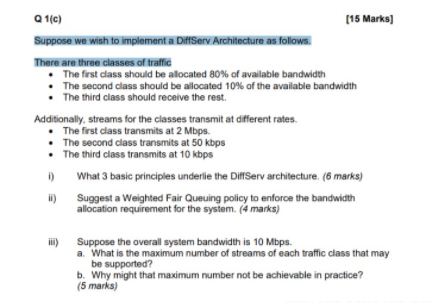
Suppose we wish to implement a DiffServ Architecture as follows. There are three classes of traffic - The first class should be allocated 80% of available bandwidth - The second class should be allocated 10% of the available bandwidth - The third class should receive the rest. Additionally, streams for the classes transmit at different rates. - The first class transmits at 2 Mbps. - The second class transmits at 50kbps - The third class transmits at 10kbps i) What 3 basic principles underlie the Difserv architecture. ( 6 marks) ii) Suggest a Weighted Fair Queuing policy to enforce the bandwidth allocation requirement for the system. (4 marks) iii) Suppose the overall system bandwidth is 10 Mbps. a. What is the maximum number of streams of each traftic class that may be supported? b. Why might that maximum mumber not be achievable in practice
Step by Step Solution
There are 3 Steps involved in it

Get step-by-step solutions from verified subject matter experts