







Question: I would like some assistance with the following Quantitative Methods probability distribution questions What is the correct equation for computing the expected value of perfect
I would like some assistance with the following Quantitative Methods probability distribution questions
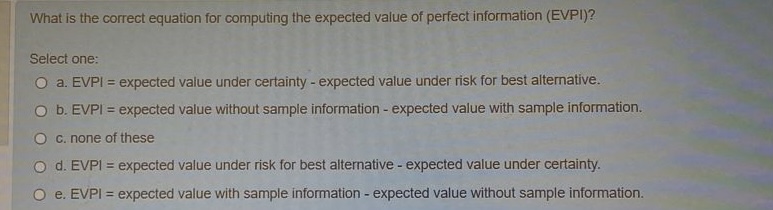
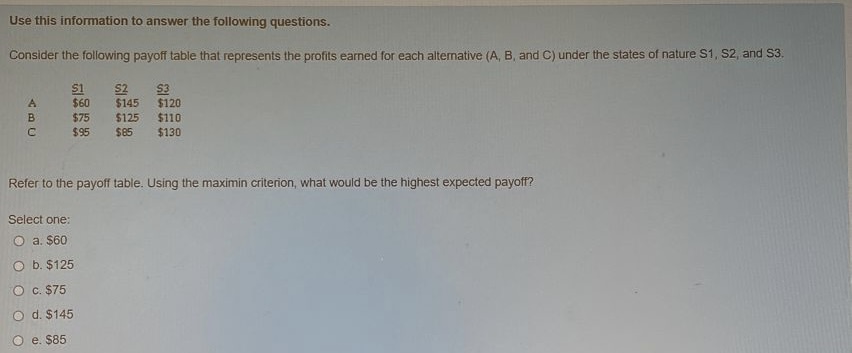
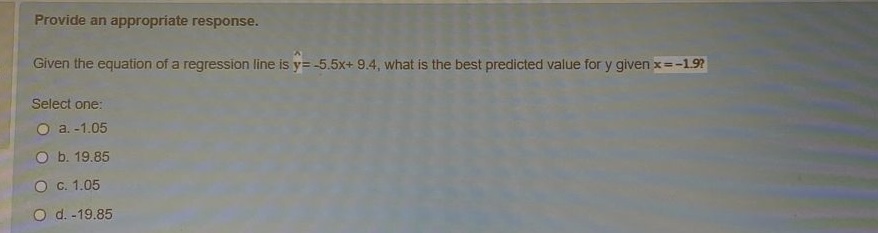
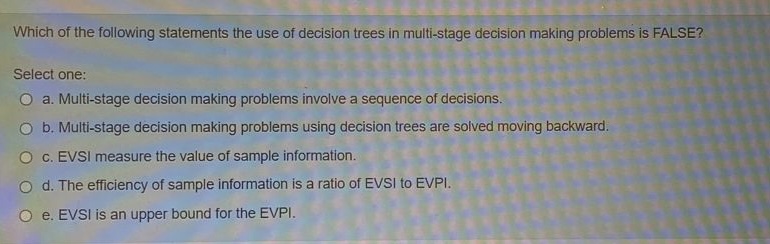
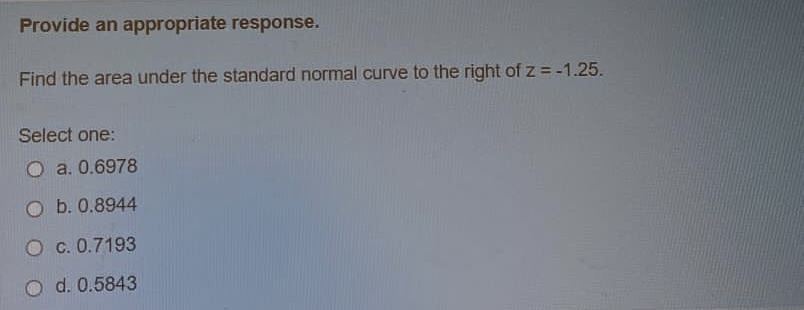
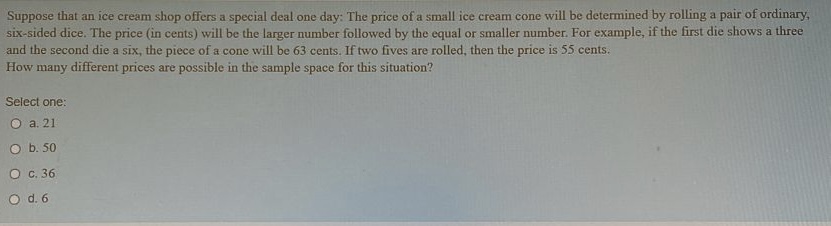
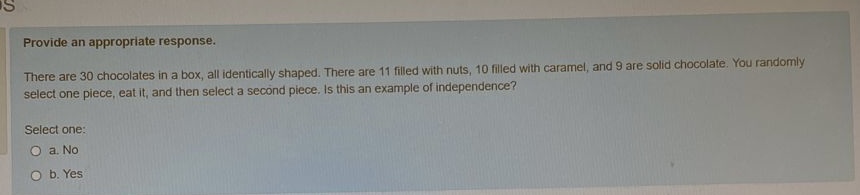
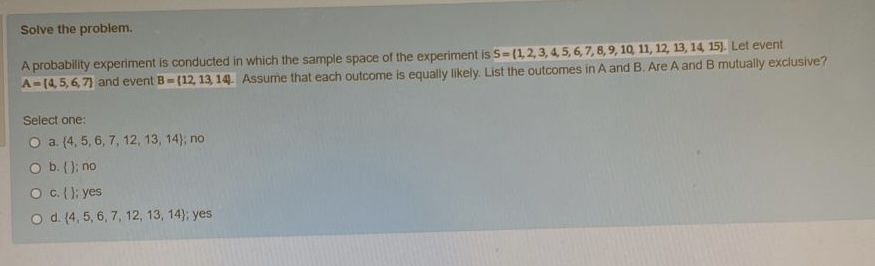
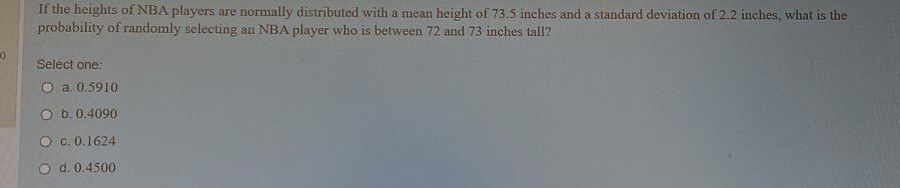
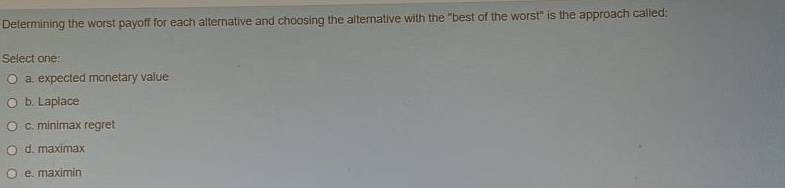
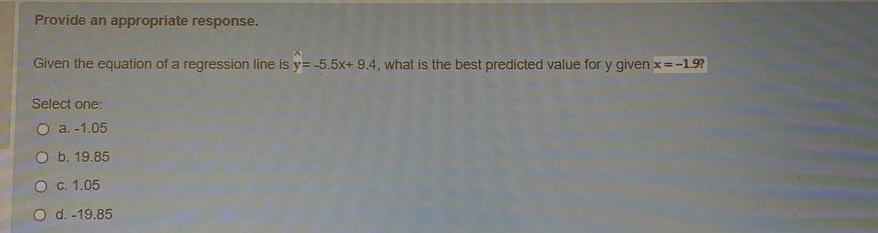
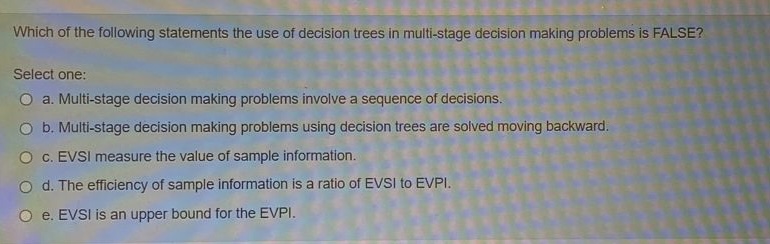
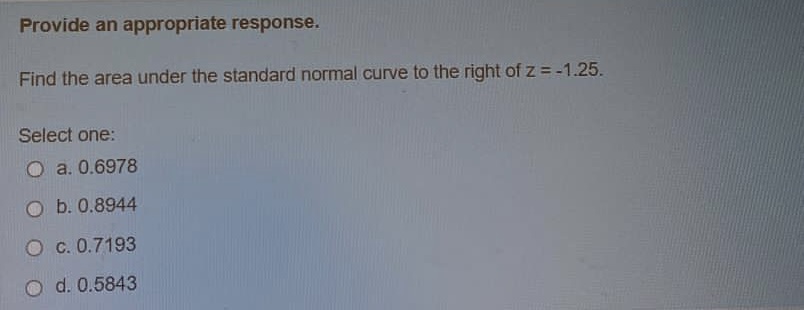
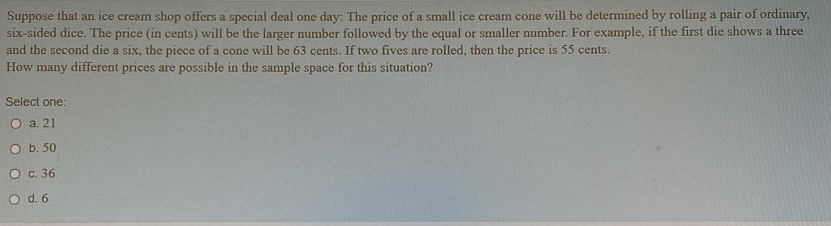
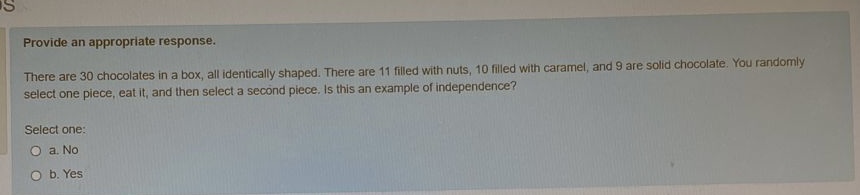
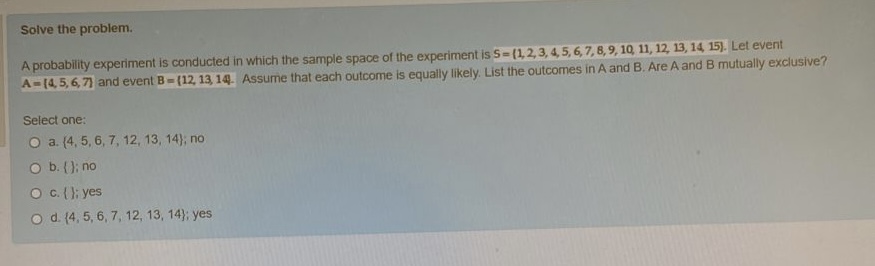
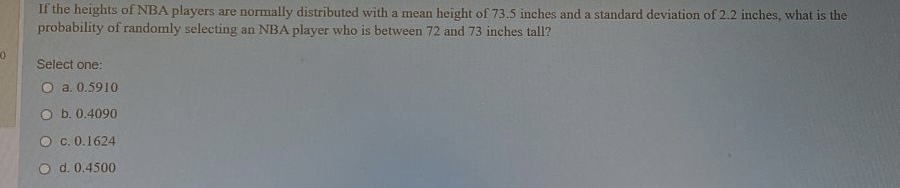
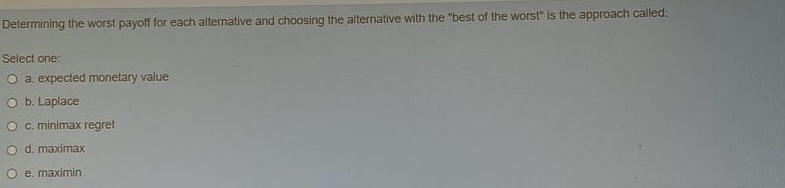
What is the correct equation for computing the expected value of perfect information (EVPI)? Select one: O a. EVPI = expected value under certainty - expected value under risk for best alternative. O b. EVPI = expected value without sample information - expected value with sample information. O c. none of these O d. EVPI = expected value under risk for best alternative - expected value under certainty. O e. EVPI = expected value with sample information - expected value without sample information.Use this information to answer the following questions. Consider the following payoff table that represents the profits earned for each alternative (A, B, and C) under the states of nature $1, $2, and $3. $2 A $60 $145 $120 B $75 $125 $110 $95 $85 $130 Refer to the payoff table. Using the maximin criterion, what would be the highest expected payoff? Select one: O a. $60 O b. $125 O c. $75 O d. $145 O e. $85Provide an appropriate response. Given the equation of a regression line is y= -5.5x+ 9.4, what is the best predicted value for y given x = -19? Select one: O a. -1.05 O b. 19.85 O C. 1.05 O d. -19.85Which of the following statements the use of decision trees in multi-stage decision making problems is FALSE? Select one: O a. Multi-stage decision making problems involve a sequence of decisions. O b. Multi-stage decision making problems using decision trees are solved moving backward. O c. EVSI measure the value of sample information. O d. The efficiency of sample information is a ratio of EVSI to EVPI. O e. EVSI is an upper bound for the EVPI.Provide an appropriate response. Find the area under the standard normal curve to the right of z = -1.25. Select one: O a. 0.6978 O b. 0.8944 O c. 0.7193 O d. 0.5843Suppose that an ice cream shop offers a special deal one day: The price of a small ice cream cone will be determined by rolling a pair of ordinary, six-sided dice. The price (in cents) will be the larger number followed by the equal or smaller number. For example, if the first die shows a three and the second die a six, the piece of a cone will be 63 cents. If two fives are rolled, then the price is 55 cents. How many different prices are possible in the sample space for this situation? Select one: O a. 21 O b. 50 O c. 36 O d. 6Provide an appropriate response. There are 30 chocolates in a box, all identically shaped. There are 11 filled with nuts, 10 filled with caramel, and 9 are solid chocolate. You randomly select one piece, eat it, and then select a second piece. Is this an example of independence? Select one: O a. No O b. YesSolve the problem. A probability experiment is conducted in which the sample space of the experiment is 5 = (1, 2, 3, 4, 5, 6, 7, 8, 9, 10, 11, 12, 13, 14, 15). Let event A- (4,5, 6, 7) and event B=(12 13, 14. Assume that each outcome is equally likely. List the outcomes in A and B. Are A and B mutually exclusive? Select one: O a. (4, 5, 6, 7, 12, 13, 14); no O b. [ ]; no O c. ( ); yes O d. (4, 5, 6, 7, 12, 13, 14); yesIf the heights of NBA players are normally distributed with a mean height of 73.5 inches and a standard deviation of 2.2 inches, what is the probability of randomly selecting an NBA player who is between 72 and 73 inches tall? Select one: O a. 0.5910 O b. 0.4090 O c. 0.1624 O d. 0.4500Determining the worst payoff for each alternative and choosing the alternative with the "best of the worst" is the approach called: Select one: O a expected monetary value O b. Laplace O c. minimax regret O d. maximax O e. maximin
Step by Step Solution
There are 3 Steps involved in it

Get step-by-step solutions from verified subject matter experts
 Study Help