







Question: I WOULD LIKE THIS PROBLEM DONE IN PYTHON AND SHOULD BE DONE RECURSIVELY AND THE OUTPUT SHOULD BE THE ONE MATCHING THE EXAMPLES Given an
I WOULD LIKE THIS PROBLEM DONE IN PYTHON AND SHOULD BE DONE RECURSIVELY AND THE OUTPUT SHOULD BE THE ONE MATCHING THE EXAMPLES
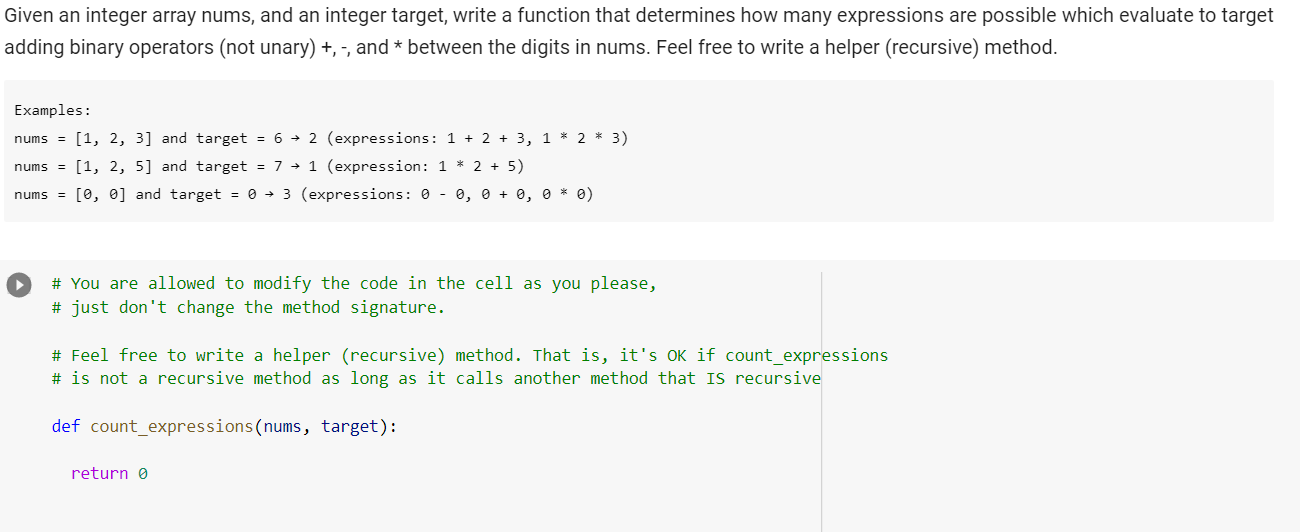
Given an integer array nums, and an integer target, write a function that determines how many expressions are possible which evaluate to target adding binary operators (not unary) +, ; and * between the digits in nums. Feel free to write a helper (recursive) method. Examples: nums = [1, 2, 3] and target = 6 + 2 (expressions: 1 + 2 + 3, 1 * 2 * 3) nums = [1, 2, 5] and target = 7 + 1 (expression: 1 * 2 + 5) nums = [0, 0] and target = 0 + 3 (expressions: 0-0, 0 + 0,0 * 0) # You are allowed to modify the code in the cell as you please, # just don't change the method signature. # Feel free to write a helper (recursive) method. That is, it's ok if count_expressions # is not a recursive method as long as it calls another method that is recursive def count_expressions(nums, target): return o
Step by Step Solution
There are 3 Steps involved in it

Get step-by-step solutions from verified subject matter experts
 Study Help