







Question: I would like to get the answer for this question below, thanks. 10. The consumer price index, or CPI, measures the cost of living for
I would like to get the answer for this question below, thanks.
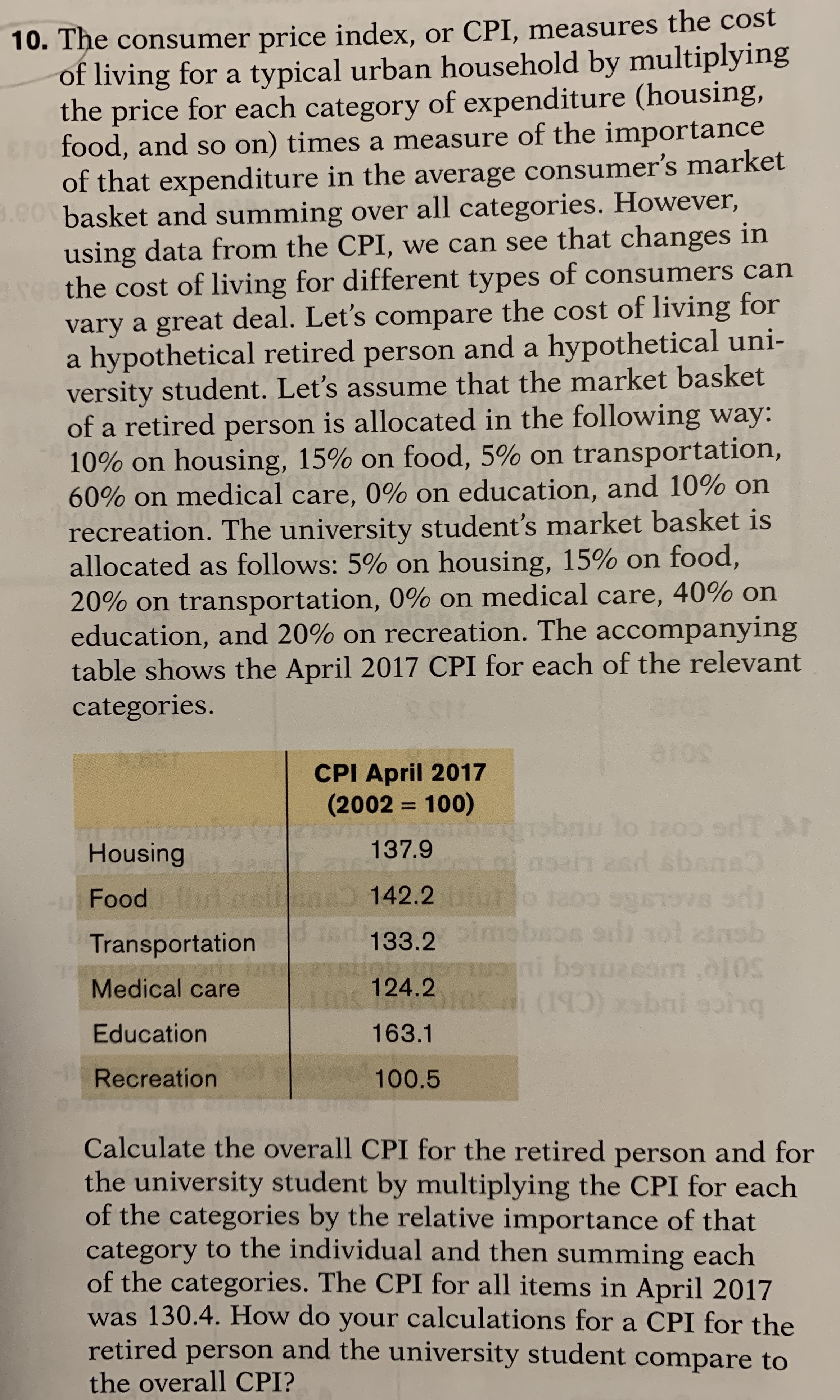
10. The consumer price index, or CPI, measures the cost of living for a typical urban household by multiplying the price for each category of expenditure (housing, to food, and so on) times a measure of the importance of that expenditure in the average consumer's market basket and summing over all categories. However, using data from the CPI, we can see that changes in "the cost of living for different types of consumers can vary a great deal. Let's compare the cost of living for a hypothetical retired person and a hypothetical uni- versity student. Let's assume that the market basket of a retired person is allocated in the following way: 10% on housing, 15% on food, 5% on transportation, 60% on medical care, 0% on education, and 10% on recreation. The university student's market basket is allocated as follows: 5% on housing, 15% on food, 20% on transportation, 0% on medical care, 40% on education, and 20% on recreation. The accompanying table shows the April 2017 CPI for each of the relevant categories. CPI April 2017 aros (2002 = 100) Housing 137.9 Thisbau lo reco andT .ar noen esd sbens) Foodsas 142.2 0 leoo sgsteve ard Transportation dish 133.2 simsbros sthi rot zinob Medical care 124.2 segni betesom ,810s las di (190) xsbai song Education 163.1 Recreation 100.5 Calculate the overall CPI for the retired person and for the university student by multiplying the CPI for each of the categories by the relative importance of that category to the individual and then summing each of the categories. The CPI for all items in April 2017 was 130.4. How do your calculations for a CPI for the retired person and the university student compare to the overall CPI
Step by Step Solution
There are 3 Steps involved in it

Get step-by-step solutions from verified subject matter experts
 Study Help