







Question: I would like to know if the boxes I checked are all correct thank you! Use your knowledge of natural deduction proofs in propositional logic
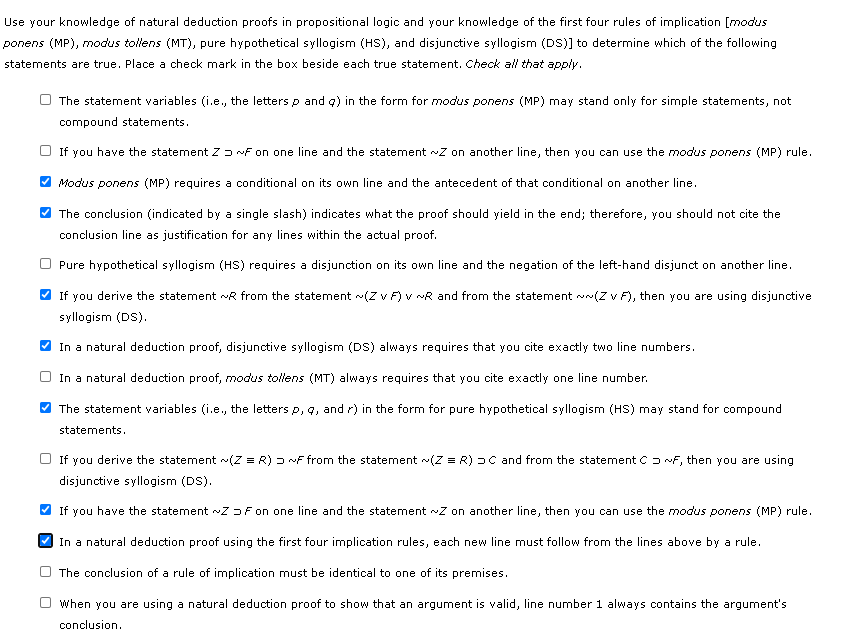
I would like to know if the boxes I checked are all correct thank you!
Use your knowledge of natural deduction proofs in propositional logic and your knowledge of the first four rules of implication [modus ponens (MP), modus tollens (MT), pure hypothetical syllogism (HS), and disjunctive syllogism (DS)] to determine which of the following statements are true. Place a check mark in the box beside each true statement. Check all that apply. The statement variables (i.e., the letters p and q) in the form for modus ponens (MP) may stand only for simple statements, not compound statements. If you have the statement ZawFon one line and the statement Z on another line, then you can use the modus ponens (MP) rule. Modus ponens (MP) requires a conditional on its own line and the antecedent of that conditional on another line. The conclusion (indicated by a single slash) indicates what the proof should yield in the end; therefore, you should not cite the conclusion line as justification for any lines within the actual proof. Pure hypothetical syllogism (HS) requires a disjunction on its own line and the negation of the left-hand disjunct on another line. If you derive the statement - from the statement (ZvF) VMR and from the statement (ZvF), then you are using disjunctive syllogism (DS). In a natural deduction proof, disjunctive syllogism (DS) always requires that you cite exactly two line numbers. In a natural deduction proof, modus tollens (MT) always requires that you cite exactly one line number. The statement variables (i.e., the letters p, q, and r) in the form for pure hypothetical syllogism (HS) may stand for compound statements O If you derive the statement (Z = R) F from the statement (Z = R) C and from the statement CF, then you are using disjunctive syllogism (DS). If you have the statement Za Fon one line and the statement Z on another line, then you can use the modus ponens (MP) rule. In a natural deduction proof using the first four implication rules, each new line must follow from the lines above by a rule. The conclusion of a rule of implication must be identical to one of its premises. When you are using a natural deduction proof to show that an argument is valid, line number 1 always contains the argument's conclusion
Step by Step Solution
There are 3 Steps involved in it

Get step-by-step solutions from verified subject matter experts
 Study Help