







Question: I'd appreciate the help In this lab we will use a couple of user defined functions to count the number of Prime Palindrome mmbers between
I'd appreciate the help
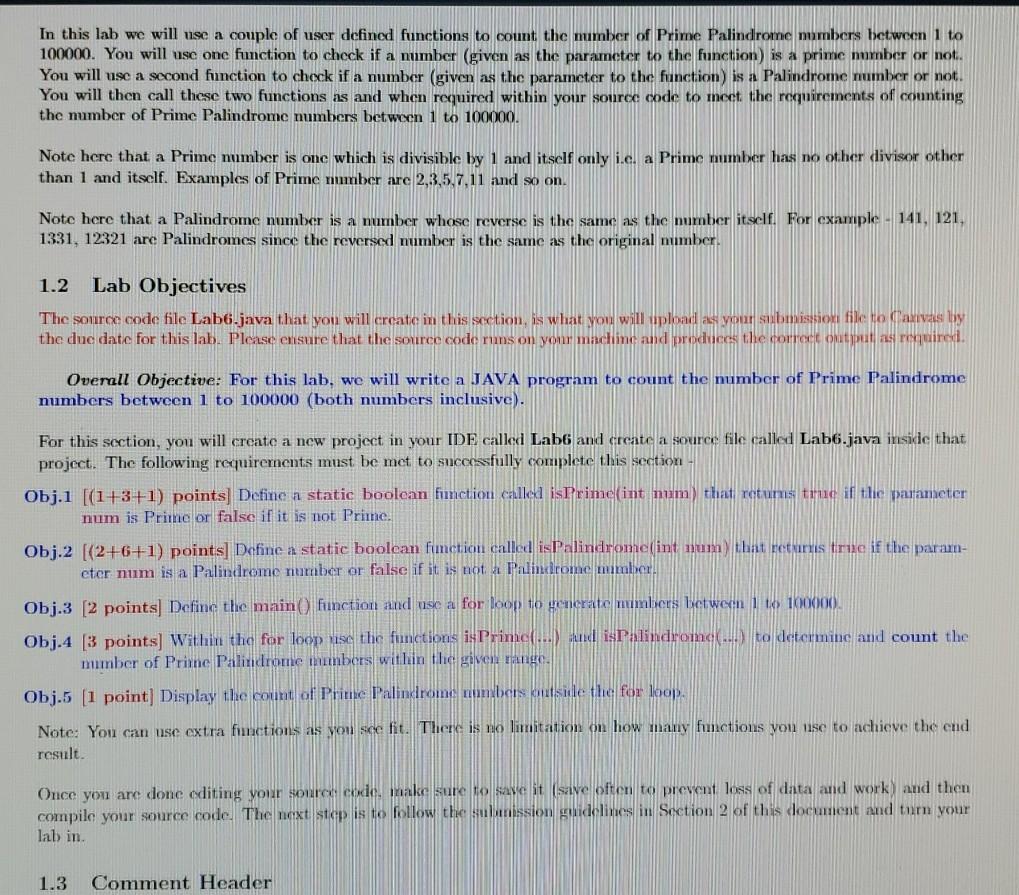
In this lab we will use a couple of user defined functions to count the number of Prime Palindrome mmbers between 1 to 100000. You will use one function to check if a mimber (given as the parameter to the function) is a prime mumber or not. You will use a second function to check if a number (given as the parameter to the function) is a Palindrome number or not. You will then call these two functions as and when required within your source code to meet the requirements of counting the number of Prime Palindrome numbcrs between 1 to 100000. Note here that a Prime number is one which is divisible by 1 and itself only i.e. a Prime number has no other divisor other than 1 and itself. Examples of Prime number are 2,3,5,7,11 and so on. Note here that a Palindrome number is a number whose reverse is the same as the number itself. For example - 141, 121, 1331, 12321 are Palindromes since the reversed number is the same as the original mumber. 1.2 Lab Objectives The source code file Lab6.java that you will create in this section, is what you will upload as your submission file to Canvas boy the due date for this lab. Please ensure that the source code runs on your machine and produces the correct output as required. Overall Objective: For this lab, we will write a JAVA program to count the number of Prime Palindrome numbers between 1 to 100000 (both numbers inclusive). For this section, you will create a new project in your IDE called Lab6 and create a source file called Lab6.java inside that project. The following requirements must be met to successfully mplete this section Obj.1 ((1+3+1) points) Define a static boolean function called isPrime(int num) that returns true if the parameter num is Prime or false if it is not Prime. Obj.2 [(2+6+1) points] Define a static boolean fimction called is Palindromelint numthat returns true if the param- etcr num is a Palindrome number or false if it is not aloneirome number Obj.3 [2 points] Define the main() function and use a for loop to generate numbers between 1 to 100000 Obj.4 (3 points) Within the for loop use the functions is Primc...) and isPalindrome ...) to determine and count the mumber of Princ Palindrome members within the given range. Obj.5 [1 point) Display the count of Prime Palindrome numbers outside the for loop Note: You can use extra functions as you see fit. There is no limitation on how many functions you use to achieve the end result. Once you are done editing your source code make sure to save it (save often to prevent loss of data and work) and then compile your source code. The next step is to follow the subunission guidelines in Section 2 of this document and turn your lab in. 1.3 Comment Header
Step by Step Solution
There are 3 Steps involved in it

Get step-by-step solutions from verified subject matter experts
 Study Help