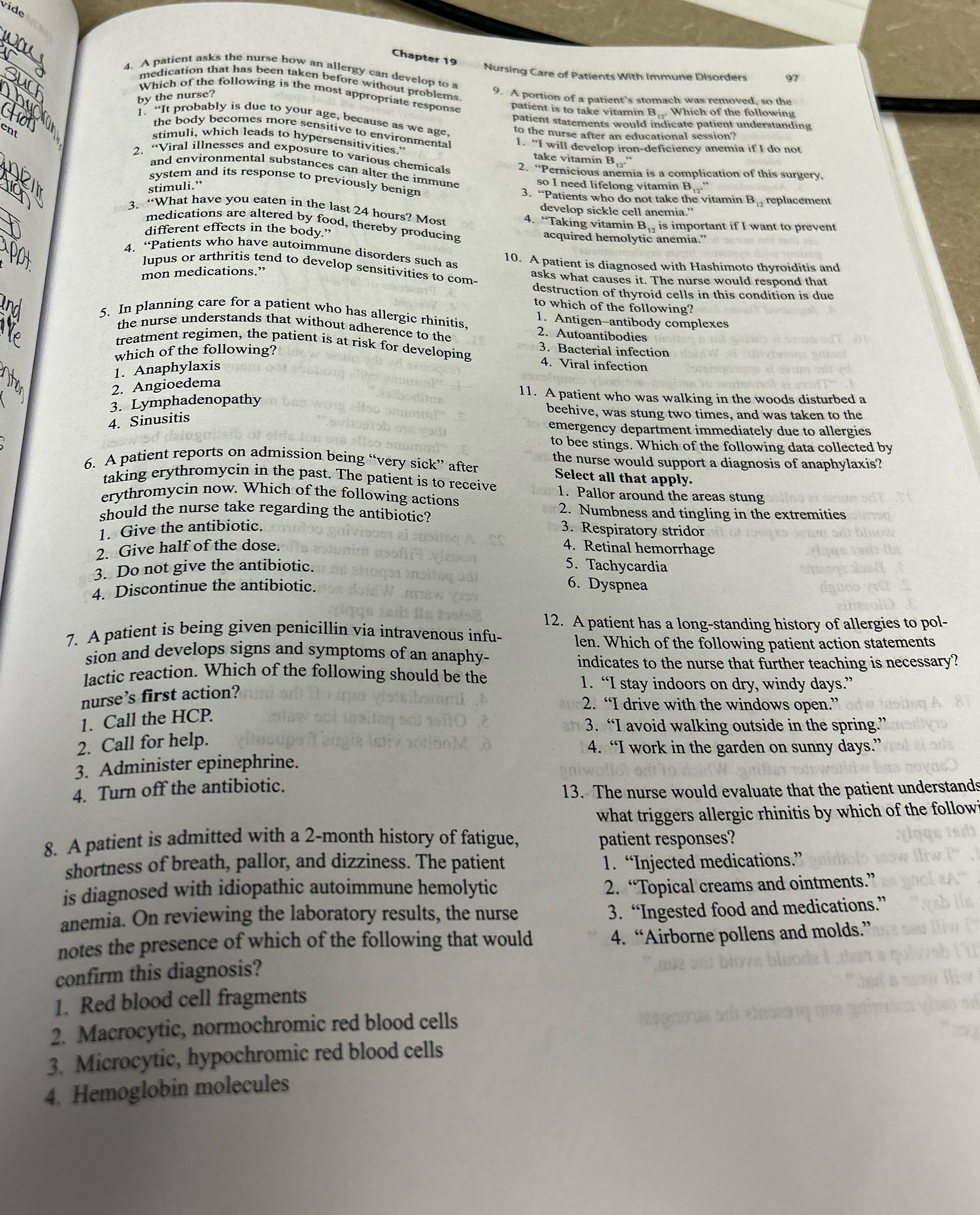
Question: ide was Chapter 19 A patient asks the nurse how an allergy can develop to a medication that has been taken before without problems. Nursing
ide was Chapter 19 A patient asks the nurse how an allergy can develop to a medication that has been taken before without problems. Nursing Care of Patients With Immune Disorders SUCH Which of the following is the most appropriate response by the nurse? 9. A portion of a patient's stomach was removed, so the "It probably is due to your age, because as we age, patient is to take vitamin B, Which of the following the body becomes more sensitive to environmental patient statements would indicate patient understanding ent stimuli, which leads to hypersensitivities." to the nurse after an educational session? 2. "Viral illnesses and exposure to various chemicals 1. "I will develop iron-deficiency anemia if I do not take vitamin B" and environmental substances can alter the immune 2. system and its response to previously benign "Pernicious anemia is a complication of this surgery, stimuli." 3. so I need lifelong vitamin B ,." "Patients who do not take the vitamin B,, replacement ."What have you eaten in the last 24 hours? Most develop sickle cell anemia." medications are altered by food, thereby producing 4. "Taking vitamin B,, is important if I want to prevent different effects in the body." acquired hemolytic anemia." Appt 4. "Patients who have autoimmune disorders such as lupus or arthritis tend to develop sensitivities to com- 10. A patient is diagnosed with Hashimoto thyroiditis and mon medications." asks what causes it. The nurse would respond that destruction of thyroid cells in this condition is due 5. In planning care for a patient who has allergic rhinitis, to which of the following? the nurse understands that without adherence to the 1. Antigen-antibody complexes treatment regimen, the patient is at risk for developing 2. Autoantibodies which of the following? 3. Bacterial infection 4. Viral infection 1. Anaphylaxis 2. Angioedema 11. A patient who was walking in the woods disturbed a 3. Lymphadenopathy beehive, was stung two times, and was taken to the . Sinusitis emergency department immediately due to allergies to bee stings. Which of the following data collected by 6. A patient reports on admission being "very sick" after the nurse would support a diagnosis of anaphylaxis? taking erythromycin in the past. The patient is to receive Select all that apply. erythromycin now. Which of the following actions 1. Pallor around the areas stung should the nurse take regarding the antibiotic? 2. Numbness and tingling in the extremities 1. Give the antibiotic. 3. Respiratory stridor 2. Give half of the dose.nim asofis anos 4. Retinal hemorrhage 3. Do not give the antibiotic.hegor mollaq and 5. Tachycardia 4. Discontinue the antibiotic.Wawa 6. Dyspnea 12. A patient has a long-standing history of allergies to pol- 7. A patient is being given penicillin via intravenous infu- len. Which of the following patient action statements sion and develops signs and symptoms of an anaphy- indicates to the nurse that further teaching is necessary? lactic reaction. Which of the following should be the 1. "I stay indoors on dry, windy days." nurse's first action? 2. "I drive with the windows open." orfe insisq A 81 1. Call the HCP. en 3. "I avoid walking outside in the spring." 2. Call for help. twoups Fergie latv wainoM o 4. "I work in the garden on sunny days."le ade 3. Administer epinephrine. 4. Turn off the antibiotic. 13. The nurse would evaluate that the patient understands what triggers allergic rhinitis by which of the follow 8. A patient is admitted with a 2-month history of fatigue, patient responses? shortness of breath, pallor, and dizziness. The patient 1. "Injected medications." nichol is diagnosed with idiopathic autoimmune hemolytic 2. "Topical creams and ointments." anemia. On reviewing the laboratory results, the nurse 3. "Ingested food and medications." 4. "Airborne pollens and molds." notes the presence of which of the following that would Ame and bioya blub confirm this diagnosis? 1. Red blood cell fragments 2. Macrocytic, normochromic red blood cells 3. Microcytic, hypochromic red blood cells 4. Hemoglobin molecules