







Question: Ideal Gas ( Work and Energy ) : Learning objectives: Calculate energy and enthalpy changes during a process using a detailed heat capacity fit. Understand
Ideal Gas Work and Energy:
Learning objectives:
Calculate energy and enthalpy changes during a process using a detailed heat capacity fit.
Understand relationship between and molecular structure.
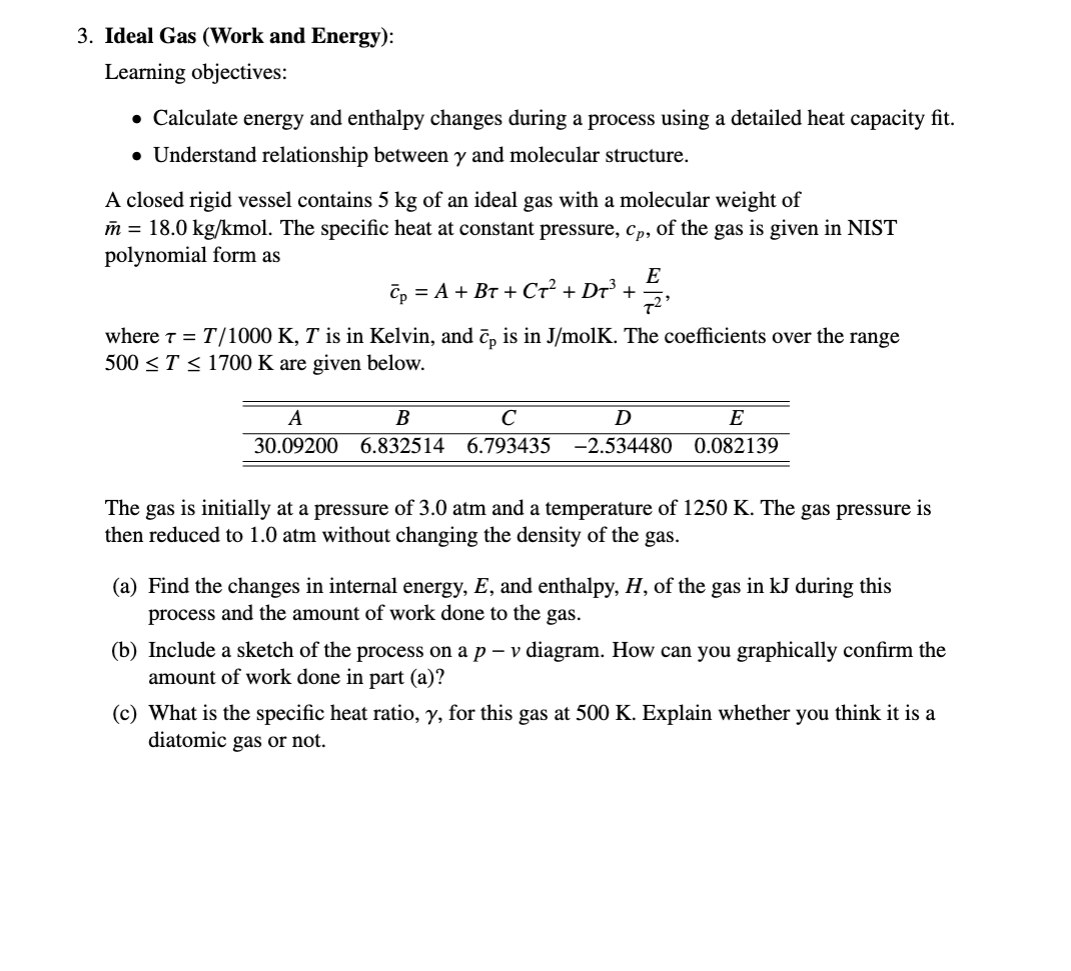
A closed rigid vessel contains kg of an ideal gas with a molecular weight of
mol. The specific heat at constant pressure, of the gas is given in NIST
polynomial form as
where is in Kelvin, and is in olK. The coefficients over the range
are given below.
The gas is initially at a pressure of atm and a temperature of K The gas pressure is
then reduced to atm without changing the density of the gas.
a Find the changes in internal energy, and enthalpy, of the gas in kJ during this
process and the amount of work done to the gas.
b Include a sketch of the process on a diagram. How can you graphically confirm the
amount of work done in part a
c What is the specific heat ratio, for this gas at K Explain whether you think it is a
diatomic gas or not.
Step by Step Solution
There are 3 Steps involved in it
1 Expert Approved Answer
Step: 1 Unlock

Question Has Been Solved by an Expert!
Get step-by-step solutions from verified subject matter experts
Step: 2 Unlock
Step: 3 Unlock
 Study Help