







Question: Ideas for the future: Fixed action patterns and breastfeeding In 2008, the Bristol Social Marketing Centre was asked to help with ideas for encouraging teenage
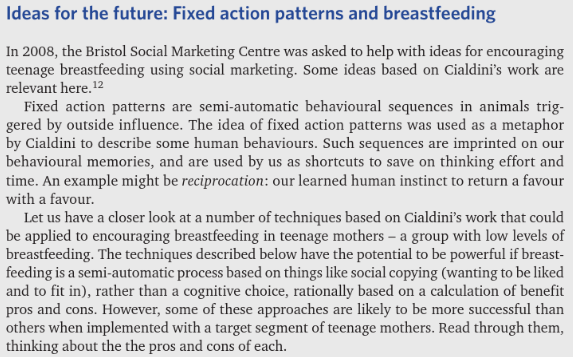
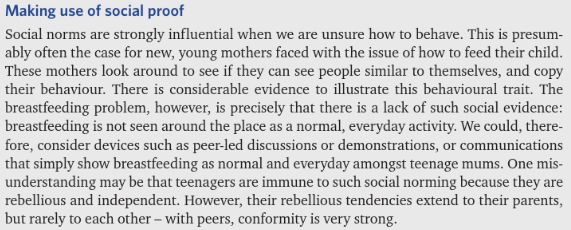
Ideas for the future: Fixed action patterns and breastfeeding In 2008, the Bristol Social Marketing Centre was asked to help with ideas for encouraging teenage breastfeeding using social marketing. Some ideas based on Cialdini's work are relevant here. 12 Fixed action patterns are semi-automatic behavioural sequences in animals trig- gered by outside influence. The idea of fixed action patterns was used as a metaphor by Cialdini to describe some human behaviours. Such sequences are imprinted on our behavioural memories, and are used by us as shortcuts to save on thinking effort and time. An example might be reciprocation: our learned human instinct to return a favour with a favour. Let us have a closer look at a number of techniques based on Cialdini's work that could be applied to encouraging breastfeeding in teenage mothers - a group with low levels of breastfeeding. The techniques described below have the potential to be powerful if breast- feeding is a semi-automatic process based on things like social copying (wanting to be liked and to fit in), rather than a cognitive choice, rationally based on a calculation of benefit pros and cons. However, some of these approaches are likely to be more successful than others when implemented with a target segment of teenage mothers. Read through them, thinking about the the pros and cons of each.Making use of social proof Social norms are strongly influential when we are unsure how to behave. This is presum- ably often the case for new, young mothers faced with the issue of how to feed their child. These mothers look around to see if they can see people similar to themselves, and copy their behaviour. There is considerable evidence to illustrate this behavioural trait. The breastfeeding problem, however, is precisely that there is a lack of such social evidence: breastfeeding is not seen around the place as a normal, everyday activity. We could, there- fore, consider devices such as peer-led discussions or demonstrations, or communications that simply show breastfeeding as normal and everyday amongst teenage mums. One mis- understanding may be that teenagers are immune to such social norming because they are rebellious and independent. However, their rebellious tendencies extend to their parents, but rarely to each other - with peers, conformity is very strong
Step by Step Solution
There are 3 Steps involved in it

Get step-by-step solutions from verified subject matter experts
 Study Help