Question: Identify Account Type nd Financial Statement on which it appears. Account Types Asset Liability Equity Income Expense Financial Statements Balance Sheet Profit and Loss Accounts
Identify Account Type nd Financial Statement on which it appears.
Account Types
Asset
Liability
Equity
Income
Expense
Financial Statements
Balance Sheet
Profit and Loss
Accounts
1. Design Income
2. Savings
3. Accounts Receivable (A/R)
4. Rent or Lease
5. Prepaid Expenses
6. Notes Payable
7. Inventory Asset
8. Opening Balance Equity
9. Utilities
10. Undeposited Funds
11. Accounts Payable (A/P)
12. MasterCard
13. Visa
14. Loan Payable
15. Sales of Product Income
16. Legal and Professional Fees
17. Advertising
18. Meals and Entertainment
19. Retained Earnings
20. Checking
21. Landscaping Services
22. Pest Control Services
23. Cost of Goods Sold
24. Automobile: Fuel
25. Bank Charges
26. Interest EarnedIdentify Account Type nd Financial Statement on which it appears.
Account Types
Asset
Liability
Equity
Income
Expense
Financial Statements
Balance Sheet
Profit and Loss
Accounts
1. Design Income
2. Savings
3. Accounts Receivable (A/R)
4. Rent or Lease
5. Prepaid Expenses
6. Notes Payable
7. Inventory Asset
8. Opening Balance Equity
9. Utilities
10. Undeposited Funds
11. Accounts Payable (A/P)
12. MasterCard
13. Visa
14. Loan Payable
15. Sales of Product Income
16. Legal and Professional Fees
17. Advertising
18. Meals and Entertainment
19. Retained Earnings
20. Checking
21. Landscaping Services
22. Pest Control Services
23. Cost of Goods Sold
24. Automobile: Fuel
25. Bank Charges
26. Interest Earned
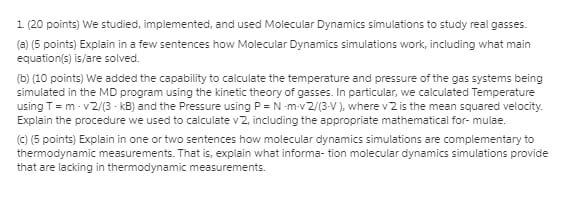
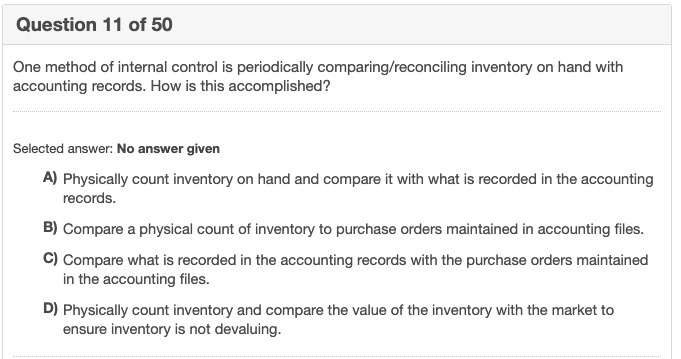
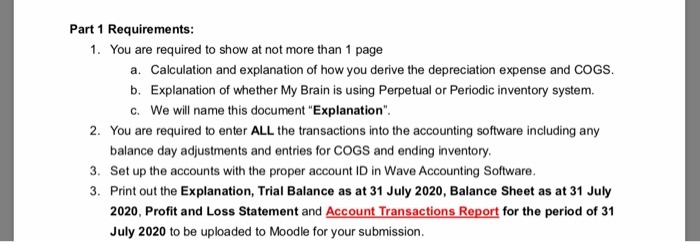
1 (20 points) We studied, implemented, and used Molecular Dynamics simulations to study real gasses. (a) (5 points) Explain in a few sentences how Molecular Dynamics simulations work, including what main equation(s) is/are solved. (b) (10 points) We added the capability to calculate the temperature and pressure of the gas systems being simulated in the MD program using the kinetic theory of gasses. In particular, we calculated Temperature using T = m - v2/(3 .kB) and the Pressure using P = N -m-v 2/(3-V ), where v2 is the mean squared velocity. Explain the procedure we used to calculate v2, including the appropriate mathematical for- mulae. (c) (5 points) Explain in one or two sentences how molecular dynamics simulations are complementary to thermodynamic measurements. That is, explain what informa- tion molecular dynamics simulations provide that are lacking in thermodynamic measurements.Question 11 of 50 One method of internal control is periodically comparing/reconciling inventory on hand with accounting records. How is this accomplished? Selected answer: No answer given A) Physically count inventory on hand and compare it with what is recorded in the accounting records. B) Compare a physical count of inventory to purchase orders maintained in accounting files. C) Compare what is recorded in the accounting records with the purchase orders maintained in the accounting files. D) Physically count inventory and compare the value of the inventory with the market to ensure inventory is not devaluing.Part 1 Requirements: 1. You are required to show at not more than 1 page a. Calculation and explanation of how you derive the depreciation expense and COGS. b. Explanation of whether My Brain is using Perpetual or Periodic inventory system. c. We will name this document "Explanation". 2. You are required to enter ALL the transactions into the accounting software including any balance day adjustments and entries for COGS and ending inventory. 3. Set up the accounts with the proper account ID in Wave Accounting Software. 3. Print out the Explanation, Trial Balance as at 31 July 2020, Balance Sheet as at 31 July 2020, Profit and Loss Statement and Account Transactions Report for the period of 31 July 2020 to be uploaded to Moodle for your submission









 Study Help