







Question: Identify and discuss three specific developments that each mark a significant change or shift in Greek justice and punishment from the Dark Age to the
Identify and discuss three specific developments that each mark a significant change or shift in Greek justice and punishment from the Dark Age to the late Archaic Age. Be sure to identify the broader change or shift in each case.
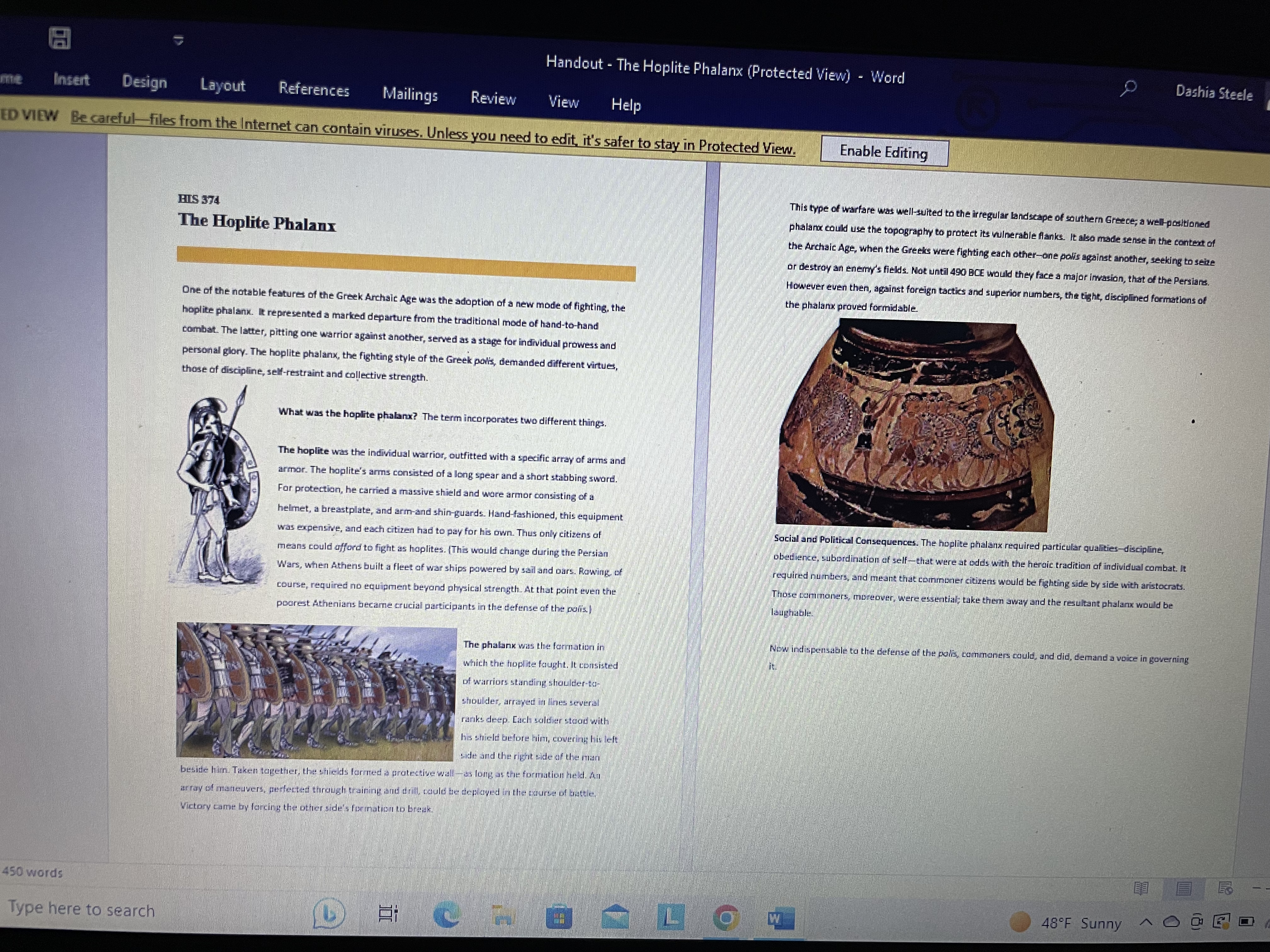
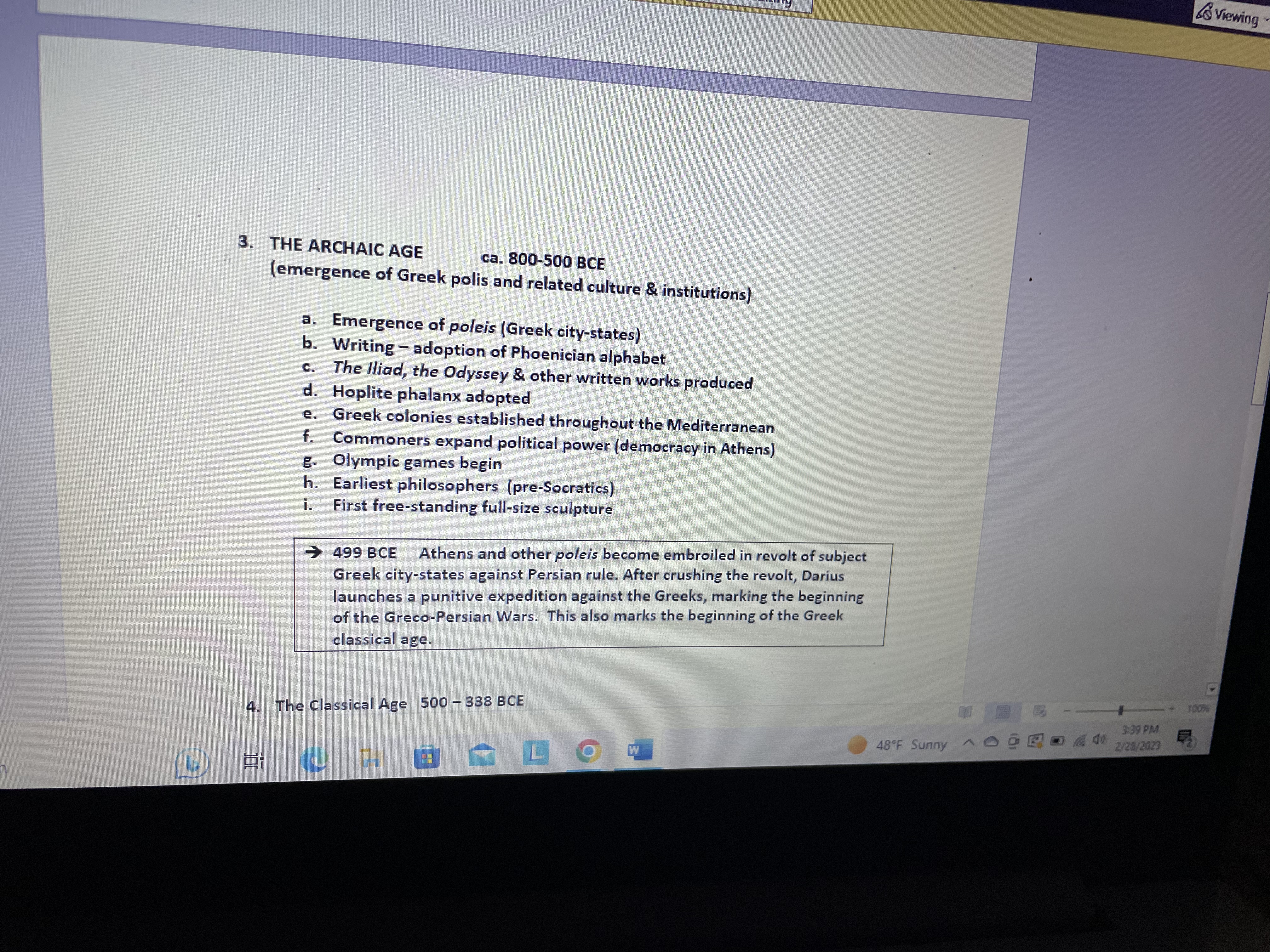

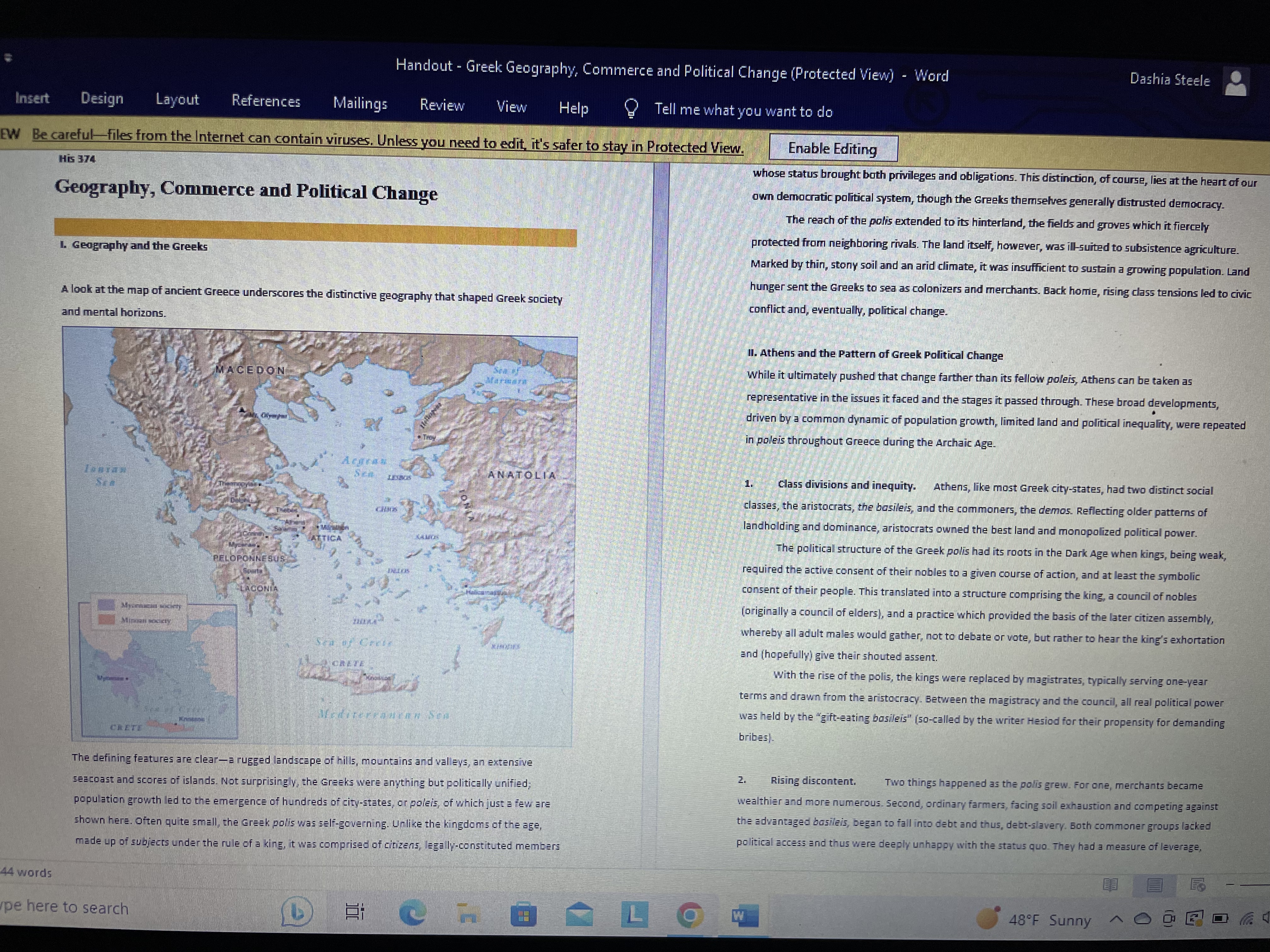
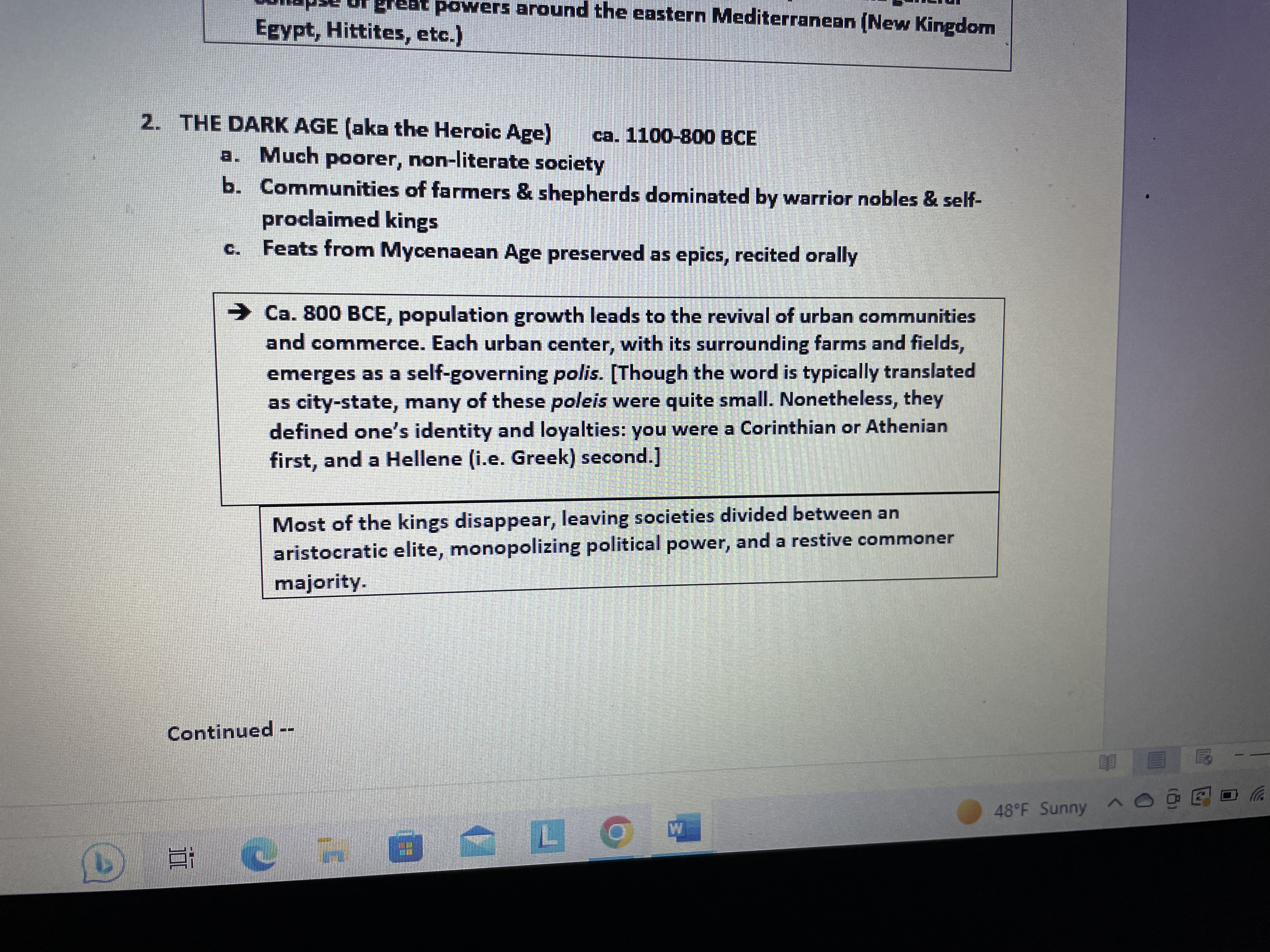
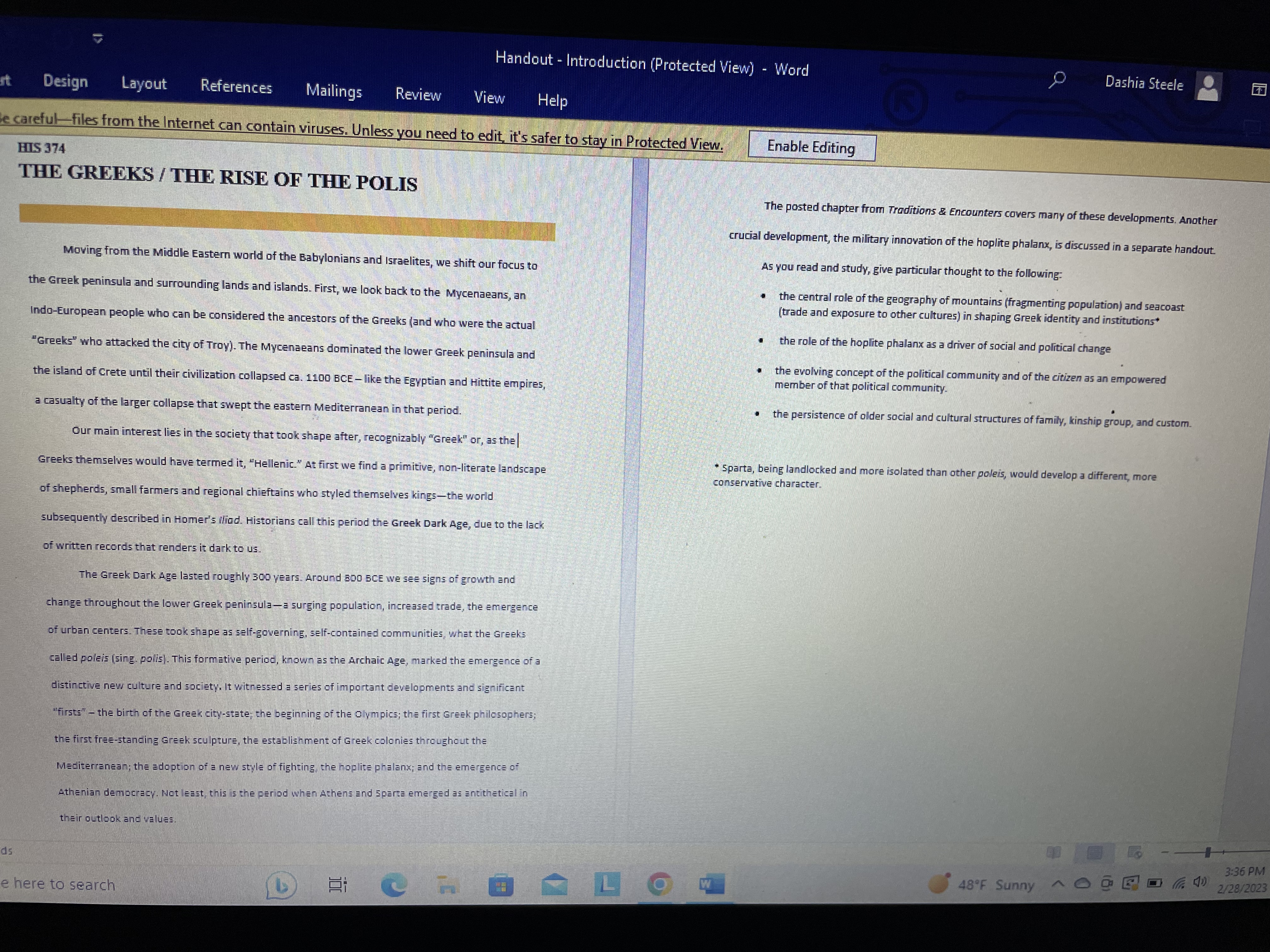
Handout - The Hoplite Phalanx (Protected View) - Word Dashia Steele Insert Design Layout References Mailings Review View Help ED VIEW Be careful-files from the Internet can contain viruses. Unless you need to edit, it's safer to stay in Protected View. Enable Editing This type of warfare was well-suited to the irregular landscape of southern Greece, a well-positioned HIS 374 phalanx could use the topography to protect its vulnerable flanks. It also made sense in the context of The Hoplite Phalanx the Archaic Age, when the Greeks were fighting each other-one polis against another, seeking to seize or destroy an enemy's fields. Not until 490 BCE would they face a major invasion, that of the Persianc. However even then, against foreign tactics and superior numbers, the tight, disciplined formations of One of the notable features of the Greek Archaic Age was the adoption of a new mode of fighting, the the phalanx proved formidable poplite phalanx. It represented a marked departure from the traditional made of hand-to-hand combat. The latter, pitting one warrior against another, served as a stage for individual prowess and personal glory. The hoplite phalanx, the fighting style of the Greek polls, demanded different virtues, those of discipline, self-restraint and collective strength. What was the hoplite phalanx? The term incorporates two different things. The hoplite was the individual warrior, outfitted with a specific array of arms and armor. The hoplite's arms consisted of a long spear and a short stabbing sword. For protection, he carried a massive shield and wore armor consisting of a helmet, a breastplate, and arm-and shin guards. Hand fashioned, this equipment was expensive, and each citizen had to pay for his own. Thus only citizens of Social and Political Consequences. The hoplite phalanx required particular qualities-discipline, means could afford to fight as hoplites. (This would change during the Persian obedience, subordination of self - that were at odds with the heroic tradition of individual combat. It Wars, when Athens built a fleet of war ships powered by sail and bars. Rowing of required numbers, and meant that commoner citizens would be fighting side by side with aristocrats . course, required no equipment beyond physical strength. At that point even the Those commoners. moreover, were essential take them away and the resultant phalanx would be poorest Athenians became crucial participants in the defense of the pors. } laughable The phalanx was the formation in New indispensable to the defense of the polls, commoners could, and did, demand a voice in governing which the toplite fought. It consisted of warrior standing shoulder-to- shoulder, arrayed in lines several rank: deep. Each solder stood with his shield before him, covering his lets side and the right side of the man beside him. Taken together, the shields formed a protective wall -as long as the formation held. an array of maneuvers, perfected through training and thin baule be deployed in the course of battle. Victory came by forcing the other side's for nation to break 450 words L W 48.F Sunny ~0 0 60 Type here to searchViewing 3. THE ARCHAIC AGE ca. 800-500 BCE (emergence of Greek polis and related culture & institutions) Emergence of poleis (Greek city-states) b. Writing - adoption of Phoenician alphabet c. The Iliad, the Odyssey & other written works produced d. Hoplite phalanx adopted e. Greek colonies established throughout the Mediterranean f. Commoners expand political power (democracy in Athens) g. Olympic games begin h. Earliest philosophers (pre-Socratics) i. First free-standing full-size sculpture 499 BCE Athens and other poleis become embroiled in revolt of subject Greek city-states against Persian rule. After crushing the revolt, Darius launches a punitive expedition against the Greeks, marking the beginning of the Greco-Persian Wars. This also marks the beginning of the Greek classical age. TOOK 4. The Classical Age 500 - 338 BCE 3:39 PM 48OF Sunny 2/28/2023 L O WHandout - Greek Geography, Commerce and Political Change (Protected View) - Word Dashia Steele Insert Design Layout References Mailings Review View Help Tell me what you want to do SO Vi W Be careful-files from the Internet can contain viruses. Unless you need to edit, it's safer to stay in Protected View. however, thanks to the hoplite phalanx and the fact that commoner participation was crucial to the Enable Editing polis's military defense. (See Handout 11.2 on the hoplite phalanx.) Cleisthenes and Athenian Democracy. Following the toppling of Peisistratus's son Hippies, an Concessions. Athenian aristocrat named cleisthenes assumed power, again with popular backing. He instituted a In the seventh century Athens adopted a written code of law, by eries of reforms that put power decisively in the hands of the Athenian demos. tradition attributed to the lawmaker Draco. Distinguished by its severe penalties, Draco's code gave The most significant involved the Assembly. Cleisthenes established the Athenian Assembly as rise to the term "draconian," used today to describe harsh measures. More notable in its time, he principal decision-making body of the polis. There questions touching on all aspects of Athenian life however, the written code brought the demos protection from arbitrary abuses. Further reforms could be broached and decided. All free adult male citizens were members, all were entitled to attend, occurred in 594 BCE when solon came to power as archon or chief magistrate. Both an aristocrat and a and all were entitled to speak and vote, irrespective of wealth or status. While the ongoing work of merchant, solon was trusted by both sides to make changes to the Athenian system. As noted in the government was done by the council of 500 (an expanded version of solon's council of 400], the textbook, he abolished the practice of debt slavery and gave relief to its victims, an action welcomed by Assembly still met regularly and dealt with the major business facing the polis. Thus in fifth-century poor commoners. In addition, he created a new Council of 400, open to those with a certain amount of Athens we find the determined creation of direct, participatory democracy. wealth-the amount judged necessary to purchase hoplite arms and armor. This addressed the Another innovation was the practice of ostracism. Derived from the Greek word ostrokon, grievances of Athens' more affluent commoners, such as merchants. Additionally Solon instituted a meaning a broken pottery shard, ostracism was designed to keep any one Athenian from gaining too number of economic reforms. While making Athens more commercially competitive, these also spurred much power. It was done through a vote. All adult male citizens would be called upon to mark down encouraged Athenian farmers to abandon grain cultivation in favor of market crops for export, the name of an individual whom they felt was a threat to the peace and security of the polis. They especially olives. over time Athens would flourish economically, while becoming dependent on voted by scratching the name on a piece of broken pottery. The shards were then collected and imported grain, in particular from the Black sea region. [Looking at the map of Greece, note the narrow counted. If any one person received 6,000, he would be ostracized - exiled from the polis for a period waterways that link the Aegean sea, a branch of the Mediterranean, with the Black sea.] of ten years. His family and property would remain untouched, and he could return at the end of his exile and resume his life as before. His power, however, would have dissipated in the interim. 4. The Tyrant. solon's reforms, while welcome, failed to end commoner discontent. The issue More reforms would follow. Under the great Athenian leader Pericles, salaries were instituted of land redistribution remained unaddressed. Popular anger helped bring about a coup d'etat, ushering for public offices and jury service, enlarging the ability of the poor to participate actively in Athenian into power the tyrant Peisistratus, As the textbook notes, the Greek word "tyrant" simply indicated government. The system wasn't perfect--the a cracy remained influential, and political factions someone who had seized power. Having done so with popular backing, Peisistratus instituted = number continued to maneuver for power. As else en had no political voice. And in the triumphant of additional measures that strengthened Athens economy and fostered civic pride. in the process, he aftermath of the Persian War, democratic ve as imperialistic as any monarchy also broke the aristocratic stranglehold on political power. Nonetheless it represented a working it based squarely on the principles of equality before As noted above, this broad pattern of class conflict, concessions and tyrant rule played out in the law and political inclusion irrespective of wealth or birth. one polis after another. (As in most things, Sparts was the anomaly.) The reign of tyrants in the poleis likewise followed = recognizable pattern- popular at first, but less so as their rule turned arbitrary or as sons succeeded fathers. One after another, Greek poleis overthrew their tyrants. Factionalism remained active. Nonetheless the removal of the tyrant presented an opportunity for further political reform. Most poleis ended with some form of oligarchy, literally "rule by a few." in other words, aristocrats retained a greater or lesser degree of political control. This was not the case in Athens. Continued - 4 words 3:37 PM O W 48OF Sunny 2/28/2023 e here to searchHandout - Greek Geography, Commerce and Political Change (Protected View) - Word Dashia Steele Insert Design Layout References Mailings Review View Help @ Tell me what you want to do EW Be careful-files from the Internet can contain viruses. Unless you need to edit, it's safer to stay in Protected View. Enable Editing His 374 whose status brought both privileges and obligations. This distinction, of course, lies at the heart of our Geography, Commerce and Political Change own democratic political system, though the Greeks themselves generally distrusted democracy. The reach of the polis extended to its hinterland, the fields and groves which it fiercely protected from neighboring rivals. The land itself, however, was ill suited to subsistence agriculture. . Geography and the Greeks Marked by thin, stony soil and an arid climate, it was insufficient to sustain a growing population. Land hunger sent the Greeks to sea as colonizers and merchants. Back home, rising class tensions led to civic A look at the map of ancient Greece underscores the distinctive geography that shaped Greek society conflict and, eventually, political change. and mental horizons. I. Athens and the Pattern of Greek Political Change while it ultimately pushed that change farther than its fellow poleis, Athens can be taken as Mare representative in the issues it faced and the stages it passed through. These broad developments, driven by a common dynamic of population growth, limited land and political inequality, were repeated in poleis throughout Greece during the Archaic Age- TOLIA 1. Class divisions and inequity. Athens, like most Greek city-states, had two distinct social classes, the aristocrats, the basileis, and the commoners, the demos. Reflecting older patterns of landholding and dominance, aristocrats owned the best land and monopolized political power. ATICA The political structure of the Greek polis had its roots in the Dark Age when kings, being weak, PELOPONNESIAN required the active consent of their nobles to a given course of action, and at least the symbolic consent of their people. This translated into a structure comprising the king, a council of nobles originally a council of elders), and a practice which provided the basis of the later citizen assembly, whereby all adult males would gather, not to debate or vote, but rather to hear the king's exhortation and (hopefully) give their shouted assent. With the rise of the polis, the kings were replaced by magistrates, typically serving one-year terms and drawn from the aristocracy. Between the magistracy and the council, all real political power was held by the "gift-eating basileis" (so-called by the writer Hesiod for their propensity for demanding bribesl. The defining features are clear-= rugged landscape of hills, mountains and valleys, an extensive 2. Rising discontent, Two things happened as the polis grew. For one, merchants became seacoast and scores of islands. Not surprisingly, the creeks were anything but politically unified; population growth led to the emergence of hundreds of city-states, or poleis, of which just a few are wealthier and more numerous. Second, ordinary farmers, facing soil exhaustion and competing against the advantaged basileis, began to fall into debt and thus, debt-slavery. Both commoner groups lacked shown here. Often quite small, the Greek polis was self-governing. Unlike the kingdoms of the age, political access and thus were deeply unhappy with the status quo_ They had a measure of leverage, made up of subjects under the rule of a king, it was comprised of citizens, legally-constituted members 44 words pe here to search W 48.F Sunny ~0 0 60Egypt, Hittites, etc.} fest powers around the eastern Mediterranean (New Kingdom 2. THE DARK AGE (aka the Heroic Age) ca. 1100-800 BCE a. Much poorer, non-literate society b. Communities of farmers & shepherds dominated by warrior nobles & self- proclaimed kings c. Feats from Mycenaean Age preserved as epics, recited orally Ca. 800 BCE, population growth leads to the revival of urban communities and commerce. Each urban center, with its surrounding farms and fields, emerges as a self-governing polis. [Though the word is typically translated as city-state, many of these poleis were quite small. Nonetheless, they defined one's identity and loyalties: you were a Corinthian or Athenian first, and a Hellene (i.e. Greek) second.] Most of the kings disappear, leaving societies divided between an aristocratic elite, monopolizing political power, and a restive commoner majority. Continued -- 48.F Sunny ~0 0 606 WHandout - Introduction (Protected View) - Word LO Dashia Steele Design Layout References Mailings Review View Help e careful-files from the Internet can contain viruses. Unless you need to edit. it's safer to stay in Protected View. Enable Editing HIS 374 THE GREEKS / THE RISE OF THE POLIS The posted chapter from Traditions & Encounters covers many of these developments. Another crucial development, the military innovation of the hoplite phalanx, is discussed in a separate handout. Moving from the Middle Eastern world of the Babylonians and Israelites, we shift our focus to As you read and study, give particular thought to the following: the Greek peninsula and surrounding lands and islands. First, we look back to the Mycenaeans, an the central role of the geography of mountains (fragmenting population) and seacoast (trade and exposure to other cultures) in shaping Greek identity and institutions Indo-European people who can be considered the ancestors of the Greeks (and who were the actual the role of the hoplite phalanx as a driver of social and political change "Greeks" who attacked the city of Troy). The Mycenaeans dominated the lower Greek peninsula and the evolving concept of the political community and of the citizen as an empowered the island of Crete until their civilization collapsed ca. 1100 BCE - like the Egyptian and Hittite empires, member of that political community. a casualty of the larger collapse that swept the eastern Mediterranean in that period. the persistence of older social and cultural structures of family, kinship group, and custom. Our main interest lies in the society that took shape after, recognizably "Greek" or, as the| Greeks themselves would have termed it, "Hellenic." At first we find a primitive, non-literate landscape * Sparta, being landlocked and more isolated than other poleis, would develop a different, more conservative character_ of shepherds, small farmers and regional chieftains who styled themselves kings- the world subsequently described in Homer's W/iod. Historians call this period the Greek Dark Age, due to the lack of written records that renders it dark to us. The Greek Dark Age lasted roughly 300 years. Around 800 BCE we see signs of growth and change throughout the lower Greek peninsula-re surging population, increased trade, the emergence of urban centers. These took shape as self-governing, self-contained communities, what the Greeks called poleis (sing polis). This formative period, known as the Archaic Age, marked the emergence of a distinctive new culture and society. It witnessed = series of important developments and significant "firsts" - the birth of the Greek city-state: the beginning of the Olympics; the first Greek philosophers; the first free-standing Greek sculpture, the establishn ent of Greek plonies throughout the Mediterranean; the adoption of a new style of fighting, the hoplite phalanx; and the emergence of Athenian democracy. Not least, this is the period when Athens and sparta emerged as antithetical in their outlook and values. 3:36 PM 48.F Sunny ~09 60(1) 2/28/2023 e here to search Ei
Step by Step Solution
There are 3 Steps involved in it

Get step-by-step solutions from verified subject matter experts
 Study Help