







Question: identify the conclusions that can be drawn from the given premises using existential generalization Check All That Apply There exists a non-six-legged creature that eats
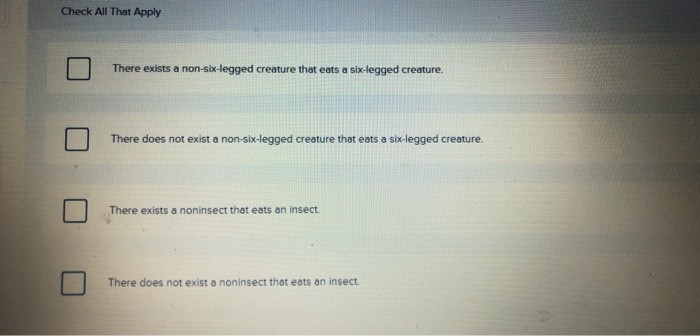

Check All That Apply There exists a non-six-legged creature that eats a six-legged creature. There does not exist a non-six-legged creature that eats a six-legged creature. i o ooo There exists a noninsect that eats an insect There does not exist a noninsect that eats an insect. *x has she NOTE: This is a multi-part question. Once an answer is submitted, you will be unable to return to this part If we let the domain be all animals, and S "xis a spider". x = x is an insect". DIX=x is a dragonfly. legs". Ex y) = x eats y, then the premises be "All insects have six legs." (Vx(1x) L(21) "Dragonflies are insects." ( (DX) x))) "Spiders do not have six legs." ("x(SX -400) "Spiders eat dragonflies." (VX, y (SX) AD) - ExYill
Step by Step Solution
There are 3 Steps involved in it

Get step-by-step solutions from verified subject matter experts
 Study Help