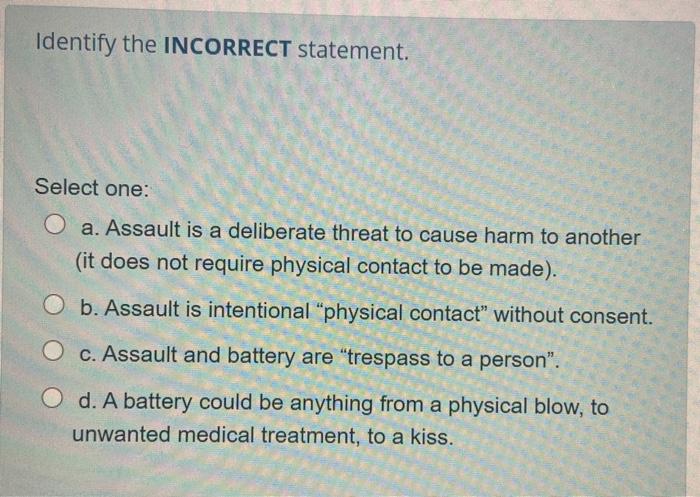
Question: Identify the INCORRECT statement. Select one: a. Assault is a deliberate threat to cause harm to another (it does not require physical contact to be
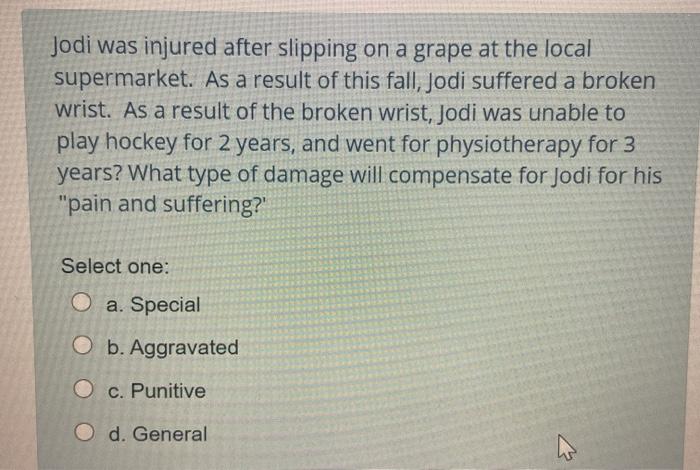
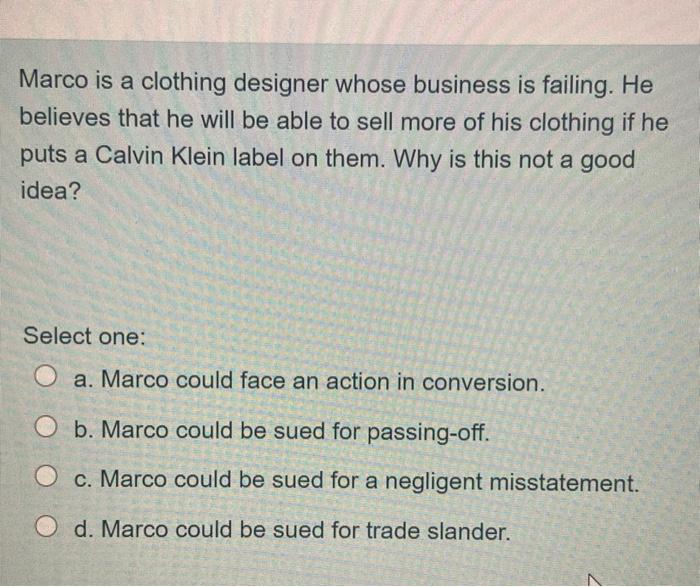
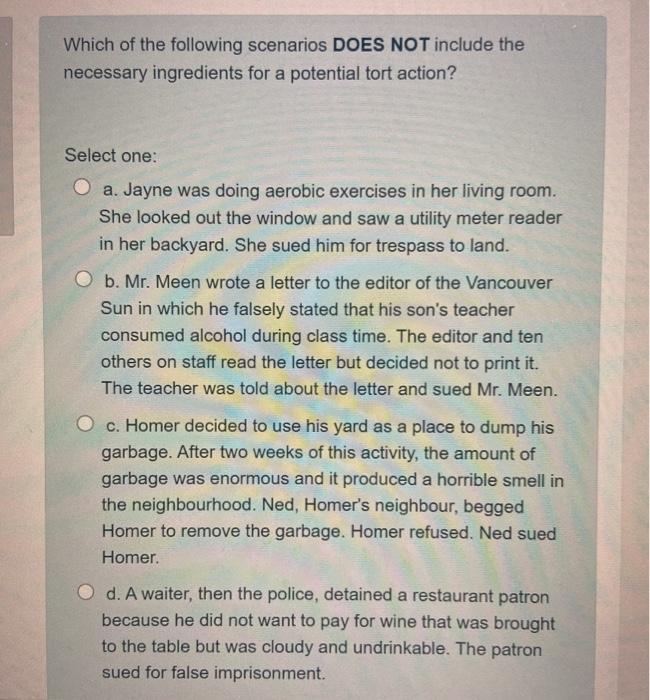
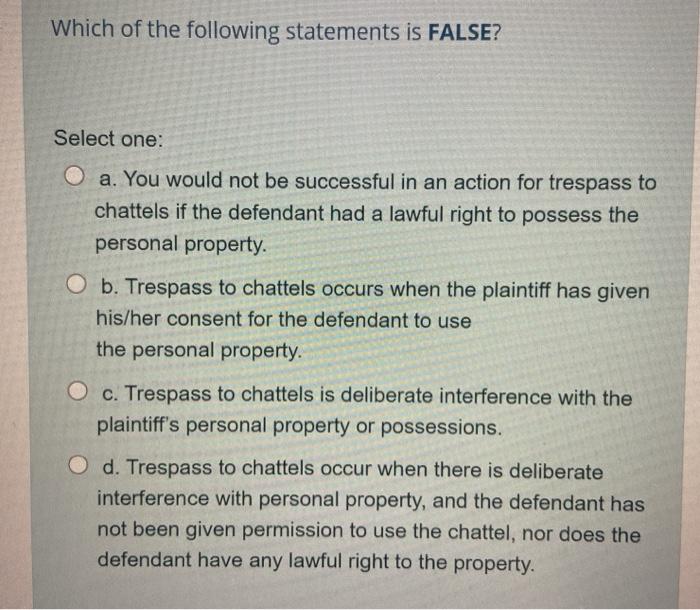
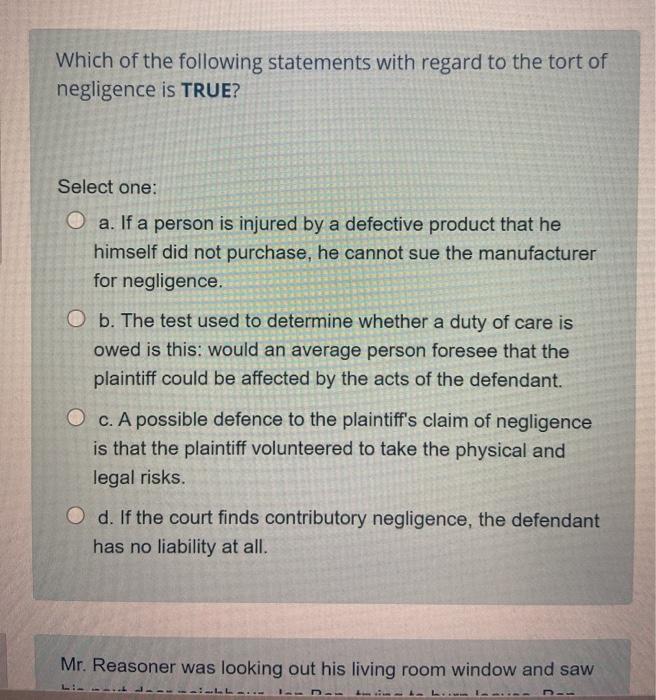
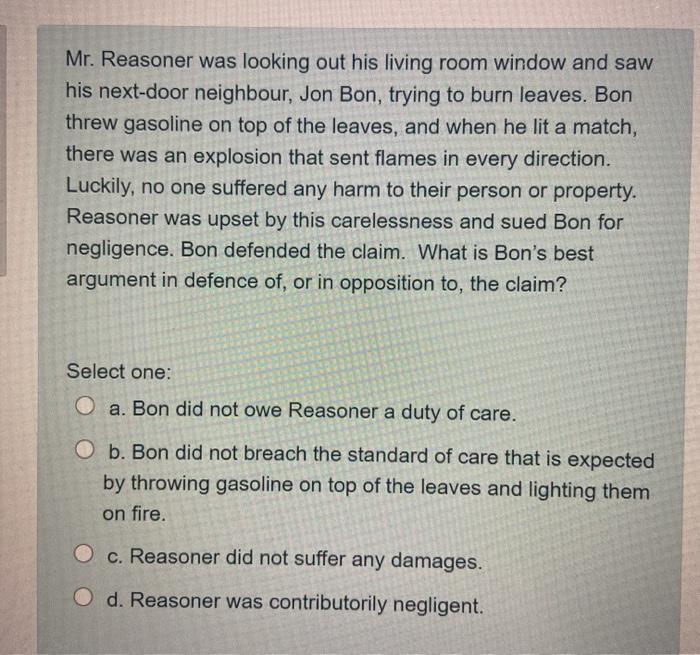
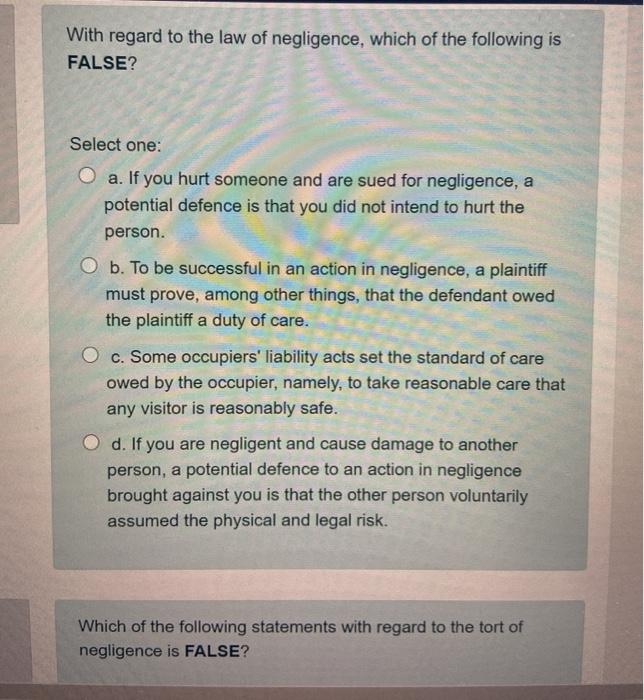
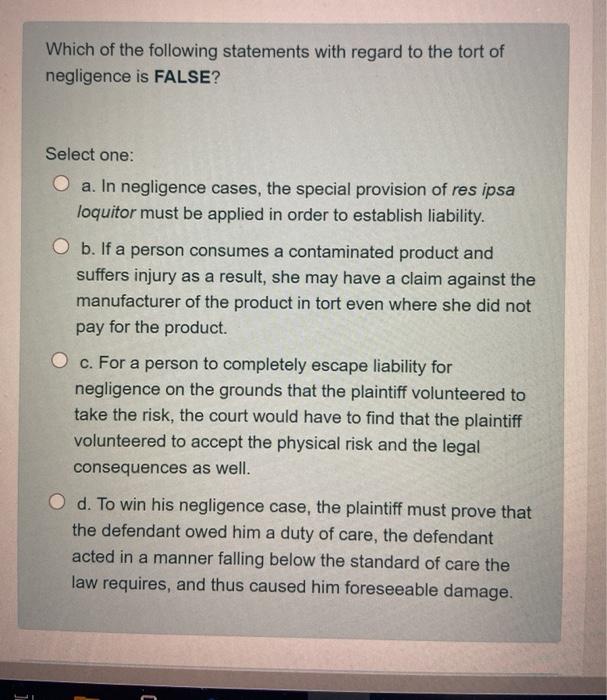
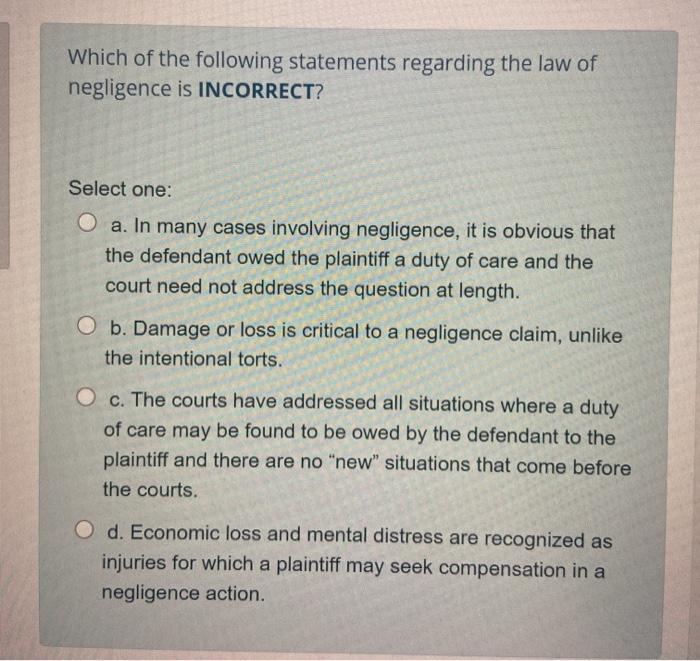
Identify the INCORRECT statement. Select one: a. Assault is a deliberate threat to cause harm to another (it does not require physical contact to be made). b. Assault is intentional "physical contact" without consent. O c. Assault and battery are "trespass to a person". O d. A battery could be anything from a physical blow, to unwanted medical treatment, to a kiss. Jodi was injured after slipping on a grape at the local supermarket. As a result of this fall, Jodi suffered a broken wrist. As a result of the broken wrist, Jodi was unable to play hockey for 2 years, and went for physiotherapy for 3 years? What type of damage will compensate for Jodi for his "pain and suffering?" Select one: O a. Special O b. Aggravated O c. Punitive O d. General Marco is a clothing designer whose business is failing. He believes that he will be able to sell more of his clothing if he puts a Calvin Klein label on them. Why is this not a good idea? Select one: O a. Marco could face an action in conversion. O b. Marco could be sued for passing-off. c. Marco could be sued for a negligent misstatement. O d. Marco could be sued for trade slander. Which of the following scenarios DOES NOT include the necessary ingredients for a potential tort action? Select one: a. Jayne was doing aerobic exercises in her living room. She looked out the window and saw a utility meter reader in her backyard. She sued him for trespass to land. O b. Mr. Meen wrote a letter to the editor of the Vancouver Sun in which he falsely stated that his son's teacher consumed alcohol during class time. The editor and ten others on staff read the letter but decided not to print it. The teacher was told about the letter and sued Mr. Meen. O c. Homer decided to use his yard as a place to dump his garbage. After two weeks of this activity, the amount of garbage was enormous and it produced a horrible smell in the neighbourhood. Ned, Homer's neighbour, begged Homer to remove the garbage. Homer refused. Ned sued Homer. O d. A waiter, then the police, detained a restaurant patron because he did not want to pay for wine that was brought to the table but was cloudy and undrinkable. The patron sued for false imprisonment. Which of the following statements is FALSE? Select one: O a. You would not be successful in an action for trespass to chattels if the defendant had a lawful right to possess the personal property. O b. Trespass to chattels occurs when the plaintiff has given his/her consent for the defendant to use the personal property. O c. Trespass to chattels is deliberate interference with the plaintiff's personal property or possessions. O d. Trespass to chattels occur when there is deliberate interference with personal property, and the defendant has not been given permission to use the chattel, nor does the defendant have any lawful right to the property. Which of the following statements with regard to the tort of negligence is TRUE? Select one: a. If a person is injured by a defective product that he himself did not purchase, he cannot sue the manufacturer for negligence. O b. The test used to determine whether a duty of care is owed is this: would an average person foresee that the plaintiff could be affected by the acts of the defendant. O c. A possible defence to the plaintiff's claim of negligence is that the plaintiff volunteered to take the physical and legal risks. O d. If the court finds contributory negligence, the defendant has no liability at all. Mr. Reasoner was looking out his living room window and saw Mr. Reasoner was looking out his living room window and saw his next-door neighbour, Jon Bon, trying to burn leaves. Bon threw gasoline on top of the leaves, and when he lit a match, there was an explosion that sent flames in every direction. Luckily, no one suffered any harm to their person or property. Reasoner was upset by this carelessness and sued Bon for negligence. Bon defended the claim. What is Bon's best argument in defence of, or in opposition to, the claim? Select one: O a. Bon did not owe Reasoner a duty of care. O b. Bon did not breach the standard of care that is expected by throwing gasoline on top of the leaves and lighting them on fire. O c. Reasoner did not suffer any damages. O d. Reasoner was contributorily negligent. With regard to the law of negligence, which of the following is FALSE? Select one: O a. If you hurt someone and are sued for negligence, a potential defence is that you did not intend to hurt the person. O b. To be successful in an action in negligence, a plaintiff must prove, among other things, that the defendant owed the plaintiff a duty of care. O c. Some occupiers' liability acts set the standard of care owed by the occupier, namely, to take reasonable care that any visitor is reasonably safe. O d. If you are negligent and cause damage to another person, a potential defence to an action in negligence brought against you is that the other person voluntarily assumed the physical and legal risk. Which of the following statements with regard to the tort of negligence is FALSE? Which of the following statements with regard to the tort of negligence is FALSE? Select one: O a. In negligence cases, the special provision of res ipsa loquitor must be applied in order to establish liability. O b. If a person consumes a contaminated product and suffers injury as a result, she may have a claim against the manufacturer of the product in tort even where she did not pay for the product. O c. For a person to completely escape liability for negligence on the grounds that the plaintiff volunteered to take the risk, the court would have to find that the plaintiff volunteered to accept the physical risk and the legal consequences as well. O d. To win his negligence case, the plaintiff must prove that the defendant owed him a duty of care, the defendant acted in a manner falling below the standard of care the law requires, and thus caused him foreseeable damage. Which of the following statements regarding the law of negligence is INCORRECT? Select one: O a. In many cases involving negligence, it is obvious that the defendant owed the plaintiff a duty of care and the court need not address the question at length. O b. Damage or loss is critical to a negligence claim, unlike the intentional torts. O c. The courts have addressed all situations where a duty of care may be found to be owed by the defendant to the plaintiff and there are no "new" situations that come before the courts. O d. Economic loss and mental distress are recognized as injuries for which a plaintiff may seek compensation in a negligence action









 Study Help