Question: Identify the major issues and problemsMake sure you have the real problem - not just symptoms (getting the problem right is half thebattle.)Most of the
Identify the major issues and problemsMake sure you have the real problem - not just symptoms (getting the problem right is half thebattle.)Most of the cases have both an immediate, short-term problem or scenario as well as a longer-term, underlying problem that will need to be dealt with. Be sure that you are addressing bothtypes of problems in your analysis.( last part of article was cut off here it is last page)necessary to confirm that Saxton's pagers would be compatible with the relevant applications in the ProductionMessaging software. After Judy spoke with Cottrill's systems group, a trial was scheduled for the first week in November.Judy was not able to be present for the trial, but her contact in the systems group advised her of the events. Unfortunately, the pagers did not immediately function with the ProductionMessaging software. However, after several attempts to solve the functionality issue, Cottrill's systems group resolved the snags in the hardware and reworked the connection after completing some repro- gramming. It appeared that the problem was under control, but Judy was worried about how easily the Saxton system could be implemented. Also, she was unsure about how the systems group perceived the functionality problems and if this would be an issue going forward.DECISION CRITERIAJudy often used a structured set of criteria to approach purchasing decisions at Cottrill. Although she had the final decision-making authority with this issue, she recognized that the systems group would have to support this switch. The systems group was primarily concernedwith functionality, and providing that the Saxton product could perform to the similar level of functionality of Tallant, they would not have any objections to switching suppliers.Judy wondered which criteria were most important to the decision of supplier selection and how these issues should be ranked. Judy knew that before a recom- mendation could be made, she would have to apply her evaluation framework and proposed criteria to the alternatives.It was Monday morning, and Judy had taken some time to think about the issues of the Saxton hardware testing that had taken place the previous Friday. She had expected the trial to be executed without incident and wondered if the decision to switch suppliers was as simple as she had initially thought. Judy wanted to be certain that she had considered all of the implications involved with switching suppliers before making a decision. She knew that the change to Saxton was an option but recognized that Cottrill could also remain with Tallant, and was now wondering if there were any other alternatives. However, Judy understood that it had been nearly a week since the Saxton sales representative had presented her proposal and she was expecting Judy's response by the end of the day
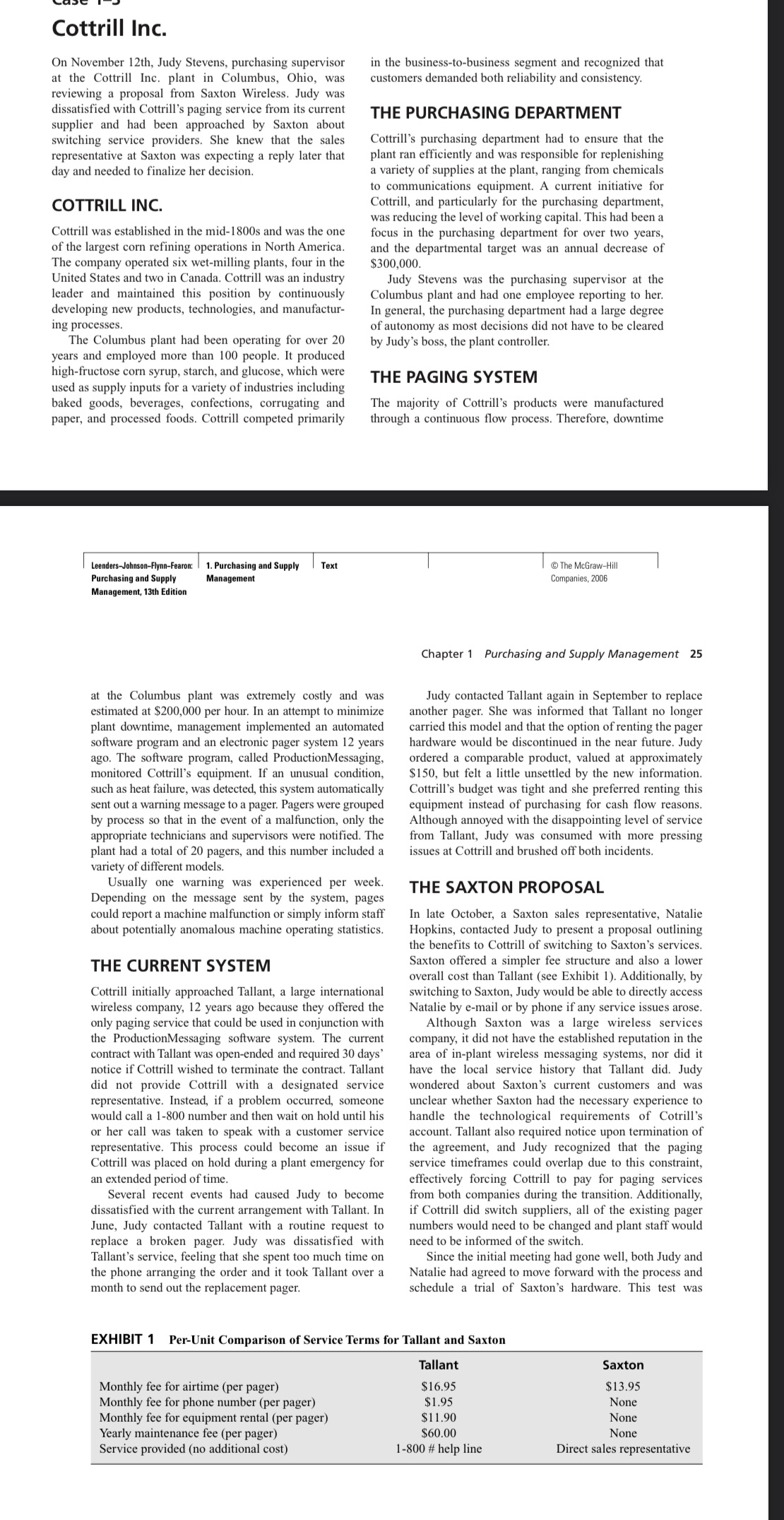
nun: IJ Cottrill Inc. On November 12th, Judy Stevens, purchasing supervisor at the Cottrill Inc. plant in Columbus, Ohio, was reviewing a proposal from Saxton Wireless. Judy was dissatisfied with Cottrill's paging service from its current supplier and had been approached by Saxton about switching service providers. She knew that the sales representative at Saxton was expecting a reply later that day and needed to finalize her decision. COTTRILL INC. Cottrill was established in the mid-1800s and was the one of the largest corn refining operations in North America. The company operated six wet-milling plants, four in the United States and two in Canada. Cottrill was an industry leader and maintained this position by continuously developing new products, technologies, and manufactur- ing processes. The Columbus plant had been operating for over 20 years and employed more than 100 people. It produced high-fructose corn syrup, starch, and glucose, which were used as supply inputs for a variety of industries including baked goods, beverages, confections, corrugating and paper, and processed foods. Cottrill competed primarily in the business-to-business segment and recognized that customers demanded both reliability and consistency. THE PURCHASING DEPARTMENT Cottrill's purchasing department had to ensure that the plant ran efficiently and was responsible for replenishing a variety of supplies at the plant, ranging from chemicals to communications equipment. A current initiative for Cottrill, and particularly for the purchasing department, was reducing the level of working capital. This had been a focus in the purchasing department for over two years, and the departmental target was an annual decrease of $300,000. Judy Stevens was the purchasing supervisor at the Columbus plant and had one employee reporting to her. In general, the purchasing department had a large degree of autonomy as most decisions did not have to be cleared by Judy's boss, the plant controller. TH E PAGING SYSTEM The majority of Cottrill's products were manufactured through a continuous ow process. Therefore, downtime lwldut'IIJII-Il-mlll-Fllml. Paschal-n Ind Supply Managlmllll, til Ell ltiill 1. Purchasing Ind Supply Teal at the Columbus plant was extremely costly and was estimated at $200,000 per hour. In an attempt to minimize plant downtime, management implemented an automated software program and an electronic pager system 12 years ago. The soware program, called ProductionMessaging, monitored Cottrill's equipment. If an unusual condition, such as heat failure, was detected, this system automatically sent out a wanting message to a pager. Pagers were grouped by process so that in the event of a malfunction, only the appropriate technicians and supervisors were notied. The plant had a total of 20 pagers, and this number included a variety of different models. Usually one warning was experienced per week. Depending on the message sent by the system, pages could report a machine malfunction or simply inform staff about potentially anomalous machine operating statistics. TH E CURRENT SYSTEM Cottrill initially approached Tallant, a large international wireless company, 12 years ago because they o'ered the only paging service that could be used in conjunction with the ProductionMessaging soware system. The current contract with Tallant was open-ended and required 30 days\" notice if Cottrill wished to terminate the contract. Tallant did not provide Cottrill with a designated service representative. Instead, if a problem occurred, someone would call a 1-800 number and then wait on hold until his or her call was taken to speak with a customer service representative. This process could become an issue if Cottrill was placed on hold during a plant emergency for an extended period of time. Several recent events had caused Judy to become dissatisfied with the current arrangement with Tallant. In June, Judy contacted Tallant with a routine request to replace a broken pager. Judy was dissatisfied with Tallant's service, feeling that she spent too much time on the phone arranging the order and it took Tallant over a month to send out the replacement pager. (D 1112 MG rawH ill Companies. 2005 Chapter 1 Purchasing and Supply Management 25 Judy contacted Tallant again in September to replace another pager. She was informed that Tallant no longer carried this model and that the option of renting the pager hardware would be discontinued in the near future. Judy ordered a comparable product, valued at approximately $150, but felt a little unsettled by the new information. Cottrill's budget was tight and she preferred renting this equipment instead of purchasing for cash flow reasons. Although annoyed with the disappointing level of service from Tallant, Judy was consumed with more pressing issues at Cottrill and brushed o' both incidents. THE SAXTON PROPOSAL In late October, a Saxton sales representative, Natalie Hopkins, contacted Judy to present a proposal outlining the benefits to Cottrill of switching to Saxton's services. Saxton otfered a simpler fee structure and also a lower overall cost than Tallant (see Exhibit 1). Additionally, by switching to Saxton, Judy would be able to directly access Natalie by e-mail or by phone if any service issues arose. Although Saxton was a large wireless services company, it did not have the established reputation in the area of in-plant wireless messaging systems, nor did it have the local service history that Tallant did. Judy wondered about Saxton's current customers and was unclear whether Saxton had the necessary experience to handle the technological requirements of Cotrill's account. Tallant also required notice upon termination of the agreement, and Judy recognized that the paging service timeframes could overlap due to this constraint, effectively forcing Cottrill to pay for paging services from both companies during the transition. Additionally, if Cot1rill did switch suppliers, all of the existing pager numbers would need to be changed and plant staff would need to be informed of the switch. Since the initial meeting had gone well, both Judy and Natalie had agreed to move forward with the process and schedule a trial of Saxton's hardware. This test was EXHIBIT 1 Per-Unit Comparison of Service Terms for Tallant and Sexton Monthly fee for airtime (per pager) Monthly fee for phone number (per pager) Monthly fee for equipment rental (per pager) Yearly maintenance fee (per pager) Service provided (no additional com) Tallant Sexton $16.95 5 1 3 .95 $1.95 None S] 1.90 None $60.00 None [-800 ft help line Direct sales representative









 Study Help