Question: Identify the observable symptoms that indicate a problem. This must be limited to evidence from the case study. The nature of the hotel was not
- Identify the observable symptoms that indicate a problem. This must be limited to evidence from the case study.
- The nature of the hotel was not accepting to the concept of empowerment due to its previous organizational structure, and this resulted in turnover of employees that were previously working there (due to their loss of decision making power)
- Beckers guidance and feedback for his concept of empowerment was lackluster to his employees
- Employees were having difficulty distinguishing between a major or minor issue/decision (confusion in the workplace)
- The lack of feedback on their decision-making led the employees to rely on the supervisors for the decisions (back to the old structure)
- More complaints from hotel guests were being made
- Employees took on stress and relationships in the workplace were falling apart
- Job satisfaction decreased leading to high turnover and more calls out of work by the employees
- Use 4-5 organizational behavior concepts to explain what might be causing the symptoms.
- Recommend solutions that eliminate or minimize the symptoms in this case by addressing the possible causes. Your recommendations must relate to the possible causes suggested in your answer to Question 2.
*PLEASE ANSWER ONLY FOR NUMBER 2 and 3* *PLEASE ANSWER ONLY FOR NUMBER 2 and 3* *PLEASE ANSWER ONLY FOR NUMBER 2 and 3* *PLEASE ANSWER ONLY FOR NUMBER 2 and 3*
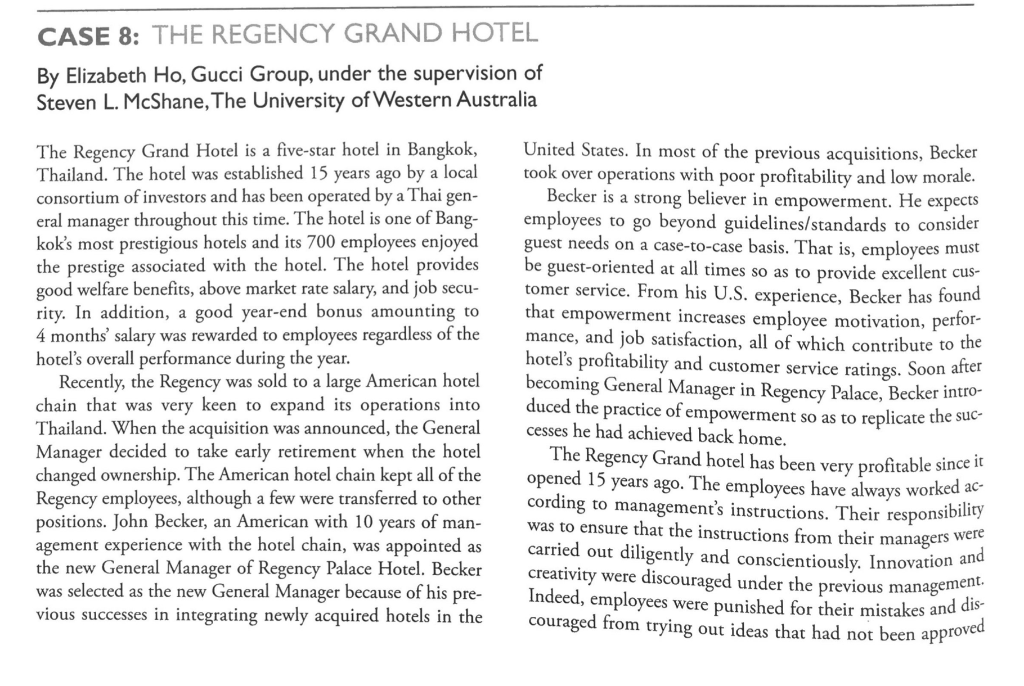
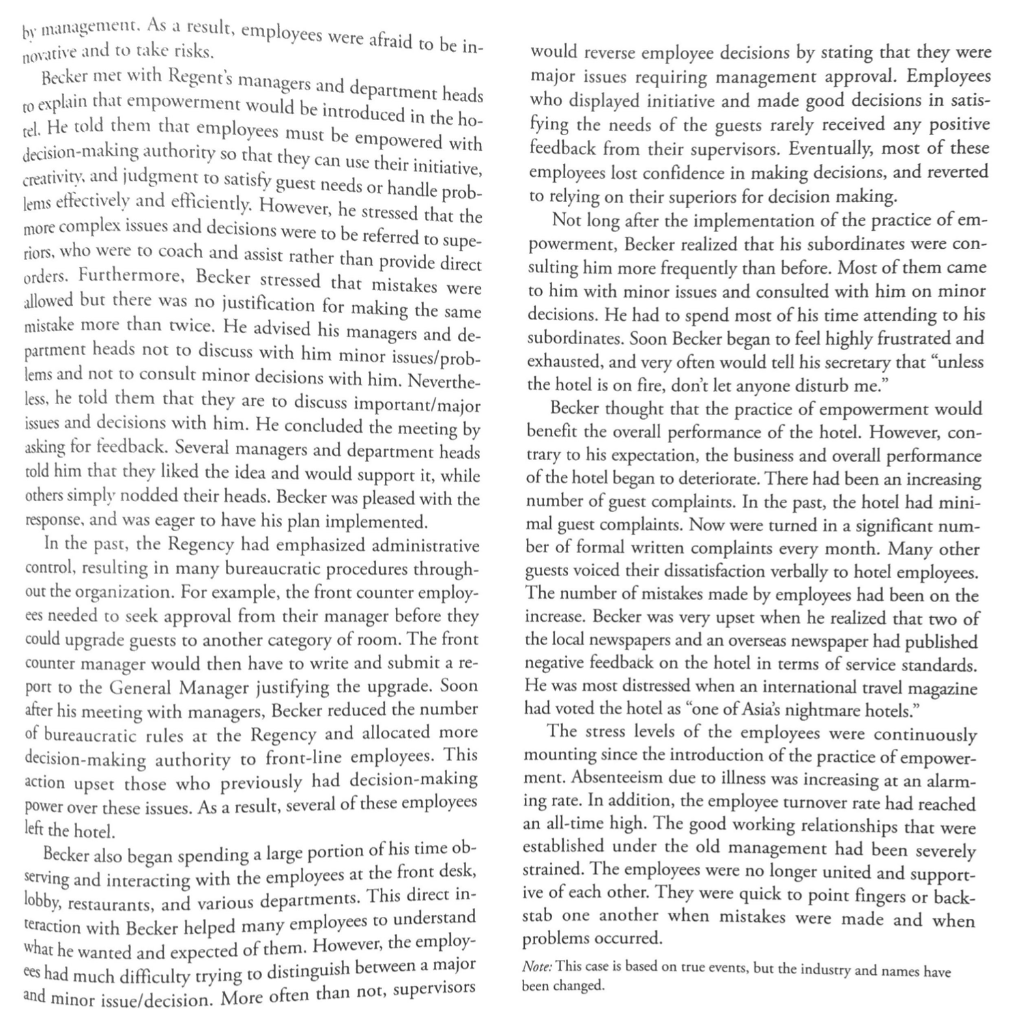
CASE 8: THE REGENCY GRAND HOTEL By Elizabeth Ho, Gucci Group, under the supervision of Steven L. McShane, The University of Western Australia The Regency Grand Hotel is a five-star hotel in Bangkok, Thailand. The hotel was established 15 years ago by a local consortium of investors and has been operated by a Thai gen- eral manager throughout this time. The hotel is one of Bang- kok's most prestigious hotels and its 700 employees enjoyed the prestige associated with the hotel. The hotel provides good welfare benefits, above market rate salary, and job secu- rity. In addition, a good year-end bonus amounting to 4 months' salary was rewarded to employees regardless of the hotel's overall performance during the year. Recently, the Regency was sold to a large American hotel chain that was very keen to expand its operations into Thailand. When the acquisition was announced, the General Manager decided to take early retirement when the hotel changed ownership. The American hotel chain kept all of the Regency employees, although a few were transferred to other positions. John Becker, an American with 10 years of man- agement experience with the hotel chain, was appointed as the new General Manager of Regency Palace Hotel. Becker was selected as the new General Manager because of his pre- vious successes in integrating newly acquired hotels in the United States. In most of the previous acquisitions, Becker took over operations with poor profitability and low morale. Becker is a strong believer in empowerment. He expects employees to go beyond guidelines/standards to consider guest needs on a case-to-case basis. That is, employees must be guest-oriented at all times so as to provide excellent cus- tomer service. From his U.S. experience, Becker has found that empowerment increases employee motivation, perfor mance, and job satisfaction, all of which contribute to the hotel's profitability and customer service ratings. Soon after becoming General Manager in Regency Palace, Becker intro- duced the practice of empowerment so as to replicate the suc cesses he had achieved back home. The Regency Grand hotel has been very profitable since it opened 15 years ago. The employees have always worked ac- cording to management's instructions. Their responsibility was to ensure that the instructions from their managers we carried out diligently and conscientiously. Innovation ar creativity were discouraged under the previous manageme Indeed, employees were punished for their mistakes and couraged from trying out ideas that had not been appro en approved agement. As a result, employees were afraid to be in- by management. As a me novative and to take risks. Becker met with Regent's managers and department heads explain that empowerment would be introduced in the ho- He told them that employees must be empowered with decision-making authority so that they can use their initiative, creativity, and judgment to satisfy guest needs or handle prob- lems effectively and efficiently. However, he stressed that the more complex issues and decisions were to be referred to supe- riors, who were to coach and assist rather than provide direct orders. Furthermore, Becker stressed that mistakes were allowed but there was no justification for making the same mistake more than twice. He advised his managers and de- partment heads not to discuss with him minor issues/prob- lems and not to consult minor decisions with him. Neverthe- less, he told them that they are to discuss important/major issues and decisions with him. He concluded the meeting by asking for feedback. Several managers and department heads told him that they liked the idea and would support it, while others simply nodded their heads. Becker was pleased with the response, and was eager to have his plan implemented. In the past, the Regency had emphasized administrative control, resulting in many bureaucratic procedures through- out the organization. For example, the front counter employ- ees needed to seek approval from their manager before they could upgrade guests to another category of room. The front counter manager would then have to write and submit a re- port to the General Manager justifying the upgrade. Soon after his meeting with managers, Becker reduced the number of bureaucratic rules at the Regency and allocated more decision-making authority to front-line employees. This action upset those who previously had decision-making power over these issues. As a result, several of these employees left the hotel. Becker also began spending a large portion of his time ob- serving and interacting with the employees at the front desk, obby, restaurants, and various departments. This direct in- teraction with Becker helped many employees to understand the wanted and expected of them. However, the employ- S had much difficulty trying to distinguish between a major nd minor issue/decision. More often than not, supervisors would reverse employee decisions by stating that they were major issues requiring management approval. Employees who displayed initiative and made good decisions in satis- fying the needs of the guests rarely received any positive feedback from their supervisors. Eventually, most of these employees lost confidence in making decisions, and reverted to relying on their superiors for decision making. Not long after the implementation of the practice of em- powerment, Becker realized that his subordinates were con- sulting him more frequently than before. Most of them came to him with minor issues and consulted with him on minor decisions. He had to spend most of his time attending to his subordinates. Soon Becker began to feel highly frustrated and exhausted, and very often would tell his secretary that "unless the hotel is on fire, don't let anyone disturb me." Becker thought that the practice of empowerment would benefit the overall performance of the hotel. However, con- trary to his expectation, the business and overall performance of the hotel began to deteriorate. There had been an increasing number of guest complaints. In the past, the hotel had mini- mal guest complaints. Now were turned in a significant num- ber of formal written complaints every month. Many other guests voiced their dissatisfaction verbally to hotel employees. The number of mistakes made by employees had been on the increase. Becker was very upset when he realized that two of the local newspapers and an overseas newspaper had published negative feedback on the hotel in terms of service standards. He was most distressed when an international travel magazine had voted the hotel as one of Asia's nightmare hotels." The stress levels of the employees were continuously mounting since the introduction of the practice of empower- ment. Absenteeism due to illness was increasing at an alarm- ing rate. In addition, the employee turnover rate had reached an all-time high. The good working relationships that were established under the old management had been severely strained. The employees were no longer united and support- ive of each other. They were quick to point fingers or back- stab one another when mistakes were made and when problems occurred. Note: This case is based on true events, but the industry and names have been changed









 Study Help