







Question: Identify two information systems you currently use. Identify the hardware, software, people, processes, and data that make up these systems. Describe what you use each
- Identify two information systems you currently use. Identify the hardware, software, people, processes, and data that make up these systems. Describe what you use each system for.
Stakeholders
- Choose one of the two information systems you identified above. Imagine a significant change like a major software update or discontinuing the system altogether. Provide a list of the internal and external stakeholders who would be impacted by a major change like this.
Citation:
All sourced content should be properly cited. cited page (APA, MLA, Chicago Style, etc.)
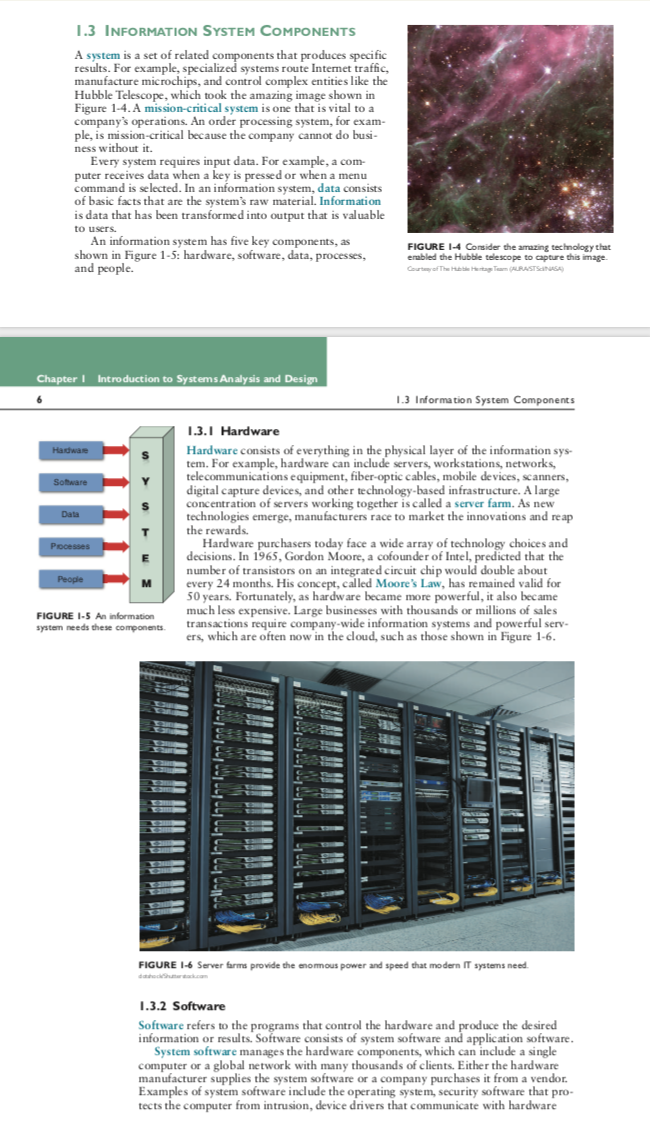
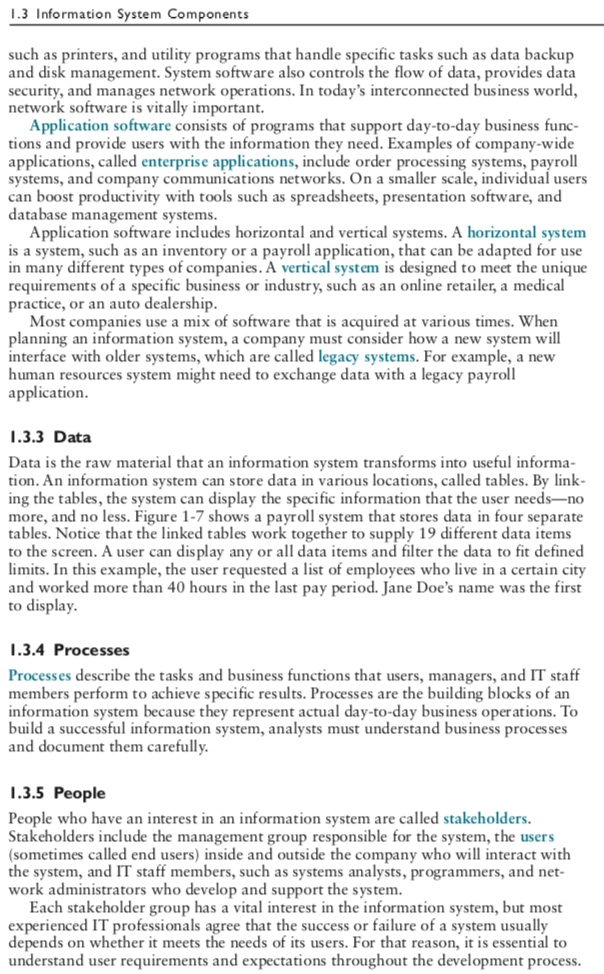
1.3 INFORMATION SYSTEM COMPONENTS A system is a set of related components that produces specific results. For example, specialized systems route Internet traffic, manufacture microchips, and control complex entities like the Hubble Telescope, which took the amazing image shown in Figure 1-4. A mission-critical system is one that is vital to a company's operations. An order processing system, for exam- ple, is mission-critical because the company cannot do busi- ness without it. Every system requires input data. For example, a com- puter receives data when a key is pressed or when a menu command is selected. In an information system, data consists of basic facts that are the system's raw material. Information is data that has been transformed into output that is valuable to users An information system has five key components, as shown in Figure 1.5: hardware, software, data, processes, and people. FIGURE 1-4 Consider the amazing technology that enabled the Hubble telescope to to capture image Gotof Them URASSA Chapter 1 Introduction to Systems Analysis and Design 1.3 Information System Components Hardware Software S Data T 1.3.1 Hardware Hardware consists of everything in the physical layer of the information sys- tem. For example, hardware can include servers, workstations, networks, telecommunications equipment, fiber optic cables, mobile devices, scanners, digital capture devices, and other technology-based infrastructure. A large concentration of servers working together is called a server farm. As new technologies emerge, manufacturers race to market the innovations and reap the rewards. Hardware purchasers today face a wide array of technology choices and decisions. In 1965, Gordon Moore, a cofounder of Intel, predicted that the number of transistors on an integrated circuit chip would double about every 24 months. His concept, called Moore's Law, has remained valid for 50 years. Fortunately, as hardware became more powerful, it also became much less expensive. Large businesses with thousands or millions of sales transactions require company-wide information systems and powerful serv- ers, which are often now in the cloud, such as those shown in Figure 1-6. Processes People M FIGURE 1-5 An information system needs these components FIGURE 1-6 Server farms provide the enomous power and speed that modern IT systems need 1.3.2 Software Software refers to the programs that control the hardware and produce the desired information or results. Software consists of system software and application software. System software manages the hardware components, which can include a single computer or a global network with many thousands of clients. Either the hardware manufacturer supplies the system software or a company purchases it from a vendor. Examples of system software include the operating system, security software that pro- tects the computer from intrusion, device drivers that communicate with hardware 1.3 Information System Components such as printers, and utility programs that handle specific tasks such as data backup and disk management. System software also controls the flow of data, provides data security, and manages network operations. In today's interconnected business world, network software is vitally important. Application software consists of programs that support day-to-day business func- tions and provide users with the information they need. Examples of company-wide applications, called enterprise applications, include order processing systems, payroll systems, and company communications networks. On a smaller scale, individual users can boost productivity with tools such as spreadsheets, presentation software, and database management systems. Application software includes horizontal and vertical systems. A horizontal system is a system, such as an inventory or a payroll application, that can be adapted for use in many different types of companies. A vertical system is designed to meet the unique requirements of a specific business or industry, such as an online retailer, a medical practice, or an auto dealership. Most companies use a mix of software that is acquired at various times. When planning an information system, a company must consider how a new system will interface with older systems, which are called legacy systems. For example, a new human resources system might need to exchange data with a legacy payroll application. 1.3.3 Data Dat raw nater that an tion system transforms into useful informa- tion. An information system can store data in various locations, called tables. By link- ing the tables, the system can display the specific information that the user needs-no more, and no less. Figure 1-7 shows a payroll system that stores data in four separate tables. Notice that the linked tables work together to supply 19 different data items to the screen. A user can display any or all data items and filter the data to fit defined limits. In this example, the user requested a list of employees who live in a certain city and worked more than 40 hours in the last pay period. Jane Doe's name was the first to display. 1.3.4 Processes Processes describe the tasks and business functions that users, managers, and IT staff members perform to achieve specific results. Processes are the building blocks of an information system because they represent actual day-to-day business operations. To build a successful information system, analysts must understand business processes and document them carefully. 1.3.5 People People who have an interest in an information system are called stakeholders. Stakeholders include the management group responsible for the system, the users (sometimes called end users) inside and outside the company who will interact with the system, and IT staff members, such as systems analysts, programmers, and net- work administrators who develop and support the system. Each stakeholder group has a vital interest in the information system, but most experienced IT professionals agree that the success or failure of a system usually depends on whether it meets the needs of its users. For that reason, it is essential to understand user requirements and expectations throughout the development process. 1.3 INFORMATION SYSTEM COMPONENTS A system is a set of related components that produces specific results. For example, specialized systems route Internet traffic, manufacture microchips, and control complex entities like the Hubble Telescope, which took the amazing image shown in Figure 1-4. A mission-critical system is one that is vital to a company's operations. An order processing system, for exam- ple, is mission-critical because the company cannot do busi- ness without it. Every system requires input data. For example, a com- puter receives data when a key is pressed or when a menu command is selected. In an information system, data consists of basic facts that are the system's raw material. Information is data that has been transformed into output that is valuable to users An information system has five key components, as shown in Figure 1.5: hardware, software, data, processes, and people. FIGURE 1-4 Consider the amazing technology that enabled the Hubble telescope to to capture image Gotof Them URASSA Chapter 1 Introduction to Systems Analysis and Design 1.3 Information System Components Hardware Software S Data T 1.3.1 Hardware Hardware consists of everything in the physical layer of the information sys- tem. For example, hardware can include servers, workstations, networks, telecommunications equipment, fiber optic cables, mobile devices, scanners, digital capture devices, and other technology-based infrastructure. A large concentration of servers working together is called a server farm. As new technologies emerge, manufacturers race to market the innovations and reap the rewards. Hardware purchasers today face a wide array of technology choices and decisions. In 1965, Gordon Moore, a cofounder of Intel, predicted that the number of transistors on an integrated circuit chip would double about every 24 months. His concept, called Moore's Law, has remained valid for 50 years. Fortunately, as hardware became more powerful, it also became much less expensive. Large businesses with thousands or millions of sales transactions require company-wide information systems and powerful serv- ers, which are often now in the cloud, such as those shown in Figure 1-6. Processes People M FIGURE 1-5 An information system needs these components FIGURE 1-6 Server farms provide the enomous power and speed that modern IT systems need 1.3.2 Software Software refers to the programs that control the hardware and produce the desired information or results. Software consists of system software and application software. System software manages the hardware components, which can include a single computer or a global network with many thousands of clients. Either the hardware manufacturer supplies the system software or a company purchases it from a vendor. Examples of system software include the operating system, security software that pro- tects the computer from intrusion, device drivers that communicate with hardware 1.3 Information System Components such as printers, and utility programs that handle specific tasks such as data backup and disk management. System software also controls the flow of data, provides data security, and manages network operations. In today's interconnected business world, network software is vitally important. Application software consists of programs that support day-to-day business func- tions and provide users with the information they need. Examples of company-wide applications, called enterprise applications, include order processing systems, payroll systems, and company communications networks. On a smaller scale, individual users can boost productivity with tools such as spreadsheets, presentation software, and database management systems. Application software includes horizontal and vertical systems. A horizontal system is a system, such as an inventory or a payroll application, that can be adapted for use in many different types of companies. A vertical system is designed to meet the unique requirements of a specific business or industry, such as an online retailer, a medical practice, or an auto dealership. Most companies use a mix of software that is acquired at various times. When planning an information system, a company must consider how a new system will interface with older systems, which are called legacy systems. For example, a new human resources system might need to exchange data with a legacy payroll application. 1.3.3 Data Dat raw nater that an tion system transforms into useful informa- tion. An information system can store data in various locations, called tables. By link- ing the tables, the system can display the specific information that the user needs-no more, and no less. Figure 1-7 shows a payroll system that stores data in four separate tables. Notice that the linked tables work together to supply 19 different data items to the screen. A user can display any or all data items and filter the data to fit defined limits. In this example, the user requested a list of employees who live in a certain city and worked more than 40 hours in the last pay period. Jane Doe's name was the first to display. 1.3.4 Processes Processes describe the tasks and business functions that users, managers, and IT staff members perform to achieve specific results. Processes are the building blocks of an information system because they represent actual day-to-day business operations. To build a successful information system, analysts must understand business processes and document them carefully. 1.3.5 People People who have an interest in an information system are called stakeholders. Stakeholders include the management group responsible for the system, the users (sometimes called end users) inside and outside the company who will interact with the system, and IT staff members, such as systems analysts, programmers, and net- work administrators who develop and support the system. Each stakeholder group has a vital interest in the information system, but most experienced IT professionals agree that the success or failure of a system usually depends on whether it meets the needs of its users. For that reason, it is essential to understand user requirements and expectations throughout the development process
Step by Step Solution
There are 3 Steps involved in it

Get step-by-step solutions from verified subject matter experts
 Study Help