Question: identifying a public health challenge. Using the table below, identify one theory or one method you believe is applicable in addressing the public health challenge.
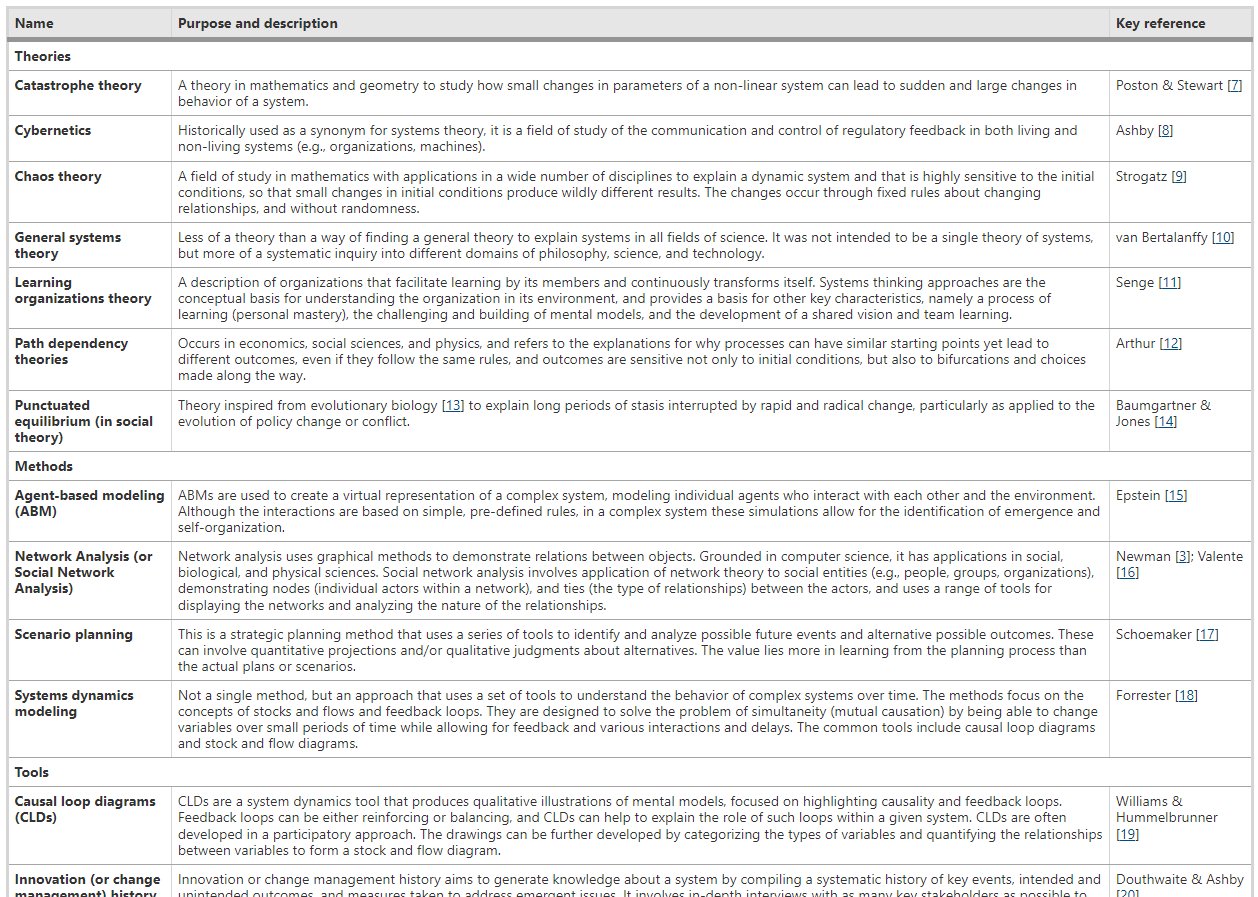
identifying a public health challenge. Using the table below, identify one theory or one method you believe is applicable in addressing the public health challenge. Describe how you would apply to address the public health challenge. Use a minimum of two external references in writing your paper.
Name Purpose and description Key reference Theories Catastrophe theory A theory in mathematics and geometry to study how small changes in parameters of a non-linear system can lead to sudden and large changes in Poston & Stewart [7] behavior of a system. Cybernetics Historically used as a synonym for systems theory, it is a field of study of the communication and control of regulatory feedback in both living and Ashby [8] non-living systems (e.g., organizations, machines). Chaos theory A field of study in mathematics with applications in a wide number of disciplines to explain a dynamic system and that is highly sensitive to the initial Strogatz [9] conditions, so that small changes in initial conditions produce wildly different results. The changes occur through fixed rules about changing relationships, and without randomness. General systems Less of a theory than a way of finding a general theory to explain systems in all fields of science. It was not intended to be a single theory of systems, van Bertalanffy [10] theory but more of a systematic inquiry into different domains of philosophy, science, and technology. Learning A description of organizations that facilitate learning by its members and continuously transforms itself. Systems thinking approaches are the Senge [11] organizations theory conceptual basis for understanding the organization in its environment, and provides a basis for other key characteristics, namely a process of learning (personal mastery), the challenging and building of mental models, and the development of a shared vision and team learning. Path dependency Occurs in economics, social sciences, and physics, and refers to the explanations for why processes can have similar starting points yet lead to Arthur [12] theories different outcomes, even if they follow the same rules, and outcomes are sensitive not only to initial conditions, but also to bifurcations and choices made along the way. Punctuated Theory inspired from evolutionary biology [13] to explain long periods of stasis interrupted by rapid and radical change, particularly as applied to the Baumgartner & equilibrium (in social evolution of policy change or conflict. Jones [14] theory) Methods Agent-based modeling |ABMs are used to create a virtual representation of a complex system, modeling individual agents who interact with each other and the environment. Epstein [15] (ABM) Although the interactions are based on simple, pre-defined rules, in a complex system these simulations allow for the identification of emergence and self-organization Network Analysis (or Network analysis uses graphical methods to demonstrate relations between objects. Grounded in computer science, it has applications in social, Newman [3]: Valente Social Network biological, and physical sciences. Social network analysis involves application of network theory to social entities (e.g., people, groups, organizations), [16] Analysis) demonstrating nodes (individual actors within a network), and ties (the type of relationships) between the actors, and uses a range of tools for displaying the networks and analyzing the nature of the relationships. Scenario planning This is a strategic planning method that uses a series of tools to identify and analyze possible future events and alternative possible outcomes. These Schoemaker [17] can involve quantitative projections and/or qualitative judgments about alternatives. The value lies more in learning from the planning process than the actual plans or scenarios. Systems dynamics Not a single method, but an approach that uses a set of tools to understand the behavior of complex systems over time. The methods focus on the Forrester [18] modeling concepts of stocks and flows and feedback loops. They are designed to solve the problem of simultaneity (mutual causation) by being able to change variables over small periods of time while allowing for feedback and various interactions and delays. The common tools include causal loop diagrams and stock and flow diagrams. Tools Causal loop diagrams CLDs are a system dynamics tool that produces qualitative illustrations of mental models, focused on highlighting causality and feedback loops. Williams & (CLDs) Feedback loops can be either reinforcing or balancing, and CLDs can help to explain the role of such loops within a given system. CLDs are often Hummelbrunner developed in a participatory approach. The drawings can be further developed by categorizing the types of variables and quantifying the relationships [19] between variables to form a stock and flow diagram. Innovation (or change |Innovation or change management history aims to generate knowledge about a system by compiling a systematic history of key events, intended and |Douthwaite & Ashby
Step by Step Solution
There are 3 Steps involved in it
1 Expert Approved Answer
Step: 1 Unlock
Question Has Been Solved by an Expert!
Get step-by-step solutions from verified subject matter experts
Step: 2 Unlock
Step: 3 Unlock
Students Have Also Explored These Related Mathematics Questions!









 Study Help