







Question: * identifying & capturing risks (events) * identifying & capturing sources (causes) Overview of the Topic: The US government's Millennium Challenge Corporation (MCC) and the
* identifying & capturing risks (events)
Overview of the Topic: The US government's Millennium Challenge Corporation (MCC) and the Government of Nepal on September 14, 2017, signed a 500 milion compact to spur economic growth and reduce poverty in Nepal. The agreement was made with the government of Nepal. However now, due to a political misunderstanding and a lack of common conclusion between different political parties, there is a high chance the deal might get dissolved and Nepal holds a high risk of losing the support it needs right now (due to Covaid 19 that's caused economic downfall). Organization: Millennium Challenge Corporation (MCC) Government of Nepal Background: The Millennium Challenge Corporation (MCC) is a bilateral United States foreign aid agency established by the U.S. Congress in 2004. It is an independent agency separate from the State Department and USAID. It provides grants to countries that have been determined to have good economic policies and potential for economic growth. The country qualification process is objective, involving scores provided by third parties in 17 different areas. An eligible country must apply for a grant with a specific project in mind. Nepal was able to meet all those eligibilities and was granted a 500 million grant for the country's development in Road and energy project. According to the plan. USD 500 milion will be used to set up a 400KV transmission line on the Lapsiphed-Galchhi-Damauli Sunawal power corridor. As per the deal, the funds will be spent on setting up a 400KV transmission line running 400 kilometers. Three substations will also be built that will connect to Nepal-India cross-border transmission line with India in Rupandhel. The remaining USD 130 million will be used to maintain roads along the East-West Highway However, this deal is likely to get jeopardize as there are conficts between different political parties on this issue causing a mixed feeling between the citizens. The disagreement between the political parties is that Why should a foreign assistance program require parliamentary ratification And the agreement should not be part of the Indo-Pacific Strategy Time Frame: 5 years Assumption: Nepal's government is assumed to receive USD 500 million in grants, while Nepal would put in $130 million for the project that prioritizes energy and roadways. USD 500 million will be used to set up a 400KV transmission line on the Lapsiphede Galchi-Damaul-Sunawal power corridor. here substations will also be built that will connect to Nepal-India cross-border transmission line with India in Rupandhei The remaining USD 130 million will be used to maintain roads along the East-West Highway. This grant will assist Nepal in bringing back the country in its highly needed sector like roadway and energy including creating job opportunities for people in Nepal Risk: Nepal's economy is projected to grow by only 0.6 percent in 2021, inching up from an estimated 0.2 percent in 2020 as lockdowns caused by COVID-19 disrupt economic activity, especially tourism, says the World Bank's latest South Asia Economic Focus "Beaten or Broken?" This grant would be a great opportunity for Nepal not only to rebuild is infrastructure but also to overcome poverty and create jobs in the local market. If this deal will be dissolved due to a disagreement and political misunderstanding. It is likely that Nepal will suffer an economic recession and would be pushed back from overcoming the ongoing social and economic turbulence due to the Covad lockdown since 2020 * identifying & capturing sources (causes) 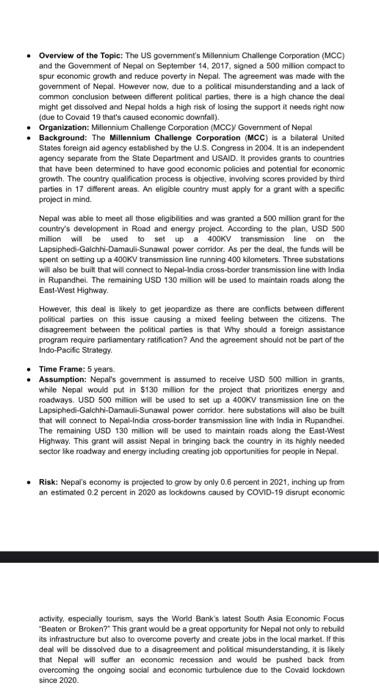
Step by Step Solution
There are 3 Steps involved in it
1 Expert Approved Answer
Step: 1 Unlock

Question Has Been Solved by an Expert!
Get step-by-step solutions from verified subject matter experts
Step: 2 Unlock
Step: 3 Unlock
 Study Help