



Question: If A is an operator, we define the Weyl transform of A, denoted A(x, p), by A (x, p ) = ase-ips/h ( x +
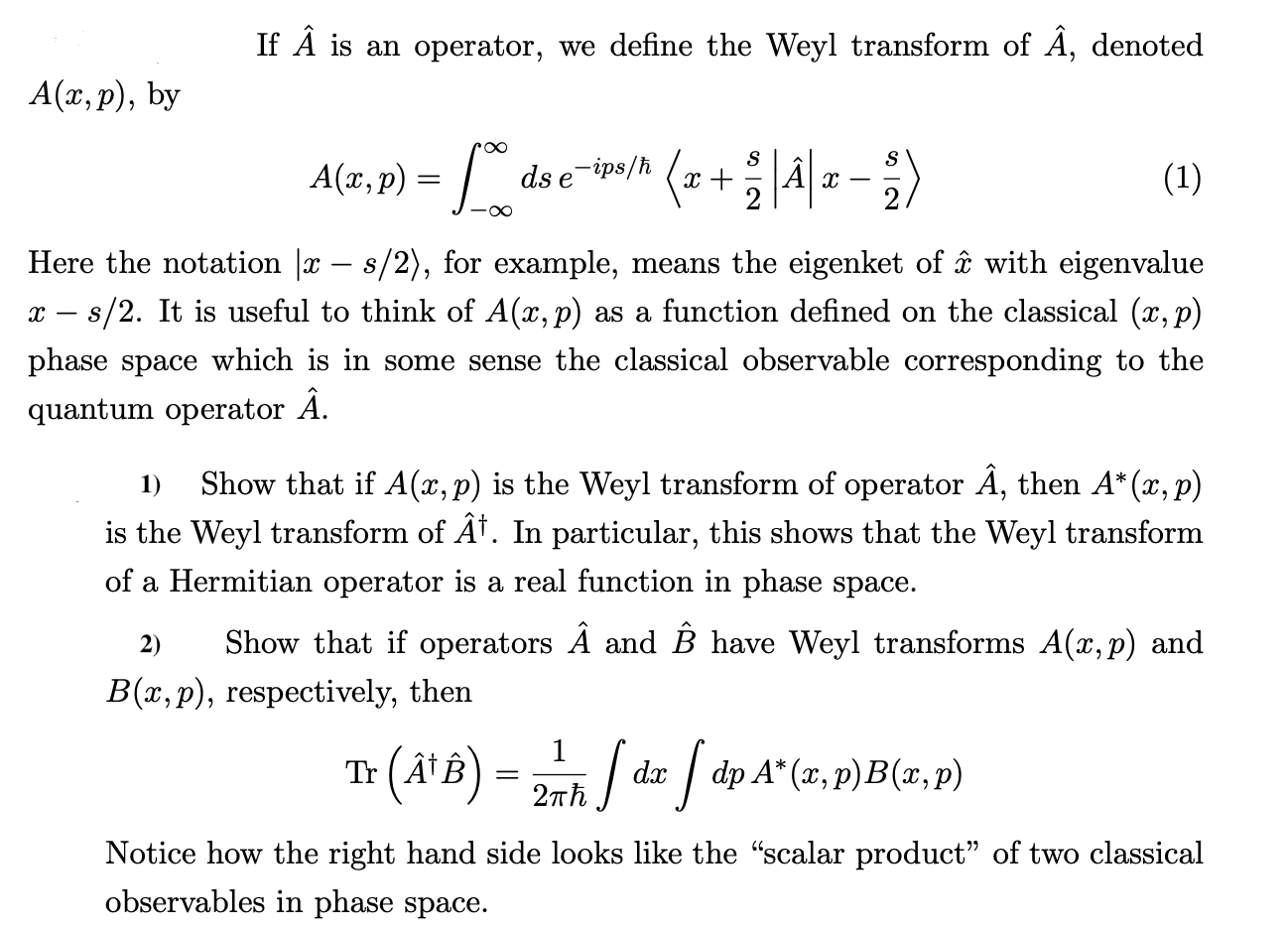
If A is an operator, we define the Weyl transform of A, denoted A(x, p), by A (x, p ) = ase-ips/h ( x + 5 |Ax - 2 ) (1) Here the notation (x - s/2), for example, means the eigenket of a with eigenvalue x - s/2. It is useful to think of A(x, p) as a function defined on the classical (x, p) phase space which is in some sense the classical observable corresponding to the quantum operator A. 1) Show that if A(x, p) is the Weyl transform of operator A, then A* (x, p) is the Weyl transform of AT. In particular, this shows that the Weyl transform of a Hermitian operator is a real function in phase space. 2) Show that if operators A and B have Weyl transforms A(x, p) and B(x, p), respectively, then Tr AtB= 27Th dx / dp A* (x, p) B(x, p) Notice how the right hand side looks like the "scalar product" of two classical observables in phase space
Step by Step Solution
There are 3 Steps involved in it

Get step-by-step solutions from verified subject matter experts